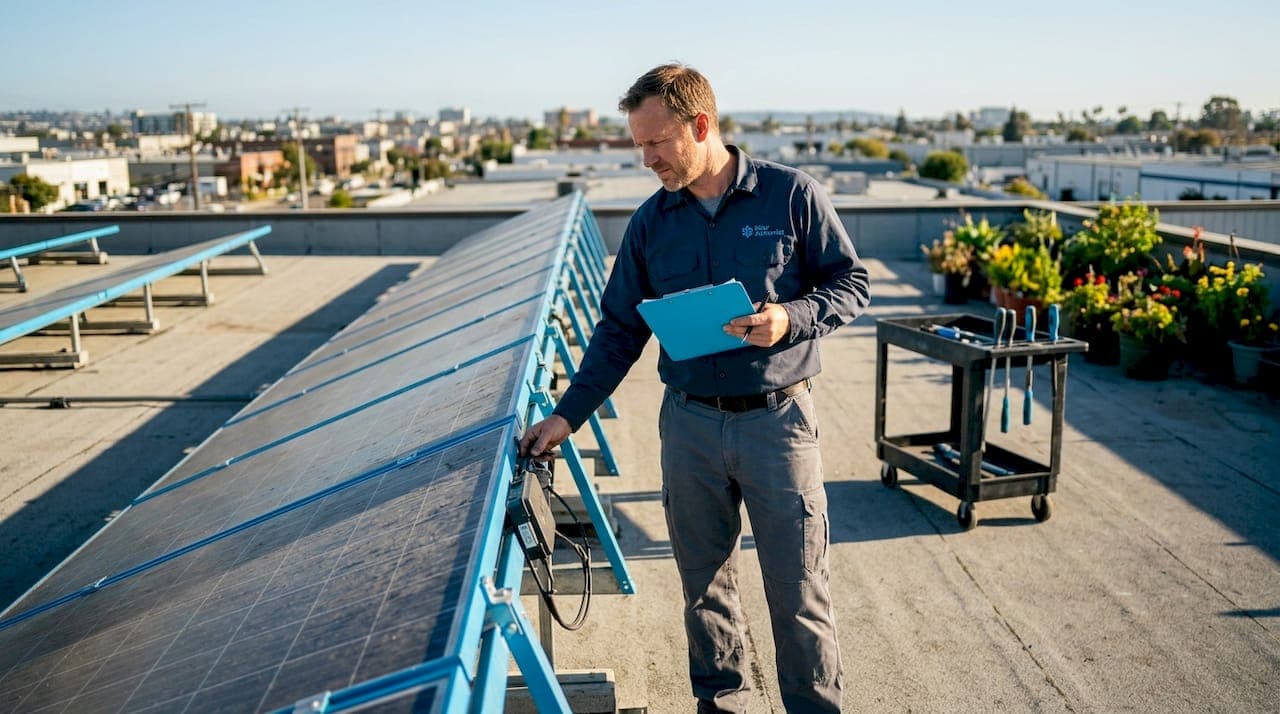
A neglected solar array doesn't fail dramatically. It just quietly underperforms, month after month, while your energy bills creep back up and your ROI projections drift further from reality. A structured commercial solar array maintenance schedule is the single most effective tool you have to prevent that slow bleed. Facility managers who treat maintenance as an afterthought typically discover the cost of that decision during an inverter failure or a warranty dispute. This guide gives you a practical, site-specific framework to build a schedule that protects your system, your budget, and your warranty.
Table of Contents
- Key takeaways
- What you need before building your maintenance schedule
- Building your commercial solar array maintenance schedule
- Core maintenance tasks and how to execute them
- Troubleshooting and avoiding common pitfalls
- Measuring success and refining your schedule
- My honest take on solar maintenance scheduling
- How Solaralchemist can support your maintenance plan
- FAQ
Key takeaways
| Point | Details |
|---|---|
| Schedule by site conditions | Cleaning and inspection frequency should reflect your local environment, not a generic calendar. |
| Condition-based beats calendar-based | Use performance data and monitoring trends to trigger maintenance rather than fixed dates alone. |
| Professional electrical work is non-negotiable | In-house inverter or electrical troubleshooting can void warranties and create serious safety hazards. |
| Document everything | Warranty compliance often depends on documented inspection records, especially in high-risk environments. |
| Budget from day one | Lifecycle maintenance costs including cleaning, inverter service, and eventual decommissioning should be planned at project inception. |
What you need before building your maintenance schedule
Before you write a single date on a calendar, you need a clear picture of what you are maintaining and how it is currently performing. Skipping this step leads to schedules that look thorough on paper but miss the actual failure points on your roof or ground mount.
System components to monitor include more than just the panels themselves. Your maintenance plan needs to account for:
- Solar panels: Surface condition, cell integrity, and soiling levels
- Inverters: String inverters, central inverters, or microinverters depending on your configuration
- Racking and mounting hardware: Corrosion, fastener torque, and structural alignment
- Wiring and combiner boxes: Insulation condition, connection integrity, and weatherproofing
- Monitoring systems: Data loggers, communication hardware, and dashboard accuracy
Baseline performance data is your most valuable asset going into any maintenance program. Pull your system's historical production data and calculate your performance ratio, which is your actual output divided by your theoretical maximum under current conditions. If you don't have a remote monitoring system in place yet, that is the first investment to make before anything else.
| Tool or resource | Purpose |
|---|---|
| Remote monitoring dashboard | Real-time output tracking and fault alerts |
| Thermal imaging camera | Detects hotspots and cell-level failures |
| Insulation resistance tester | Verifies wiring integrity without full shutdown |
| Torque wrench | Confirms mounting hardware is within spec |
| Maintenance log software | Documents inspections, findings, and corrective actions |
Pro Tip: If your site uses string inverters, map each string to its physical panel location on your roof plan. When a string underperforms, you'll know exactly where to look instead of spending hours tracing wires.
Professional electrical and inverter diagnostics are tasks that require certified technicians. Attempting these in-house risks both safety incidents and warranty cancellation. Build a service contract with a qualified provider into your plan from the start. O&M contracts often bundle services from $500 or more per year and include preventive maintenance, priority corrective response, and performance benchmarking.
Building your commercial solar array maintenance schedule
The most effective commercial solar upkeep schedule layers three types of activity: continuous remote monitoring, periodic physical inspections, and condition-triggered interventions. Here is how to structure each layer.
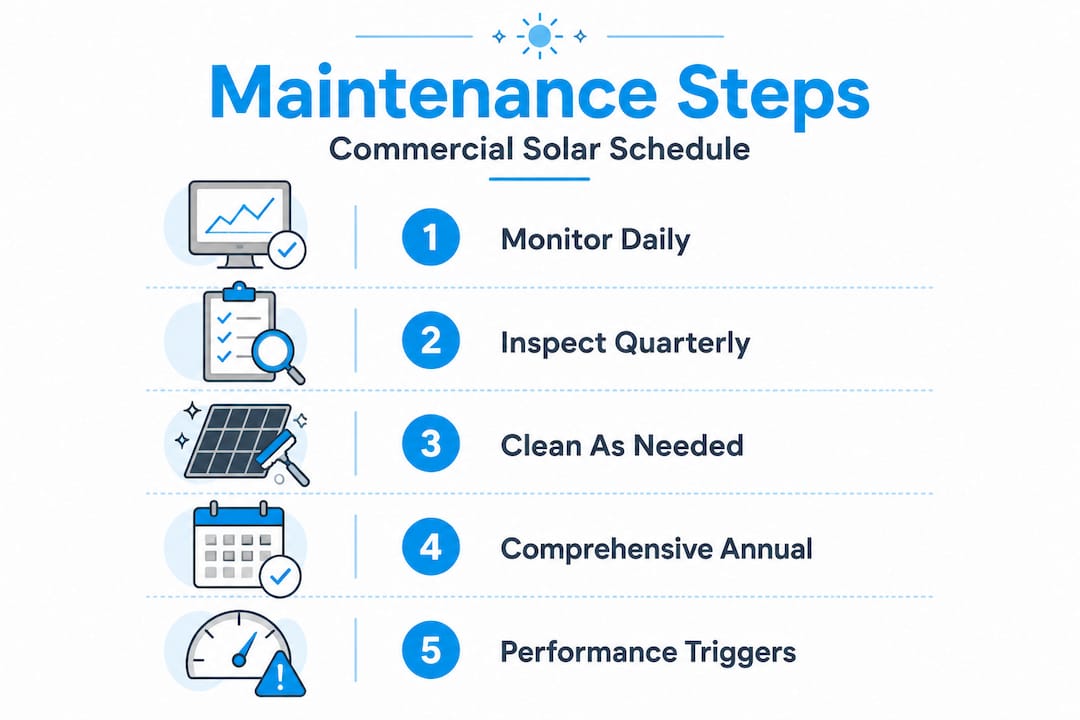
Step 1: Set up daily remote monitoring. Your inverter monitoring system should be generating daily output data. Review it weekly at minimum, and configure automated alerts for output drops greater than 10% compared to expected production for that weather day.
Step 2: Schedule quarterly visual inspections. Quarterly inspections are the baseline for most commercial sites, with higher frequencies required in coastal or high-corrosion environments and immediately after extreme weather events. A quarterly walk-through covers panel surface condition, visible cracks, mounting hardware, and wire management.
Step 3: Plan bi-annual or annual comprehensive inspections. The standard commercial maintenance schedule includes annual comprehensive electrical safety checks as the foundation, with bi-annual visits for larger or more exposed sites. These deeper inspections include insulation resistance testing, torque verification on all mounting hardware, and inverter diagnostics.
Step 4: Build a cleaning schedule based on your environment. This is where most generic guides fall short. Cleaning frequency depends heavily on site conditions. A facility in a temperate climate with regular rainfall may only need annual cleaning, while a site near a highway, agricultural operation, or industrial facility may need cleaning every few weeks. The typical commercial standard is two to four cleanings per year, but let your soiling data drive that number.
Step 5: Add performance-based triggers. Rather than relying solely on fixed dates, define thresholds that automatically trigger an unscheduled inspection or cleaning. A performance ratio drop of more than 5% over two consecutive weeks is a reliable trigger that something needs attention.
Step 6: Align with warranty requirements. Some manufacturers require documented inspections at specific intervals to keep warranties valid. Pull your equipment warranty documents and build those requirements directly into your calendar.
| Maintenance activity | Minimum frequency | High-risk site frequency |
|---|---|---|
| Remote output monitoring | Daily | Daily |
| Visual inspection | Quarterly | Monthly |
| Full electrical inspection | Annual | Bi-annual |
| Panel cleaning | 2 to 4 times per year | Every 3 to 7 days |
| Inverter diagnostics | Annual | Bi-annual |
| Mounting hardware torque check | Annual | Bi-annual |
Pro Tip: Schedule your annual comprehensive inspection in late fall. You'll catch any damage from summer heat and storms before winter loads stress the mounting system, and you'll enter the high-production spring season with a clean bill of health.
Core maintenance tasks and how to execute them
Understanding what goes on a maintenance checklist for solar arrays is one thing. Knowing how to execute each task without creating new problems is another.
Visual and structural inspections should follow a consistent route across your array. Check for cracked or discolored cells, delamination at panel edges, bird or pest activity under panels, and any visible corrosion on racking. Document findings with photos tied to a panel location map.
Cleaning methods matter more than most managers realize. Hard water leaves mineral deposits that are harder to remove than the original soiling. Solaralchemist uses professional-grade deionized water systems specifically to avoid this problem. Abrasive materials, high-pressure sprayers, and harsh chemicals can scratch anti-reflective coatings and void panel warranties. Always verify that your cleaning method aligns with manufacturer guidelines. You can review when cleaning is overdue based on eight specific environmental and performance indicators.
Electrical safety checks should be performed by certified technicians only. Rotating insulation resistance tests across 5 to 10% of strings annually reduces system downtime while maintaining full coverage across a multi-year testing cycle. Connection torque verification prevents resistance buildup at terminals, which is a leading cause of hotspots and fire risk.
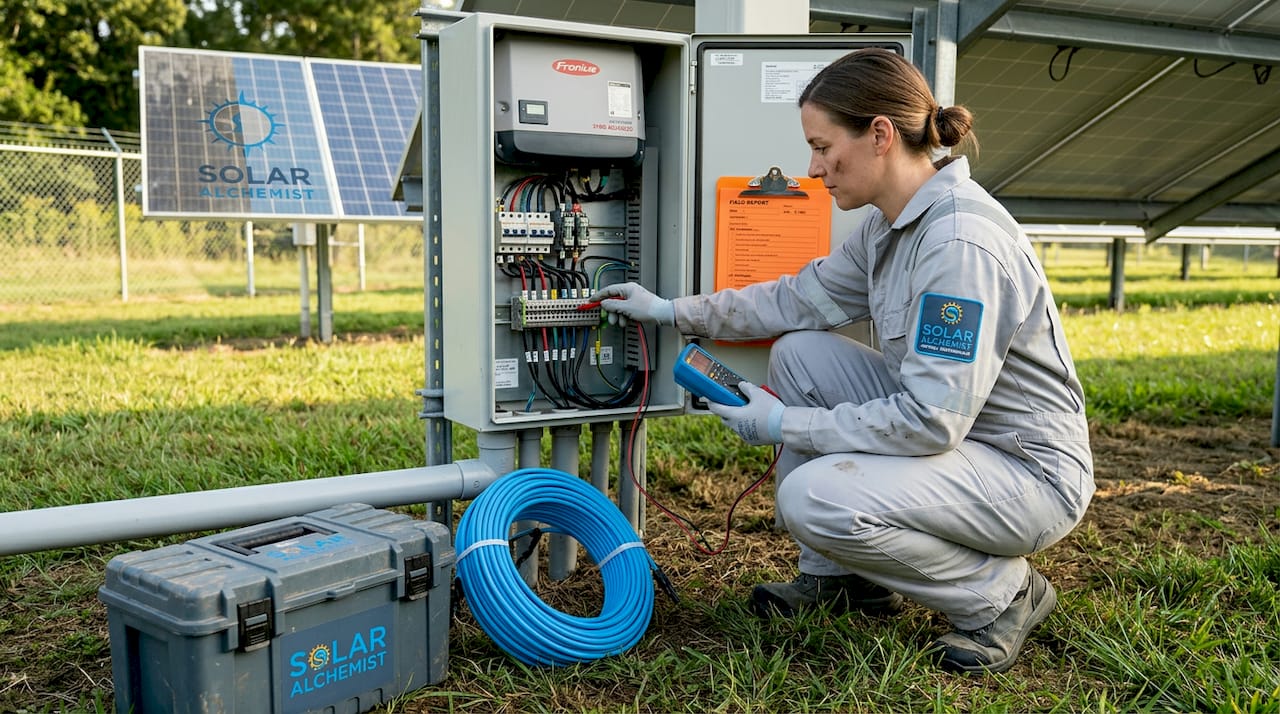
Inverter performance monitoring between physical visits is where remote systems earn their value. Watch for recurring fault codes, unusual temperature readings, and any string that consistently underperforms its neighbors. Condition-based maintenance using thermal imaging and inverter monitoring allows proactive intervention weeks before a fault becomes a full outage.
Pro Tip: Keep a dedicated maintenance log for each piece of equipment, not just the system as a whole. When an inverter fails five years from now, that individual service history is what your warranty claim will depend on.
Troubleshooting and avoiding common pitfalls
Even well-managed arrays run into problems. The difference between a minor correction and a costly repair usually comes down to how quickly you catch the issue and whether you respond correctly.
Common symptoms to watch for include:
- Output from one string consistently 15% or more below adjacent strings
- Inverter fault codes that clear on their own but recur within days
- Visible hotspots on thermal scans that do not correlate with shading
- Mounting hardware showing rust or movement at connection points
- Soiling patterns that appear uneven across sections of the array
The most expensive mistake facility managers make is attempting in-house electrical repairs to avoid service call costs. Avoid in-house inverter or electrical troubleshooting to maintain safety and warranty coverage. A $200 service call that preserves a $50,000 warranty is not a cost. It's an investment.
Seasonal adjustments are also frequently overlooked. After any significant weather event, including hail, high winds, or heavy snow load, add an unscheduled visual inspection before resuming normal monitoring. Coastal sites require bi-monthly checks because salt air accelerates corrosion on racking hardware at a rate that quarterly inspections simply cannot catch in time.
Proactive condition-based maintenance enabled by SCADA data analytics helps prevent outages and maximize production far more effectively than reactive maintenance triggered by alarms alone.
Technology is your best early warning system. If your monitoring platform allows it, set up trend alerts rather than just threshold alerts. A string that loses 2% of output each week for six weeks tells a clearer story than one that suddenly drops 12% and triggers an alarm.
Measuring success and refining your schedule
A maintenance schedule that never gets updated is just a document. The goal is a living plan that gets sharper every year based on what your data actually shows.
| Metric | What it tells you |
|---|---|
| Performance ratio trend | Whether output efficiency is holding, improving, or degrading over time |
| Fault frequency by component | Which equipment is generating the most corrective calls |
| Cleaning response lift | How much output recovers after each cleaning event |
| Downtime hours per quarter | Total production lost to maintenance or faults |
| Cost per kWh maintained | Whether your O&M spend is proportional to production value |
Review these metrics quarterly with your service provider. If cleaning consistently produces a 4% output lift, that tells you your current cleaning frequency is probably too low. If inspections repeatedly find nothing, you may be able to extend the interval and redirect that budget elsewhere. Maintenance planning integrated from project inception including lifecycle cost analysis produces far better long-term outcomes than treating it as an operational afterthought.
My honest take on solar maintenance scheduling
I've worked with enough commercial solar sites to say this plainly: the calendar-based maintenance schedule is a starting point, not a destination. Most facility managers I talk to are running their arrays on a fixed annual inspection plus a couple of cleanings, and they genuinely believe that's enough. For some sites, it is. For most, it isn't.
What I've found actually works is treating your performance ratio like a vital sign. When it drops and stays down, something is wrong. When it spikes back up after a cleaning, you've just learned something about your optimal cleaning frequency. The data is telling you what your schedule should be. The problem is that most managers aren't reading it that way.
I've also seen the warranty damage that comes from well-meaning in-house maintenance attempts. One facility had a maintenance tech tighten connections on a combiner box without a torque spec. The result was a resistance fault that caused a partial arc, which the manufacturer successfully used to deny a warranty claim on three inverters. That was a $28,000 lesson in why certified technicians are not optional.
The balance I recommend is this: do your own visual checks between professional visits, use your monitoring dashboard daily, and let the professionals handle anything involving electrical connections or inverter hardware. That division of responsibility keeps costs reasonable and keeps your warranty intact. Consistent documentation of every visit, every finding, and every corrective action is what protects your warranty coverage when you need it most.
— Marquis
How Solaralchemist can support your maintenance plan
If you manage a commercial solar array in the Madison, Wisconsin area, Solaralchemist offers professional cleaning and maintenance services built specifically for the performance demands of commercial systems.
Solaralchemist uses professional-grade deionized water systems and specialized equipment that clean effectively without risking panel coatings or voiding manufacturer warranties. Whether your site needs a one-time cleaning after a harsh winter or a recurring service plan tied to your performance data, the team can build a schedule around your actual site conditions. Explore before and after cleaning results from real commercial projects, or review the full professional cleaning process to see exactly how Solaralchemist protects your investment. Ready to put a real maintenance plan in place? Visit Solaralchemist's commercial services to get started.
FAQ
How often should a commercial solar array be inspected?
Quarterly inspections are the standard baseline for most commercial sites, with monthly checks required in coastal or high-corrosion environments and after any major weather event.
What is included in a commercial solar maintenance checklist?
A complete maintenance checklist for solar arrays covers visual panel inspections, mounting hardware torque checks, electrical insulation testing, inverter diagnostics, cleaning, and performance data review.
Can facility staff perform solar maintenance in-house?
Visual inspections and monitoring reviews are appropriate for in-house staff, but electrical work and inverter diagnostics should always be handled by certified technicians to avoid safety risks and warranty issues.
How does cleaning frequency affect solar output?
Soiling can reduce output by 5% or more depending on site conditions, and typical commercial cleaning frequency of two to four times per year is a reasonable baseline, adjusted based on performance data.
What is condition-based maintenance for solar arrays?
Condition-based maintenance uses real-time performance data and thermal imaging to trigger inspections and cleaning when the system shows signs of degradation, rather than waiting for a fixed calendar date.
Recommended
- Solar Panel Cleaning Madison WI | Professional Solar Maintenance | Solar Alchemist
- When to Clean Solar Panels | 8 Signs You Need a Cleaning | Solar Alchemist
- Solar Panel Warranty Protection | Manufacturer Cleaning Guidelines | Solar Alchemist
- About Solar Alchemist | Dane County Solar Panel Cleaning Expert