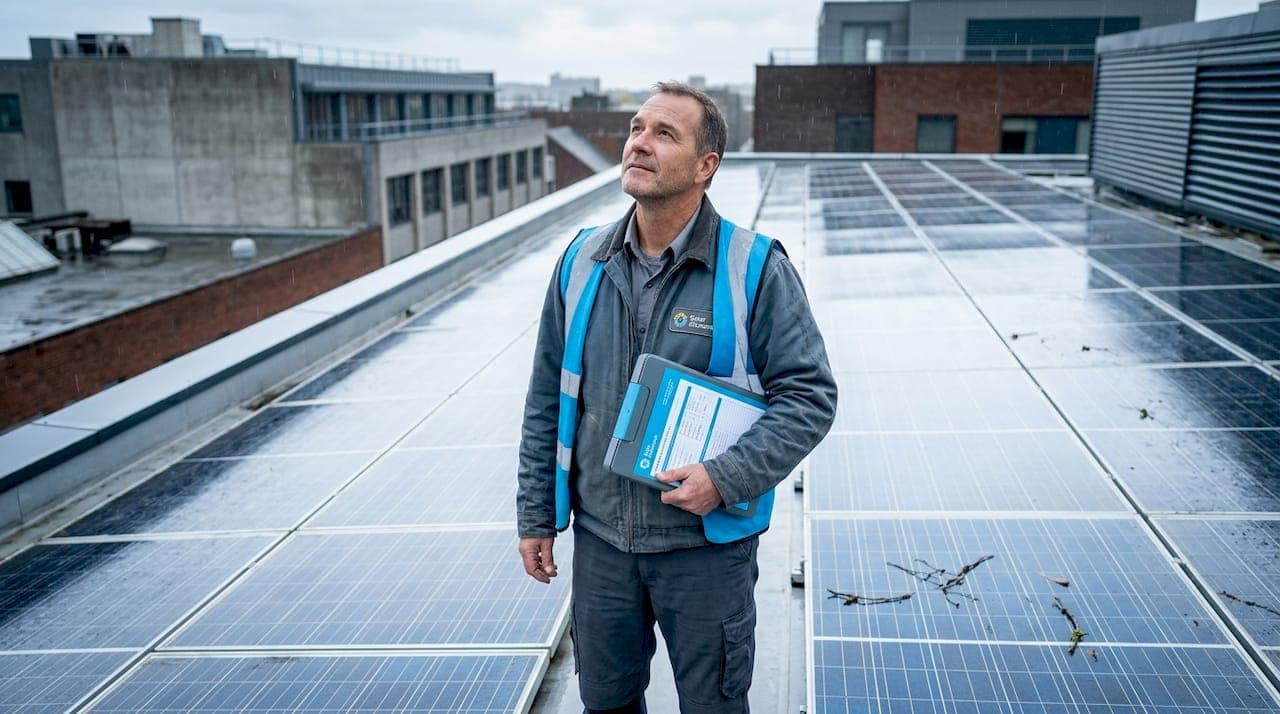
Rain feels like nature's free maintenance crew. You watch a storm roll through and assume your solar panels are getting a solid rinse. The reality is more complicated. Understanding how rain cleans solar panels partially, rather than completely, is one of the most practical things you can do as a panel owner. Observational research confirms that soiling losses are never fully reset after rain, meaning relying on rainfall alone leaves real money on the table. Here is what you actually need to know.
Table of Contents
- Key takeaways
- How rain cleans solar panels partially
- How tilt angle affects rain's cleaning power
- Debris rain cannot remove and why it costs you
- When to clean beyond what rain handles
- My honest take on rain and solar panel maintenance
- Ready to see what your panels are actually producing?
- FAQ
Key takeaways
| Point | Details |
|---|---|
| Rain only partially cleans | Rain removes loose dust and some soluble deposits but cannot touch baked-on grime or bird droppings. |
| Tilt angle changes everything | Panels at 15° or more shed water effectively; flatter installations pool water and accumulate residue faster. |
| Hard water can make things worse | Mineral-rich rain leaves calcium spots after evaporation, adding a new layer of residue with every storm. |
| Energy losses can be significant | Soiling from residue rain leaves behind can cut output by up to 36% over extended dry or low-rainfall periods. |
| Schedule manual cleaning anyway | Professional cleaning one to two times per year keeps efficiency 15 to 25% higher than rain alone can maintain. |
How rain cleans solar panels partially
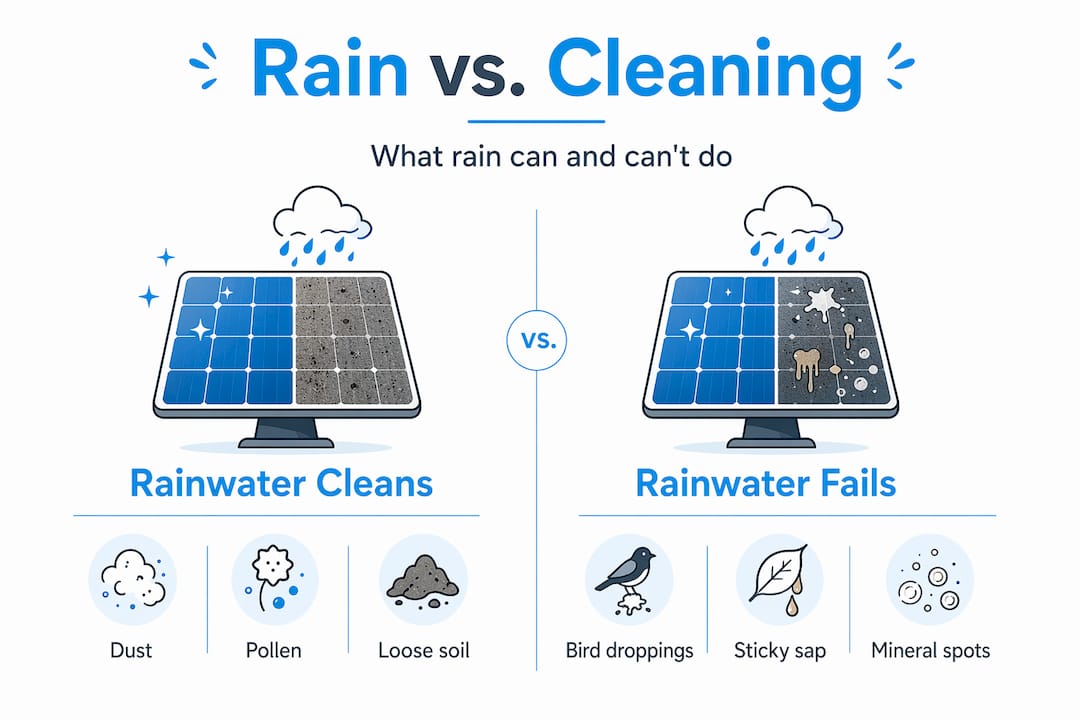
Rain works through two distinct mechanisms, and both matter. First, there is the mechanical action: falling water and surface runoff physically dislodge loose particles sitting on the glass. Dust, light pollen, and some dry organic debris get swept off the panel face when water flows across it quickly. Second, there is chemical dilution: rainwater dissolves soluble deposits like light salt films and some water-soluble organic compounds, carrying them away with the runoff.
These two actions together make rain genuinely useful. After a dry summer week in Madison, a good rainstorm will visibly freshen your panels. You might even see a small bump in your monitoring app output the next morning. That part is real.
The critical word is partially. Rain works best on debris that is already loose and dry. Once something has baked onto the glass surface under weeks of sun, water alone cannot break that bond. Think about leaving a dirty dish out for three days before rinsing it. The water runs off, but the dried food stays put. Your solar panels face the same physics.
Here is what rain cannot reliably remove:
- Bird droppings that have dried and bonded to the glass surface
- Sticky pollen from trees like oaks and cottonwoods that creates a resinous film
- Baked-on organic residue from exhaust, smoke, or nearby vegetation
- Mineral and hard water films that build up through repeated wet-dry cycles
- Traffic film and oily atmospheric deposits that repel water rather than mix with it
The effectiveness of rainwater on solar panels also depends heavily on the rainfall itself. A hard, sustained downpour with rapid runoff does far more cleaning than a light drizzle that barely wets the surface. For water to clean effectively, it needs to form continuous flowing sheets across the glass. Droplets that bead and pool trap dirt rather than carry it away.
Pro Tip: After any major storm, give your panels a visual inspection from the ground. If you can still see dark streaks, white spots, or concentrated debris patches, rain did not finish the job.
How tilt angle affects rain's cleaning power
Your roof pitch is doing more work than you probably realize. Panel tilt angle directly determines whether rainwater runs off cleanly or pools and evaporates, leaving residue behind.
Research shows clear performance brackets based on tilt:
| Tilt angle | Rain cleaning outcome |
|---|---|
| Less than 5° | Almost no cleaning effect; water pools and evaporates |
| 5° to 15° | Partial cleaning with significant streak and spot risk |
| 15° to 30° | Good self-cleaning; most loose debris removed |
| 30° and above | Optimal runoff; best natural cleaning performance |
Panels tilted at 15° or more promote the kind of sheet-flow that actually moves debris off the glass. Steeper angles let gravity do its job. Shallower installations, common on low-slope roofs, create a surface where water spreads slowly, slows down, and then evaporates before it can carry debris to the edge.
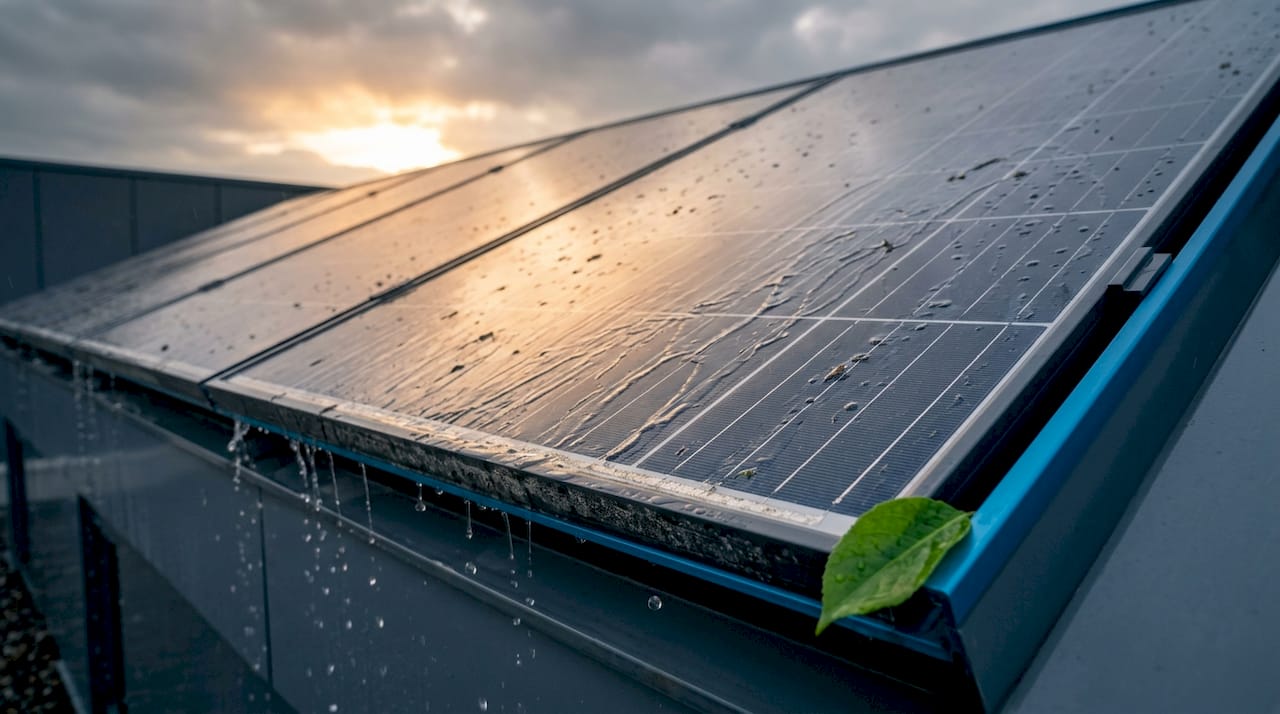
The pooling problem compounds over time. Each rain cycle on a low-tilt panel deposits a thin film of dissolved minerals, then evaporates and leaves those minerals behind. After a dozen rain cycles, you have a visible whitish haze on the glass that is far harder to remove than the original dust. This is why flat or near-flat roof installations need professional cleaning more frequently, regardless of how much it rains.
There is also the edge buildup issue. On panels under 10°, water tends to slow near the frame and leave a concentrated strip of residue along the lower edge. That strip creates shading on the bottom row of cells, which can drag down the output of an entire string in some system configurations.
Pro Tip: If you are not sure of your panel tilt angle, your installation paperwork or inverter documentation will usually list it. If your system is on a roof under 15°, plan on manual cleaning at least twice a year regardless of local rainfall.
Debris rain cannot remove and why it costs you
This is the part most panel owners discover the hard way, usually through a drop in monthly production they cannot explain.
Soiling losses are never fully reset after rain, meaning stubborn residue accumulates in layers between cleanings. The types of debris that survive every rainstorm and keep building up include:
- Bird droppings: The concentrated uric acid in droppings bonds to glass quickly. A dropping the size of a quarter can shade an entire cell and cause disproportionate output loss through a phenomenon called partial shading.
- Tree sap: Sap dissolves in nothing but specialized solvents. Rain does not touch it.
- Calcium and mineral deposits: Hard water rain leaves calcium spots after evaporation that stack with each storm cycle, forming a frosted appearance that blocks light transmission.
- Sticky seasonal pollen: Oak, birch, and cottonwood pollen creates a resinous, almost glue-like film when wet, which then dries hard.
The performance impact of leaving these residues in place is significant. Output losses of up to 36% have been documented after extended periods without proper cleaning. Even moderate soiling in the 10 to 15% loss range translates directly to dollars on your utility bill every month.
"Soiling losses not reset to zero after rain highlight the limits of natural cleaning. Persistent, sticky soiling accumulates between rain events and continues to reduce output until mechanically removed." — EPJ Photovoltaics research on partial rain cleaning effects
Here is what makes the tracking part tricky. After rain, panels often look cleaner because loose surface dust is gone. The underlying sticky and mineral residue is still there, just less obvious. Your monitoring system is the better truth-teller. If production is still lagging post-storm compared to similar weather days from a month ago, visible cleanliness is misleading you. You can see before and after production comparisons from real systems in Solaralchemist's cleaning results to understand how much performance stubborn residue actually steals.
When to clean beyond what rain handles
Does rain clean solar panels enough to skip manual maintenance entirely? No. But rain does reduce how often you need to clean, and understanding your local environment helps you set the right schedule.
Here is a practical approach to deciding when professional or manual cleaning is needed:
- Monitor your production data monthly. Compare current output to the same month in previous years. A consistent downward trend that weather alone does not explain is a strong signal.
- Inspect visually after the first dry stretch of the season. In Madison and similar Midwest climates, post-winter inspection is especially important after months of road salt, ice, and tree debris.
- Check for bird activity near your array. Even a few active birds can deposit enough material to justify cleaning every 60 to 90 days on affected panels.
- Consider your local water quality. If your area has hard water and frequent light rain, you may be accumulating mineral spotting faster than visible dust. In hard-water environments, a soft water rinse is needed periodically after organic debris removal.
- Follow manufacturer guidelines. Most manufacturers recommend at least annual professional cleaning, and some warranty protection requirements specify cleaning intervals that support your coverage.
Scheduled cleaning one to two times per year keeps efficiency 15 to 25% higher than panels cleaned by rain alone. For most homeowners, that represents meaningful savings across a system's 25-year lifespan.
Pro Tip: Never clean panels during peak sun hours. Glass expands when hot, and cold water contact can cause micro-cracks. Early morning, after any dew has evaporated but before full sun, is ideal.
My honest take on rain and solar panel maintenance
I have seen a lot of solar arrays in a range of conditions, and the panels that disappoint their owners most are almost always the ones where someone assumed rain was handling things.
Rain is a useful ally. I will not dismiss it. In climates with regular, heavy rainfall and panels at decent tilt angles, natural washing genuinely slows residue accumulation and reduces cleaning frequency. That is worth something.
But I have also stood on roofs and seen what rain leaves behind: calcium halos ringing every dried droplet, a yellow pollen film that survived dozens of storms, bird droppings with rings of dried acid spreading outward like tide marks. None of that moves in rain. And every month it sits there, it is quietly reducing what your system produces.
The thing that surprises homeowners most is how targeted the damage is. One heavy bird dropping over a single cell can drag down a whole string. A panel does not need to be uniformly dirty to lose significant output. That is why anti-soiling coating durability also matters. Rain exposure can shorten the life of those coatings depending on water chemistry and tilt, meaning the panel's built-in defense against soiling degrades over time.
My advice is simple. Treat rain as a partial maintenance credit, not a maintenance solution. Inspect regularly, monitor your production data, and schedule professional cleaning at least once a year. You will protect both your output and your investment.
— Marquis
Ready to see what your panels are actually producing?
If you have been relying on rain to keep your panels clean, there is a good chance your system is leaving production on the table right now. Solaralchemist works with homeowners across Madison and Dane County to remove exactly the residues that rain cannot touch, using professional-grade deionized water systems that leave no spotting behind.

Start with 8 signs you need a cleaning to see whether your panels are showing the signals that indicate rain has not been enough. If you are ready for a professional assessment or want to see real before and after results from systems like yours, Solaralchemist is ready to help you get back to peak production.
FAQ
Does rain fully clean solar panels?
No. Rain removes loose dust and some soluble deposits but cannot eliminate bird droppings, sticky pollen, tree sap, or mineral spots. These residues require manual or professional cleaning.
How often do solar panels need cleaning beyond rainfall?
Most systems benefit from professional cleaning one to two times per year. Panels in areas with heavy bird activity, hard water, or low tilt angles may need cleaning every 60 to 90 days.
What is the impact of rain on solar efficiency?
Rain can restore some lost efficiency by removing loose soiling, but persistent residues mean output losses up to 36% accumulate without manual cleaning during extended dry or high-soiling periods.
Are solar panels self-cleaning in rainy climates?
Partially. Higher rainfall frequency slows soiling buildup, but panels are not truly self-cleaning. Stubborn residues survive multiple rain cycles and continue reducing light transmission until physically removed.
Can rain make solar panels dirtier?
Yes, in hard water areas. Repeated rain cycles leave mineral deposits after evaporation that accumulate into visible calcium spotting, which actually worsens panel cleanliness compared to before the rain.
Recommended
- Solar Panel Cleaning Before & After Results | Our Work | Solar Alchemist
- When to Clean Solar Panels | 8 Signs You Need a Cleaning | Solar Alchemist
- Solar Panel Cleaning Madison WI | Professional Solar Maintenance | Solar Alchemist
- Solar Panel Warranty Protection | Manufacturer Cleaning Guidelines | Solar Alchemist