
Dirt is quietly costing your solar investment more than you think. Understanding how solar panel soiling affects business revenue is not a theoretical exercise. It is a financial necessity. Soiling from dust, pollution, and debris reduces global solar output by 4 to 7% annually, translating into multibillion-dollar losses across commercial installations worldwide. For business owners who depend on predictable energy production and favorable ROI timelines, that number is not background noise. It is a line item that deserves serious attention, and this article gives you the framework to act on it.
Table of Contents
- Key takeaways
- How solar panel soiling affects business revenue
- Financial and contractual risks from unmanaged soiling
- Operational strategies to protect revenue from soiling
- Cleaning decision frameworks and financial models
- My take on why businesses keep getting this wrong
- Protect your solar revenue with Solaralchemist
- FAQ
Key takeaways
| Point | Details |
|---|---|
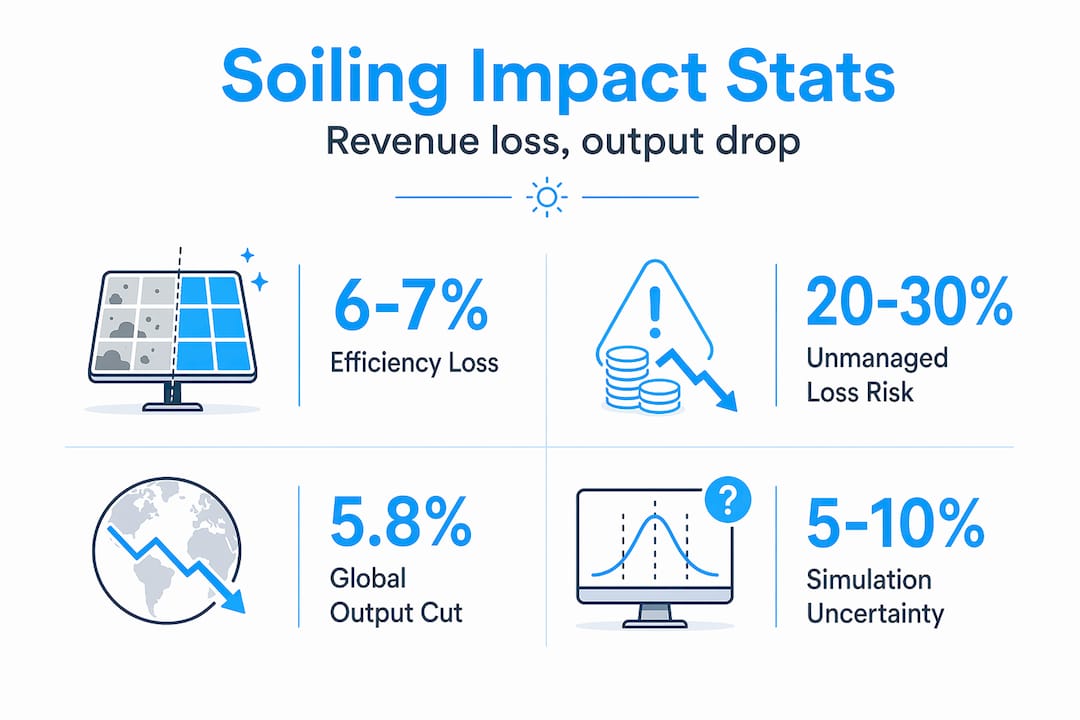
| Soiling cuts output fast | Short-term soiling causes 6 to 7% efficiency loss within months, compounding into 20 to 30% if left unmanaged. |
| Small losses carry big risk | Even 1 to 2% soiling loss can trigger capacity test failures, leading to penalties and costly retesting. |
| Calendar cleaning wastes money | Performance-based cleaning tied to revenue thresholds consistently outperforms fixed cleaning schedules. |
| Soiling inflates financial uncertainty | Soiling contributes 5 to 10% to simulation uncertainty, directly affecting performance guarantees and OPEX planning. |
| Monitoring pays for itself | Continuous soiling data enables smarter cleaning decisions, reducing unnecessary costs and protecting yield. |
How solar panel soiling affects business revenue
Soiling is not just dust settling on glass. It is a measurable performance tax that compounds over time, and the physical mechanisms behind it explain exactly why revenue takes a hit.
When particles land on a solar panel surface, they scatter and absorb incoming sunlight before it reaches the photovoltaic cells underneath. The more opaque and uneven the layer, the more light is blocked. The types of soiling agents vary significantly by location and industry:
- Dust and sand in arid or agricultural regions accumulate quickly and create a uniform but dense film
- Industrial pollution and soot from nearby manufacturing or coal plants leave chemically adhesive deposits that resist natural rain cleaning
- Pollen creates a sticky seasonal layer that bonds with other particles
- Bird droppings cause localized but severe shading that disproportionately reduces string output
Short-term soiling causes a 6 to 7% efficiency loss within months, with long-term unmanaged losses exceeding 20 to 30%. Those numbers translate directly into kilowatt-hours not generated and revenue not collected.
Regional variation matters enormously here. Coal pollution aerosols caused a 5.8% global solar PV output reduction in 2023, climbing to 7.7% in heavily polluted regions by 2025. If your facility sits near industrial corridors or high-traffic roads, your soiling rate is almost certainly above the global average, and your revenue exposure is proportionally higher.
One technical detail that often gets overlooked: uneven dirt distribution across a solar array causes string current mismatch. When one section of panels is dirtier than another, the underperforming section drags down the output of the entire string, not just its own modules. The financial effects of solar soiling are therefore not always proportional to how dirty the panels look. They can be significantly worse.
Financial and contractual risks from unmanaged soiling
The revenue impact of solar dust goes well beyond monthly energy bills. For businesses operating under power purchase agreements, performance guarantees, or project financing structures, soiling creates risks that can trigger penalties, damage lender relationships, and destabilize cash flow projections.

Soiling losses as low as 1 to 2% can cause solar plants to fail capacity tests, resulting in financial penalties and the cost of retesting. That threshold is shockingly low. A single dry season without a cleaning visit can push a well-maintained system past that margin. For operators who assumed their panels were performing adequately, the first sign of a problem often arrives as a failed test, not a monitoring alert.
The financing implications are equally serious. Unmanaged soiling can cause breaches in financing covenants, affecting debt coverage ratios and overall project viability. Lenders increasingly require documented soiling assumptions as part of project underwriting. If your actual soiling rate exceeds modeled assumptions, your debt service coverage ratio may fall below required minimums, a situation that can trigger covenant violations even when the underlying asset is physically sound.
"Early incorporation of soiling measurement during commissioning can prevent costly disputes and delays later." — Soiling Measurement During Commissioning
Revenue forecasting models that ignore soiling variability also introduce risk. Soiling contributes 5 to 10% to PV simulation uncertainty, directly affecting performance guarantees and OPEX planning. That uncertainty makes it harder to commit to revenue projections with confidence, which matters when you are reporting to investors, boards, or lenders.
Pro Tip: If your solar system is financed, request a copy of the soiling assumptions used in your original energy yield assessment. Compare those assumptions against your actual site conditions. A mismatch is a financial risk hiding in plain sight.
Operational strategies to protect revenue from soiling
Knowing that soiling costs money is one thing. Having a system to quantify and respond to it is another. The good news is that the tools available to business owners today make data-driven soiling management genuinely accessible.
-
Install continuous soiling monitoring. Paired reference modules, one kept clean and one exposed to site conditions, feed real-time soiling ratio data into performance analytics platforms. Continuous soiling monitoring enables data-driven cleaning decisions that improve yield and reduce unnecessary cleaning costs. This is the foundation of any serious soiling management program.
-
Switch from calendar cleaning to revenue-based triggers. Operators using calendar cleaning often waste money. Cleaning triggered by economic thresholds, specifically when the revenue recovered from cleaning exceeds the cost of the cleaning event, consistently delivers better ROI. Set a soiling ratio threshold, then act when you cross it.
-
Validate performance after every cleaning. Post-cleaning output data confirms whether the intervention worked and establishes a clean baseline for the next monitoring cycle. Without this step, you cannot prove the value of your maintenance spend or catch equipment issues that soiling was masking.
-
Time cleaning around market price peaks. For businesses selling energy at variable rates, cleaning aligned with market price peaks maximizes revenue recovery. Cleaning just before a high-demand period when electricity prices are elevated means the recovered output is worth more per kilowatt-hour.
Pro Tip: Review your cleaning timing decisions at least quarterly. Soiling rates shift with seasons, nearby construction activity, and weather patterns. A trigger threshold that works in spring may be too conservative for a dry Wisconsin summer.
Cleaning decision frameworks and financial models
Not every cleaning decision is the same, and the financial case for cleaning looks very different depending on your revenue model. Understanding the right framework for your situation is what separates a well-run solar asset from one that quietly underperforms.
| Revenue Model | Cleaning Sensitivity | Recommended Approach |
|---|---|---|
| Fixed tariff (FIT) | Moderate | Calendar-based with annual review |
| Power Purchase Agreement (PPA) | High | Performance-triggered with contractual floor monitoring |
| Merchant market (spot price) | Very high | Revenue-optimized cleaning timed to price forecasts |
| Self-consumption (commercial) | Moderate to high | Demand-aligned cleaning before peak consumption periods |
For businesses under PPAs or merchant market contracts, the financial effects of solar soiling are amplified because every lost kilowatt-hour represents a specific dollar amount tied to current market rates. A net present value analysis for cleaning interventions under these models often shows payback periods measured in weeks, not years.
Structured models that monetize lost MWh against specific revenue models help justify cleaning costs and improve ROI. The math is straightforward: calculate your daily revenue loss per percentage point of soiling, multiply by your current soiling ratio, and compare that figure to the cost of a cleaning event. If the cleaning pays back within 30 to 60 days, it is almost always worth doing.
Soiling is a significant component of financial uncertainty in solar projects, influencing budgeting and investor confidence. Businesses that build soiling variability into their financial models, rather than treating it as a fixed assumption, produce more accurate forecasts and face fewer surprises at year-end reporting.
Regional soiling patterns also shift the calculus. A commercial installation in Madison, Wisconsin faces very different soiling profiles in April (pollen season) versus August (dry heat and road dust) versus November (leaf debris and early frost). A one-size-fits-all cleaning schedule ignores that variability entirely, which means it is almost certainly over-cleaning in some periods and under-cleaning in others.
My take on why businesses keep getting this wrong
I've worked with enough commercial solar owners to recognize a pattern. The businesses that struggle most with soiling losses are not the ones who ignore solar entirely. They are the ones who installed a system, set up a basic monitoring dashboard, and assumed that a green light meant everything was fine.
What I've learned is that "no alarms" and "optimal performance" are not the same thing. Soiling degrades output gradually, below the threshold of most alert systems, until the cumulative loss becomes significant. By the time a business owner notices the problem, months of revenue have already been left on the table.
The other mistake I see constantly is treating cleaning as a cost rather than a revenue recovery mechanism. When you frame it correctly, cleaning is not maintenance spending. It is a financial intervention with a measurable return. The businesses that adopt that mindset, and back it up with real soiling data, consistently outperform those that run fixed schedules or skip cleaning altogether.
My honest advice: get a soiling monitoring baseline established before you make any other decisions. You cannot optimize what you cannot measure. Once you have real data, the financial case for proactive management becomes obvious, and the conversations with lenders, investors, and operations teams get a lot easier.
— Marquis
Protect your solar revenue with Solaralchemist
If this article has made one thing clear, it is that solar panel cleaning and revenue are directly connected, and leaving that connection unmanaged is a choice that costs real money. Solaralchemist works with commercial solar owners across Madison, Wisconsin and Dane County to quantify soiling impact, build performance-aligned cleaning schedules, and deliver results you can verify in your output data. Using professional-grade deionized water systems and specialized equipment, the team at Solaralchemist cleans panels safely without risking surface damage or voiding manufacturer warranties. Check out real cleaning results from commercial installations, or explore warranty-compliant cleaning to protect your asset value long-term. When you are ready to stop guessing and start recovering lost revenue, get in touch with Solaralchemist for a personalized assessment.
FAQ
How much revenue can soiling cost a commercial solar installation?
Soiling typically reduces annual output by 4 to 7% globally, with long-term unmanaged losses exceeding 20 to 30%, each percentage point representing direct lost revenue tied to your energy rate or PPA contract value.
Can dirty solar panels cause contractual penalties?
Yes. Soiling losses as low as 1 to 2% can cause a solar plant to fail capacity tests, triggering financial penalties and the expense of retesting under the terms of many performance agreements.
How often should a business clean its solar panels?
The answer depends on your soiling rate, revenue model, and local conditions rather than a fixed calendar. Performance-triggered cleaning, based on when recovered revenue exceeds cleaning cost, consistently delivers better ROI than scheduled intervals.
Does soiling affect solar panel warranties?
Neglecting cleaning can void manufacturer warranties that require panels to be maintained according to published guidelines. Professional cleaning using approved methods protects both your warranty and the long-term value of your solar asset.
What is the best way to track soiling losses in real time?
Paired reference module systems that feed soiling ratio data into a performance analytics platform provide the most accurate real-time picture, enabling cleaning decisions based on actual financial impact rather than visual inspection.
Recommended
- Solar Panel Cleaning Madison WI | Professional Solar Maintenance | Solar Alchemist
- When to Clean Solar Panels | 8 Signs You Need a Cleaning | Solar Alchemist
- Solar Panel Cleaning Before & After Results | Our Work | Solar Alchemist
- Solar Panel Warranty Protection | Manufacturer Cleaning Guidelines | Solar Alchemist