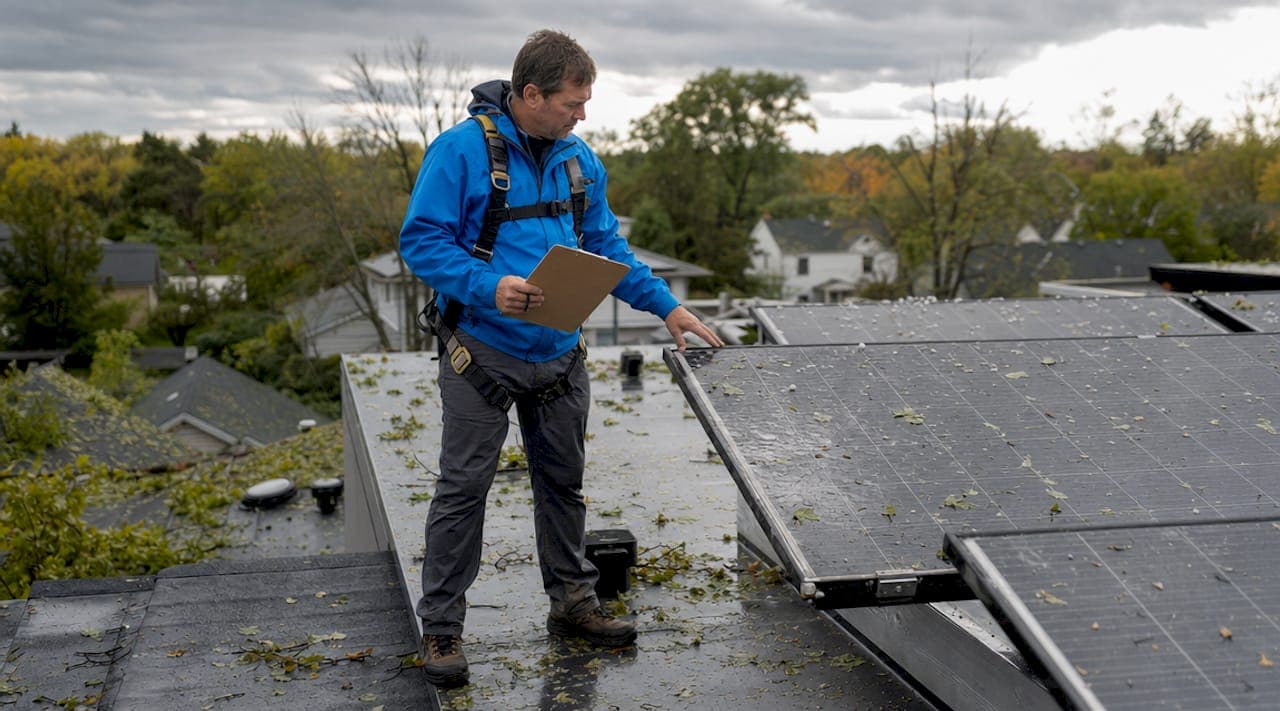
Wisconsin solar panels face five distinct weather threats: hailstorms, snow accumulation, cloud cover, cold temperatures, and high winds. Each one affects your system differently, and knowing which types weather affecting Wisconsin solar panels matters most can mean the difference between peak production and a costly repair bill. Organizations like RENEW Wisconsin have documented local storm damage extensively, and international standards like IEC 61215 set the durability benchmarks every quality panel must meet. This guide breaks down each weather type with real Wisconsin examples and the science behind the numbers.
1. How hailstorms damage Wisconsin solar panels
Hail is the single most destructive weather event for solar panels in Wisconsin. It causes two categories of damage: visible fractures you can see, and internal microcracks you cannot. Hail cracks panel glass and fractures cell busbars beneath the surface, reducing output even when the panel looks intact from the ground.
The April 14, 2026 Madison hailstorm produced baseball-sized hail measuring roughly three inches in diameter. That event forced many homeowners into repair or full replacement decisions within weeks. What made it especially tricky is that internal microcracks from hail impact can propagate over time, creating hot spots and gradual efficiency loss even when panels still produce power.
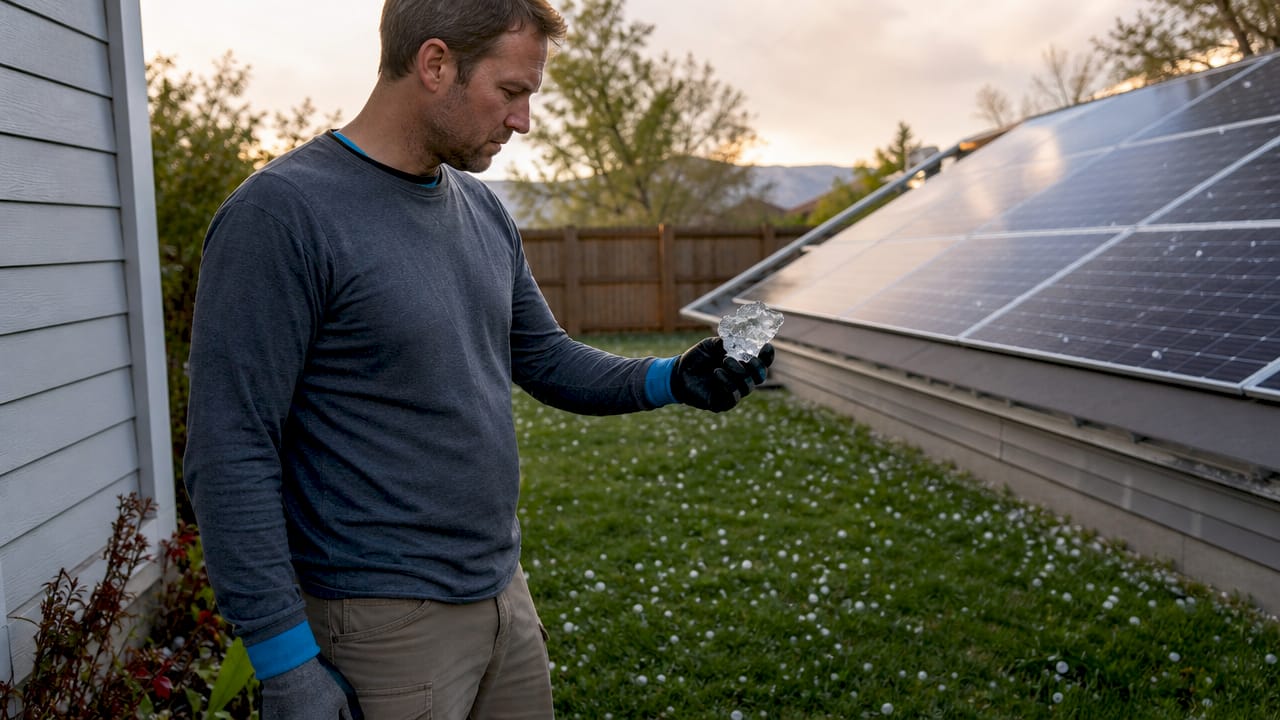
The key risk here is false confidence. A panel that still generates electricity after a hailstorm is not necessarily undamaged. Full Spectrum Solar, a Madison installer, warned homeowners after the April 2026 storm not to assume their system was fine just because it was still running. Performance diagnostics, not visual checks, are the only reliable way to assess post-hail condition.
Insurance coverage for hail damage in Wisconsin varies by policy. Most homeowner policies cover hail under the same clause as roof damage, but you need documentation to file a claim successfully.
- Check your system's production data immediately after any hailstorm
- Photograph all visible damage from the ground before touching anything
- Request a professional diagnostic inspection, not just a visual walkthrough
- Contact your insurance provider within 48 hours of the event
Pro Tip: Schedule a solar maintenance inspection within one week of any hailstorm, even if your panels look undamaged. Hidden internal fractures are far more common than cracked glass, and catching them early prevents long-term efficiency loss.
2. Snow and cold weather effects on panel efficiency
Cold temperatures are not the enemy of solar panels. Heat is. Panels are rated at 25°C (77°F), and extreme heat lowers output by reducing voltage. Wisconsin winters actually give your panels a thermal advantage on clear days. The real winter problem is snow coverage and reduced daylight hours, not the cold itself.
Snow accumulation is where Wisconsin homeowners feel the most direct impact on production. Monthly snow losses can reach 100% during heavy coverage events, and annual losses near 30% have been recorded in snowy climates. That is a significant production gap, and it varies based on your system's tilt angle, mounting type, and exact location within the state.
The science of snow shedding near 0°C is genuinely complex. Frost and ice increase snow adhesion on panel surfaces, making it harder to model when snow will slide off. Two systems in the same zip code can behave very differently based on panel angle and microclimate. This is why snow loss estimates from online calculators often miss the mark for Wisconsin specifically.
| Condition | Effect on output | Key variable |
|---|---|---|
| Full snow coverage | Up to 100% monthly loss | Tilt angle and temperature |
| Partial snow coverage | 20–50% reduction | Panel orientation |
| Cold clear day | Slight efficiency gain | Ambient temperature |
| Overcast winter day | 10–25% reduction | Cloud density |
Key factors that determine your snow impact:
- Tilt angle: Steeper panels shed snow faster and more completely
- Mounting type: Ground-mounted systems generally outperform roof-mounted in snow conditions
- Temperature fluctuation: Freeze-thaw cycles near 0°C create the most unpredictable shedding behavior
- Panel surface: Some anti-reflective coatings reduce snow adhesion
3. How cloudy and overcast conditions affect solar power generation
Solar panels still generate electricity on cloudy days. The output drops, but it does not stop. Diffuse and indirect light still reaches the cells and produces usable energy. This is one of the most misunderstood aspects of Wisconsin solar panel efficiency, and it leads some homeowners to underestimate their system's winter value.
The real limitation in Wisconsin winters is the combination of shorter days and lower sun angles, not clouds alone. By December, Madison receives roughly nine hours of daylight, and the sun sits low enough that irradiance is significantly reduced even on clear days. Clouds compound this by scattering the available light further.
What you gain in cold-weather efficiency, you largely lose in irradiance. The net result is that winter months in southern Wisconsin typically produce 30 to 50 percent less energy than summer months. That reduction is real, but it does not erase the value of solar. A well-sized system accounts for seasonal variation in its annual production estimates.
- Panels produce roughly 10 to 25 percent of their rated output on heavily overcast days
- Light cloud cover causes less reduction than most homeowners expect
- Winter production still offsets grid consumption and earns net metering credits in Wisconsin
- Systems with battery storage buffer the impact of low-production days most effectively
4. Wind and extreme weather effects on panel durability
Wind is the weather type Wisconsin solar owners think about least, but it deserves serious attention. Quality solar panels withstand wind speeds up to 140 mph, which exceeds Category 3 hurricane wind ranges of 111 to 129 mph. That tolerance is built into the design, not an accident.
The real wind risk is not the wind itself. It is wind-driven debris. Branches, gravel, and other projectiles traveling at speed can crack glass or damage mounting hardware in ways that pure wind pressure would not. After any severe storm, a physical inspection of your racking system and panel surfaces is worth the time.
Long-term mechanical stress from repeated thermal cycling is a separate concern. IEC 61215 certification requires panels to survive thermal cycling between negative 40°C and positive 85°C, humidity freeze testing, UV exposure, and mechanical load tests. This certification simulates more than 20 years of outdoor stress, which means a certified panel is built to handle Wisconsin's seasonal extremes across its full lifespan.
Panels without IEC 61215 certification carry a meaningfully higher risk of premature failure from Wisconsin's temperature swings and storm exposure. When evaluating a new installation or replacement, certification status is a non-negotiable quality check.
Pro Tip: After any storm with sustained winds above 50 mph, check your production monitoring data for output drops that don't match cloud cover. A sudden unexplained dip often signals loose racking or a damaged connection, not panel failure.
5. Roof-mounted vs. ground-mounted systems in Wisconsin weather
The way your panels are mounted changes how every weather type affects them. Roof-mounted and ground-mounted systems face the same Wisconsin climate, but their exposure profiles are different enough to affect both production and maintenance costs.
Snow is where the gap is most pronounced. Ground-mounted arrays lose less energy from snow than roof-mounted systems because they can be installed at steeper tilt angles and are more accessible for manual clearing. Roof pitch often limits the tilt angle available, which means snow sits longer and blocks more light.
| Factor | Roof-mounted | Ground-mounted |
|---|---|---|
| Snow shedding | Depends on roof pitch | Better with high-tilt option |
| Hail damage risk | Similar, harder to inspect | Easier post-storm inspection |
| Wind exposure | Partially sheltered by roof | More exposed in open areas |
| Maintenance access | Requires ladder or lift | Ground-level access |
| Snow clearing | Risky and often skipped | Practical and safer |
For homeowners in southern Wisconsin with standard pitched roofs, snow losses are manageable but real. Businesses with flat commercial roofs face the worst snow accumulation scenario because flat-mounted panels shed almost nothing. Ground-mounted commercial arrays in open fields near Madison or Sun Prairie offer the most consistent year-round production, though they require more land and face higher wind exposure in open terrain.
The right choice depends on your property, budget, and production goals. What matters is that you factor in Wisconsin's specific weather patterns, not just the national averages that most solar calculators default to.
Key takeaways
Wisconsin solar panels perform best when owners understand how each weather type creates distinct production and maintenance challenges across the full year.
| Point | Details |
|---|---|
| Hail causes hidden damage | Internal microcracks reduce long-term output even when panels still produce power. |
| Snow losses vary widely | Monthly losses can reach 100%; tilt angle and mounting type are the main variables. |
| Cold improves efficiency | Low temperatures boost panel voltage; reduced daylight and irradiance are the real winter limits. |
| Wind risk is debris, not speed | Panels tolerate 140 mph winds; storm debris and loose racking are the practical threats. |
| Mounting type changes outcomes | Ground-mounted systems shed snow better and allow safer post-storm inspection than roof-mounted arrays. |
What working with Wisconsin panels taught me about weather damage
Most homeowners I talk to worry about the wrong things. They fear cold winters will kill their system's output, when the data consistently shows that cold temperatures actually help panel efficiency. The real threats are the ones you cannot see: a hailstorm in April that leaves your panels looking fine but running at 80 percent capacity, or a winter's worth of snow residue that never fully cleared and left a film of mineral deposits across your array.
The April 2026 Madison hailstorm was a turning point for a lot of local solar owners. Systems that had been running quietly for years suddenly needed professional diagnostics. What struck me was how many owners had no baseline production data to compare against. Without that reference point, you cannot know what you lost.
My honest advice: treat your solar system like any other mechanical investment. Schedule inspections after major storms. Monitor your production data monthly, not just when something seems wrong. And when you choose panels, verify IEC 61215 certification before anything else. Wisconsin's temperature swings from negative 20°F in January to 95°F in July are not gentle on equipment.
The weather here is real, but so is the long-term value of solar. The owners who get the most from their systems are the ones who stay proactive rather than reactive.
— Marquis
Keep your Wisconsin solar system performing after tough weather
Wisconsin's weather does not let up, and neither should your maintenance routine. After hailstorms, heavy snow seasons, or high-wind events, the panels that hold their production numbers are the ones that get professional attention before small problems compound.

Solaralchemist specializes in post-weather cleaning and maintenance for Wisconsin solar arrays, using professional-grade deionized water systems that remove snow residue, hail debris, and mineral deposits without scratching panel surfaces. Serving Madison, Sun Prairie, Whitewater, and surrounding communities, the team at Solaralchemist knows exactly what local weather does to your system. Check when your panels need cleaning after this season's storms, or book a service visit for your Madison area system before production losses add up.
FAQ
Does cold weather hurt Wisconsin solar panel output?
Cold temperatures actually improve panel efficiency by increasing voltage output. The production drop in Wisconsin winters comes from shorter days, lower sun angles, and snow coverage, not the cold itself.
How do I know if hail damaged my solar panels?
Visual inspection alone is not reliable. Panels can sustain internal damage and still produce power while losing long-term efficiency. Compare your production data before and after the storm, and schedule a professional diagnostic inspection.
How much energy do Wisconsin solar panels lose to snow?
Snow losses vary significantly by system type and location, with monthly losses reaching 100% during full coverage events and annual losses near 30% in heavily snowy climates. Ground-mounted systems at steeper tilt angles lose less than flat or low-tilt roof systems.
Can solar panels handle Wisconsin wind storms?
Quality panels rated to IEC 61215 standards withstand wind speeds up to 140 mph. The primary risk in Wisconsin storms is wind-driven debris and damage to mounting hardware, not the wind pressure itself.
Do solar panels work on cloudy Wisconsin winter days?
Yes. Panels generate electricity from diffuse light even under heavy cloud cover, though output drops to roughly 10 to 25 percent of rated capacity on overcast days. Winter production is lower overall but still contributes to your annual energy offset.