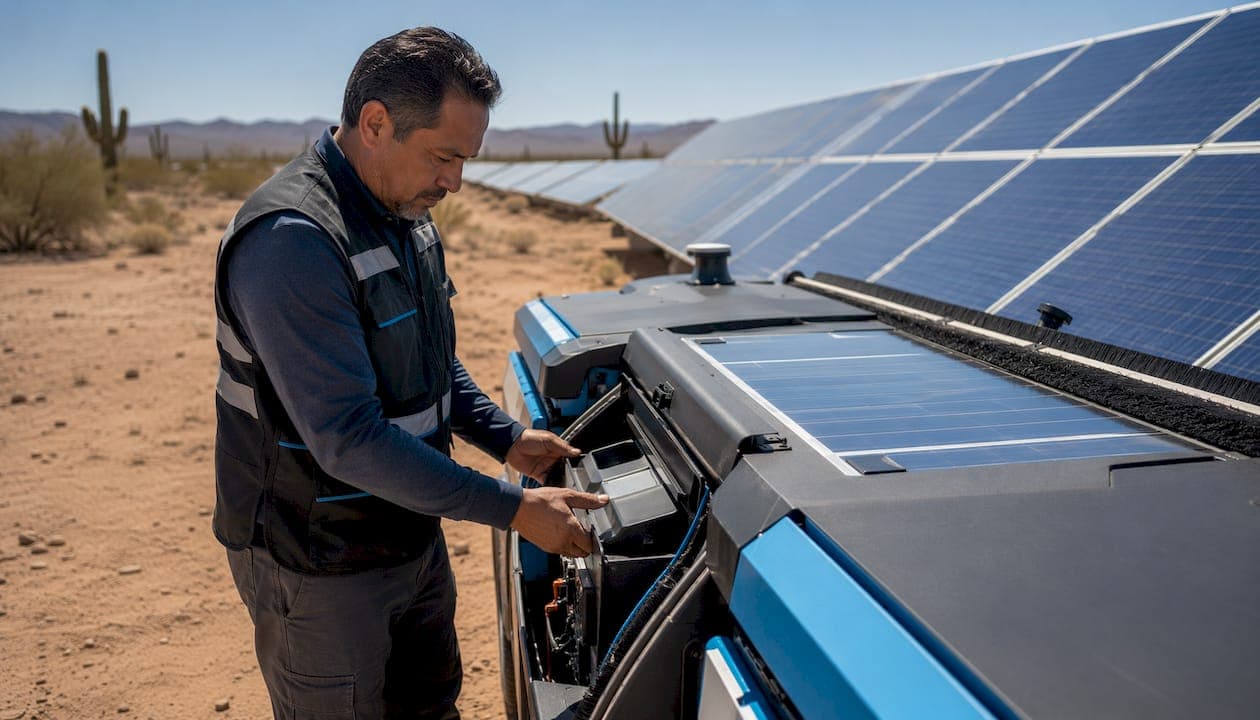
What are the best commercial solar cleaning equipment options right now?
The top performers for US solar farms in 2026 are the Sweeper-180 PRO for fully autonomous large-scale coverage, the solarROBOT Pro for high-throughput robotic cleaning, SPCF Tractor Brush Systems for heavy-duty mechanical work across utility fields, and the Streamline Maxi1000 for professional-grade water treatment. Manual kits from Tucker Solar Panel Cleaning Kits, ProDesign Solar Panel Cleaning Kit, and ProTool SS Max Cart Solar Brush Kit round out the field for smaller commercial and rooftop operations.
Dust and soiling are quietly stealing output from your arrays every day. Research confirms that particle buildup can cut photovoltaic efficiency by up to 80% in dry environments, and that robotic and electrostatic cleaning methods restore nearly all original panel efficiency. Choosing the wrong equipment for your farm's scale or environment doesn't just slow your crew down. It risks permanent coating damage, voided warranties, and production losses that compound over years.
| Product | Best For | Throughput | Automation Level | Water Treatment |
|---|---|---|---|---|
| SPCF Tractor Brush Systems | Utility-scale dusty outdoor fields | Up to 1,760 m²/hr | Semi-automated (tractor-mounted) | Compatible with external supply |
| solarROBOT Pro | Medium to large commercial farms | 500–1,800 m²/hr | Remote/autonomous | Low-pressure, ~0.5 l/m² |
| Sweeper-180 PRO | Large PV plants, high automation | Up to 12,000 m²/day | Fully autonomous (AI route planning) | Wet or dry capable |
| Streamline Maxi1000 | Professional water treatment ops | Continuous 120 L/hr output | Manual/semi-automated pairing | Dual 500L RO/DI tanks |
| Tucker Solar Panel Cleaning Kits | Small to medium commercial/rooftop | Manual rate | Manual/semi-automated | Pure water compatible |
| ProDesign Solar Panel Cleaning Kit | Small commercial, manual pros | Manual rate | Manual | Chemical-free |
| ProTool SS Max Cart Solar Brush Kit | Mobile mid-scale maintenance teams | Manual/cart-assisted | Manual | High-volume water feed |
How do the main commercial solar cleaning equipment categories compare?
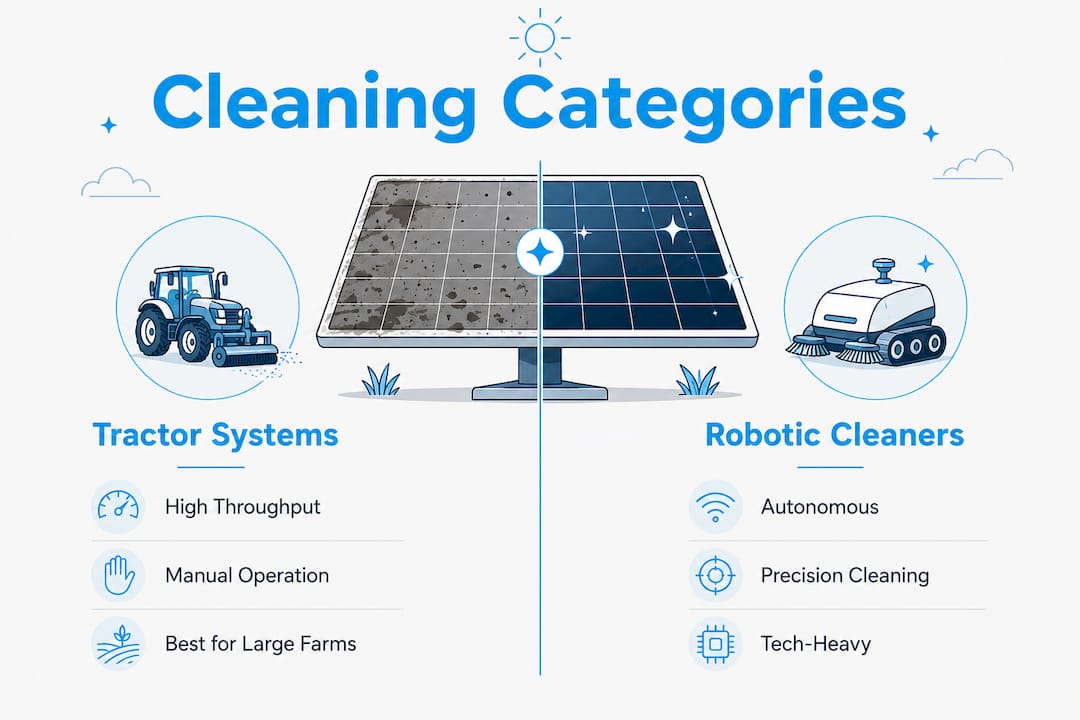
The three categories, tractor systems, robotic cleaners, and manual kits, each serve a distinct operational profile. Matching category to context is the first decision you need to make before evaluating individual products.
Tractor brush systems like the SPCF Tractor Brush Systems deliver the raw throughput that utility-scale ground-mount farms demand. The SPCF California model runs a Honda GX35 engine and scratch-proof nylon 66 brushes at 1,760 m²/hr, covering extensive fields without the per-unit cost of full robotics. The tradeoff is that a tractor requires terrain access and an operator on-site at all times.
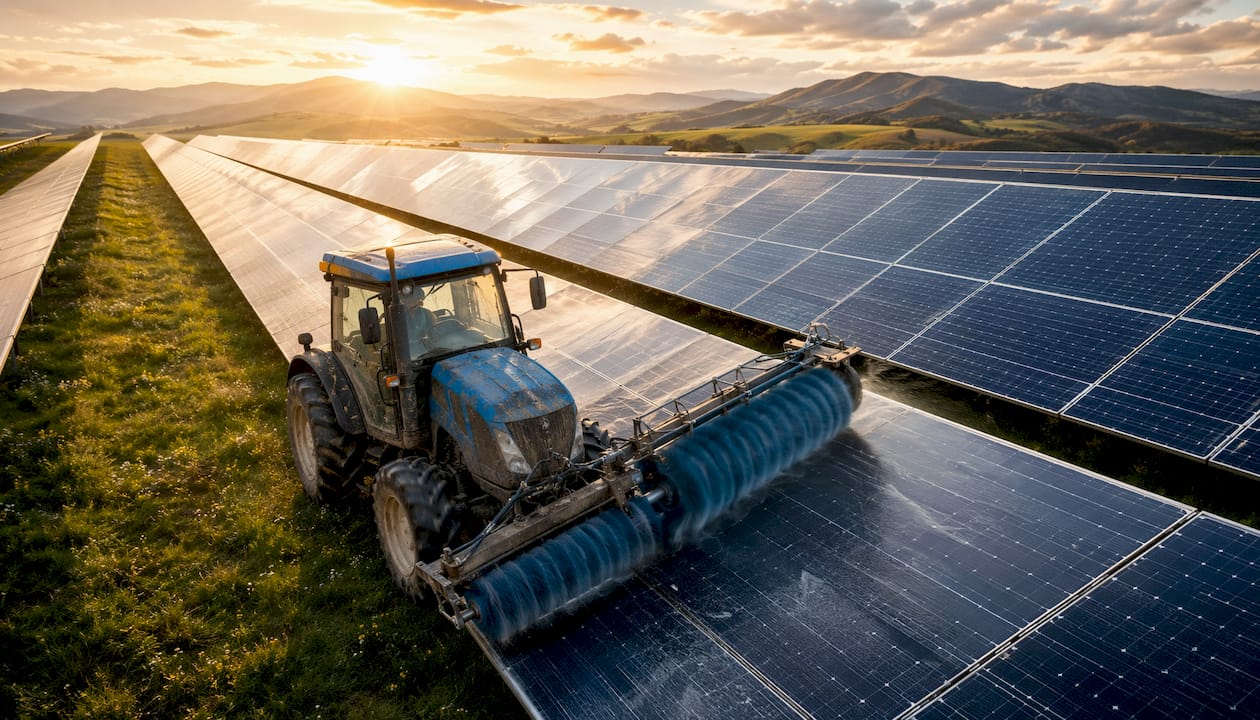
Robotic cleaners are where the category has moved fastest. The solarROBOT Pro cleans 500–1,100 m²/hr with standard dual brushes, and reaches up to 1,800 m²/hr in offset configuration, using roughly 0.5 liters of water per square meter. Battery runtime runs about 3 hours before a swap, with recharge under 2 hours. The Sweeper-180 PRO pushes further: its AI route planning delivers up to 12,000 m²/day with consistent coverage accuracy, automatic deviation correction, and a 100-meter remote control range. For farms where labor supervision is the binding constraint, the PRO version's autonomous operation is a genuine operational shift.
Manual and pole kits still have a clear place. Tucker Solar Panel Cleaning Kits, the ProDesign Solar Panel Cleaning Kit, and the ProTool SS Max Cart Solar Brush Kit all deliver chemical-free, soft-bristle cleaning suited to rooftop arrays and smaller ground-mount sites where robot deployment isn't cost-justified. Tucker's water-fed pole systems pair well with purified water sources and have a track record going back to 1957.
- Tractor systems: High throughput, terrain-dependent, operator-required, best for large open fields
- Robotic cleaners: Consistent coverage, scalable, higher upfront cost, best for medium to utility-scale farms
- Manual kits: Low entry cost, flexible deployment, labor-intensive, best for smaller commercial and rooftop work
The Streamline Maxi1000 sits in its own category as a water treatment system rather than a cleaning machine. Its dual 500L baffled tanks produce 120 liters per hour of RO/DI purified water, making it the backbone supply unit for any wet-cleaning operation, whether paired with robotic brushes or pole systems.
How do you choose the right solar cleaning system for your farm?
Scale is the first filter. Robotic cleaners suit utility-scale farms where automation and consistent coverage justify the investment; water-fed pole systems remain cost-effective for smaller arrays. A farm under 500 kWp can often be served efficiently with a cart-based kit like the ProTool SS Max Cart Solar Brush Kit. Above 2,000 m², the economics of a robot like the solarROBOT Pro or Sweeper-180 PRO start to work in your favor.
Key selection factors:
- Soiling type: Sandy desert dust cleans dry; cement-like agricultural residue or bird droppings need wet cleaning with filtered water for lubrication
- Water availability: Arid sites favor dry brushing robots that skip water entirely; sites with reliable supply can run full wet cycles
- Automation needs: If your crew covers multiple sites, autonomous route-planning robots reduce supervision hours per megawatt cleaned
- Budget: Manual kits start at a few hundred dollars; the solarROBOT Pro starts at EUR 34,000 in standard configuration; tractor systems sit in between
- Panel type: Thin-film panels require softer bristles and lower pressure than monocrystalline or polycrystalline modules
Pro Tip: Ask any equipment supplier specifically what brush bristle material and operating pressure their system uses. Nylon 66, synthetic nylon, and boar's hair are all panel-safe at low pressure. Any supplier who can't answer that question clearly is a red flag.
Red flags to watch for: vague warranty terms on brush replacement, no documentation of water pressure specs, and any claim that high-pressure washing is safe for standard PV modules. High-pressure washers risk seal damage and can void panel warranties.
What technical details actually determine cleaning performance and panel safety?
Water quality is the most undervalued factor in commercial solar maintenance. Hard tap water leaves mineral deposits that etch anti-reflective coatings permanently over time. RO/DI systems prevent that mineral residue, protecting glass integrity across a panel's 25-year lifespan. The Streamline Maxi1000's dual-tank RO/DI setup is the standard reference for professional wet-cleaning operations.
Brush selection matters almost as much. Soft synthetic bristles, nylon 66, or boar's hair at low rotational pressure clean effectively without scratching. The solarROBOT Pro runs at ±400 RPM with its longest bristles, using minimal water and no chemical additives. SPCF Tractor Brush Systems use 200mm diameter nylon 66 brushes across a 210cm cleaning length, purpose-built for ground-mount field conditions.
Dry versus wet cleaning is a site-specific call, not a preference. Autonomous dry brushing robots dominate arid sites where water is scarce; wet cleaning is reserved for heavy residue that needs lubrication to avoid scratching the glass. The Sweeper-180 PRO handles both modes, which is part of why it suits diverse utility-scale environments.
Pro Tip: Track your cleaning frequency against production data, not just a calendar schedule. If output drops more than 5% between cleanings, your interval is too long for your site's soiling rate. Knowing when to clean your panels is as important as knowing how.
| Equipment | Brush Type | Water Use | Dry Clean Option | Maintenance Interval |
|---|---|---|---|---|
| SPCF Tractor Brush Systems | Nylon 66, 200mm | Moderate | No | Seasonal brush inspection |
| solarROBOT Pro | Soft synthetic, ±400 RPM | ~0.5 l/m² | Yes | Battery and brush check per use |
| Sweeper-180 PRO | Soft brush + squeegee | Low to moderate | Yes | Periodic brush and sensor check |
| Streamline Maxi1000 | N/A (water system) | 120 L/hr output | N/A | Filter replacement per cycle |
| Tucker/ProDesign/ProTool kits | Soft bristle, manual | Variable | No | Brush replacement as needed |
Solaralchemist brings professional-grade solar cleaning to Wisconsin commercial farms
If you'd rather hand off the equipment decisions entirely and know the job is done right, Solaralchemist offers a different route. Based in Madison, Wisconsin, Solaralchemist brings professional-grade deionized water systems and manufacturer-approved cleaning methods to commercial solar arrays across the region, protecting your warranty and your production numbers at the same time.
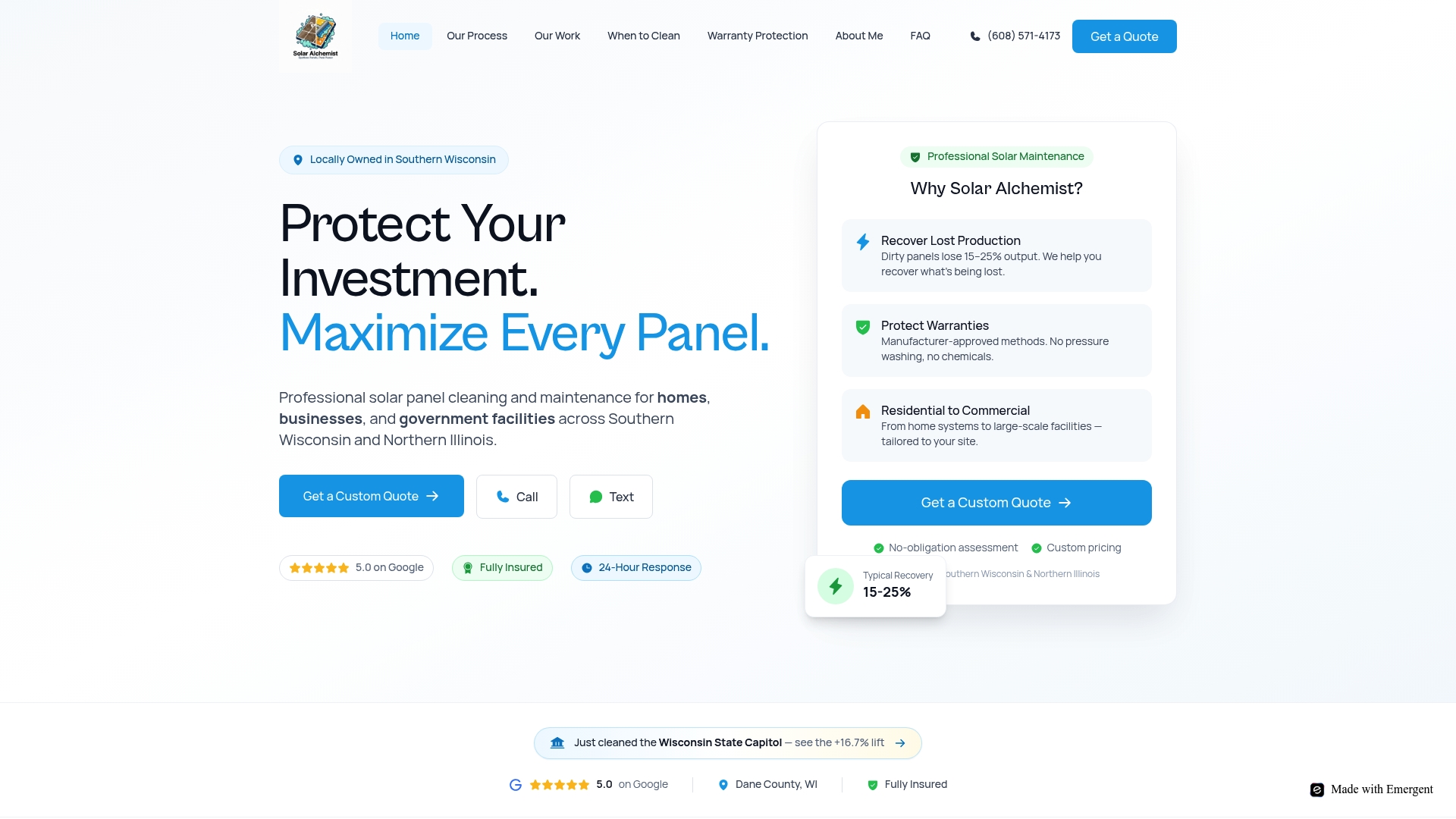
Every service visit is documented, every panel cleaned to spec, and every water system calibrated to deliver spot-free results without chemicals. Whether your array is on a rooftop or a ground-mount field, Solaralchemist's team knows when your panels need cleaning and how to restore peak output safely. For commercial operators in Wisconsin who want measured results without managing equipment themselves, Solaralchemist is the straightforward answer.
Key Takeaways
The most effective commercial solar cleaning equipment matches farm scale, soiling type, and water availability before any other factor.
| Point | Details |
|---|---|
| Scale drives the decision | Robotic systems suit farms above 2,000 m²; manual kits remain cost-effective for smaller arrays. |
| Water treatment protects panels | RO/DI systems like the Streamline Maxi1000 prevent mineral damage that permanently etches anti-reflective coatings. |
| Dry vs. wet cleaning is site-specific | Arid sites favor dry brushing robots; heavy residue requires wet cleaning with filtered water for lubrication. |
| Throughput varies widely | The Sweeper-180 PRO cleans up to 12,000 m²/day autonomously; the solarROBOT Pro cleans between 500 and 1,100 m²/hr with standard brushes, and can reach up to 1,800 m²/hr in offset mode. |
| Solaralchemist handles it for you | For Wisconsin commercial operators, Solaralchemist provides documented, warranty-safe professional cleaning with deionized water systems. |