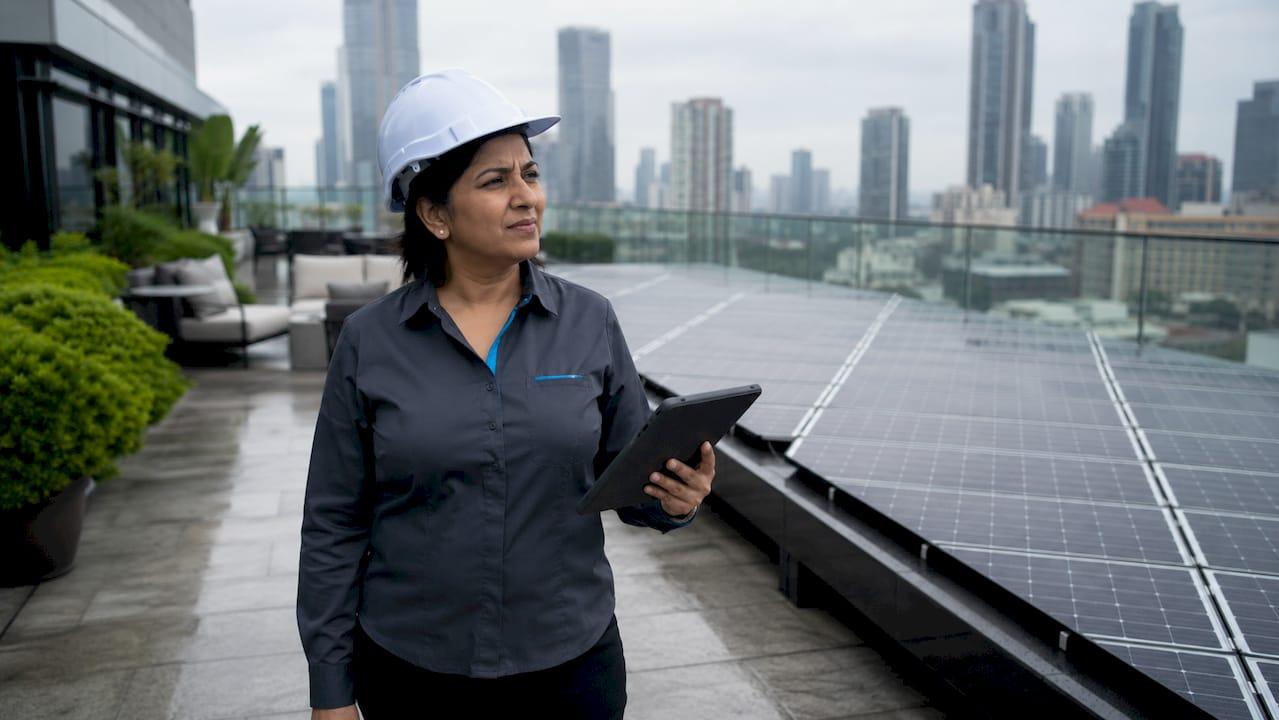
Solar panel maintenance is a core facility management function, not an optional line item that gets cut when budgets tighten. Facility managers who treat cleaning solar installations as a reactive task consistently underperform on energy output targets and accelerate panel degradation. Understanding how solar cleaning fits facility management means recognizing it as a scheduled, documented, and data-supported operation that belongs alongside HVAC servicing, roof inspections, and electrical testing. This guide gives you the framework to integrate solar cleaning into your existing programs, protect warranties, and recover measurable energy revenue.
How solar cleaning fits facility management as a core function
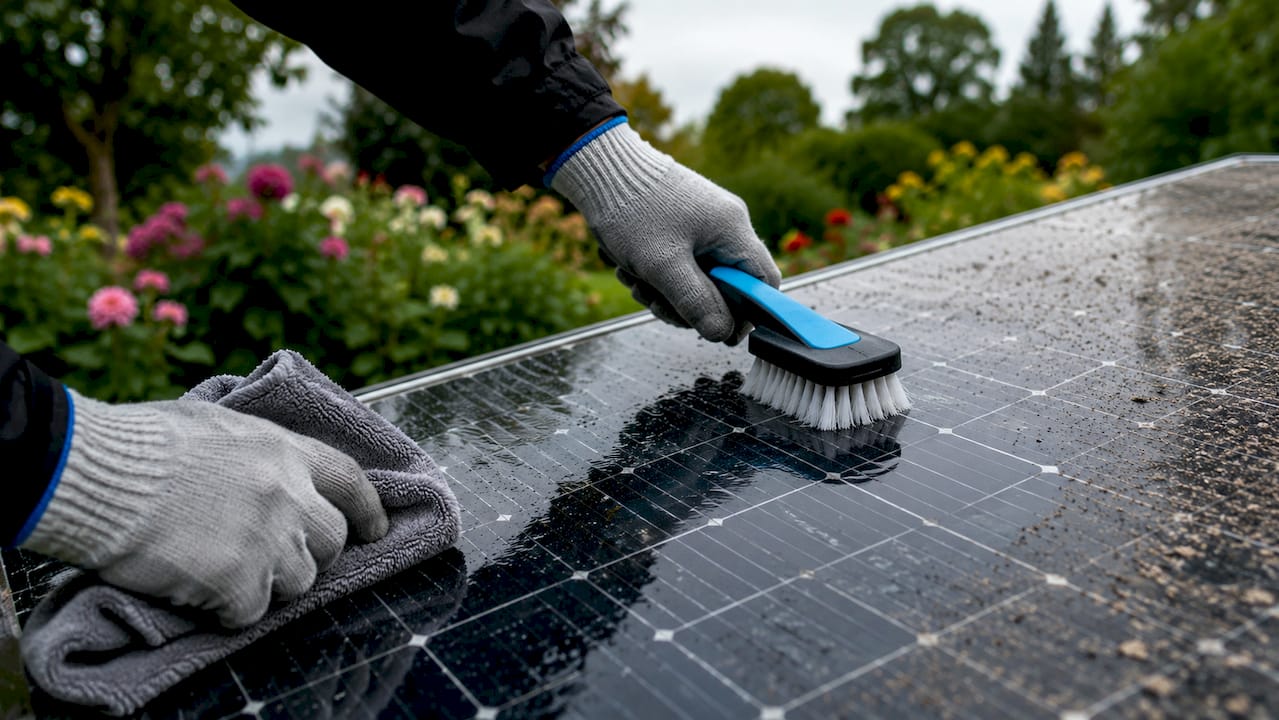
Soiling is the accumulation of dust, pollen, bird droppings, and industrial particulates on panel surfaces. It is the leading cause of preventable solar energy loss in commercial facilities. The IEA-PVPS reports that soiling causes 4–7% annual energy loss globally, with losses reaching 15–25% in dust-heavy or coastal regions. For a 500 kW commercial array generating $60,000 annually, a 7% loss equals $4,200 in unrecovered revenue every year.
The financial case is straightforward. What facility managers often miss is the safety dimension. Bird droppings concentrate heat beneath them, creating electrical hotspots that damage panels and risk fires. Treating solar cleaning as a safety and asset protection task, not just an efficiency measure, changes how it gets prioritized in maintenance planning.
Soiling loss by environment
| Environment | Typical Annual Energy Loss |
|---|---|
| Temperate / Low Dust | 4–7% |
| Coastal / High Humidity | 8–15% |
| Desert / High Dust | 15–25% |
| Urban / Industrial | 6–12% |
Pro Tip: Install a reference cell or use inverter telemetry to establish a clean-panel baseline. Any sustained deviation of 3% or more from that baseline is a reliable trigger for a cleaning inspection, regardless of the calendar.
How do you integrate solar cleaning into facility maintenance budgets?
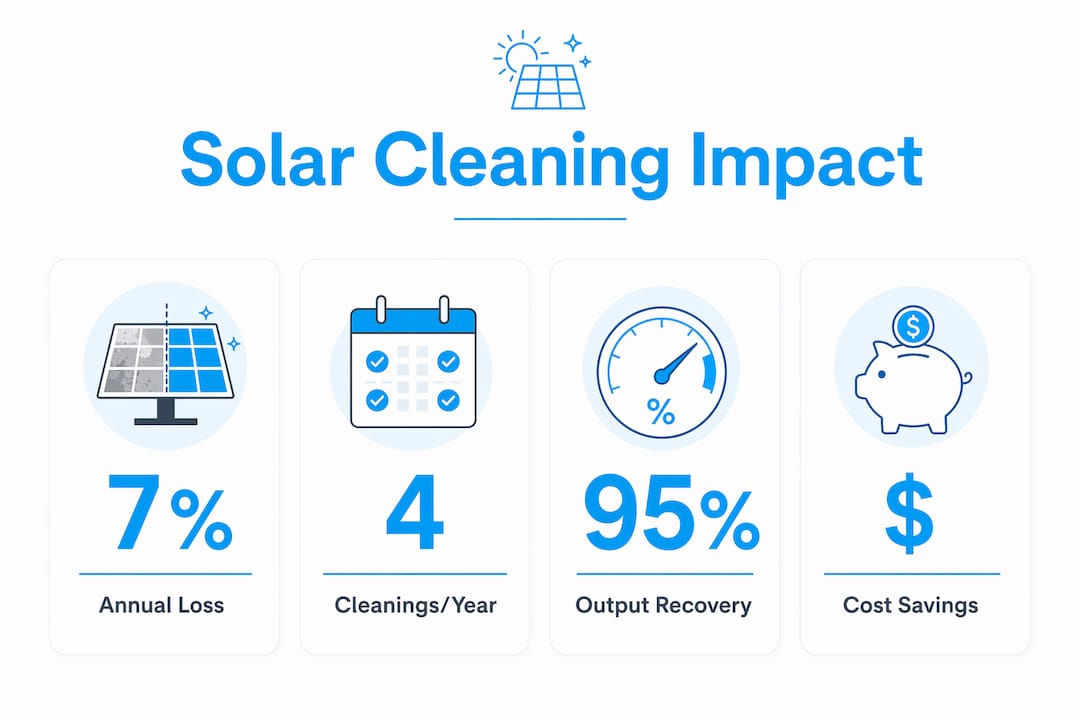
Solar cleaning belongs in your operating expenditure budget as a recurring, planned cost. The industry standard for commercial solar operations and maintenance programs calls for cleaning 2–4 times per year, paired with quarterly visual inspections, targeting 95–98% system availability. Facilities that fall below that availability threshold often face contractual penalties under power purchase agreements or energy performance contracts.
Budgeting for solar cleaning is simpler when you frame it against the cost of lost generation. If a single cleaning event costs $800 and recovers 5% output on a system generating $5,000 per month, the payback is measured in weeks, not years. The solar cleaning benefits compound when you factor in avoided panel replacement costs and preserved warranty coverage.
Hiring specialized commercial cleaning vendors also transfers financial and physical risk off your books. Professional cleaning services assume 100% liability for rooftop operations through general liability and workers' compensation insurance. That risk transfer alone justifies the cost for most risk-conscious operations directors.
Cleaning frequency vs. ROI vs. risk
| Cleaning Frequency | Estimated Output Recovery | Warranty Risk | Liability Exposure |
|---|---|---|---|
| Once per year | Low (2–4%) | Moderate | High (DIY or uninsured) |
| Twice per year | Moderate (4–6%) | Low with documentation | Transferred (insured vendor) |
| 3–4 times per year | High (6–10%) | Minimal with reporting | Fully transferred |
| As-needed only | Unpredictable | High | Variable |
Pro Tip: Align solar cleaning visits with other scheduled rooftop maintenance, such as HVAC filter changes or roof inspections. Coordinating access reduces labor costs and minimizes operational disruption across your facility.
What standards protect panel warranties during professional cleaning?
Manufacturer warranty compliance is non-negotiable for commercial solar assets. Purified water and approved equipment are mandatory under most manufacturer specifications. Tap water leaves mineral deposits that accelerate soiling and can etch glass surfaces over time. Deionized water systems, like those used by Solaralchemist, eliminate that risk entirely.
The chemical selection issue is more serious than most procurement teams realize. Fraunhofer CSP research found that unapproved cleaning agents can degrade anti-reflective coatings and cause up to 5.6% permanent power loss per module. That degradation is irreversible. A single improper cleaning event can permanently reduce your array's output more than a full year of soiling would.
Professional cleaning vendors must provide the following to protect your assets:
- Pre-cleaning inspection reports that document existing panel condition, microcracks, and soiling patterns before any work begins
- Post-cleaning reports that confirm water purity levels, cleaning method used, and any faults identified during service
- Proof of insurance covering general liability and workers' compensation for all rooftop personnel
- Manufacturer-approved cleaning agents with documentation confirming compatibility with your panel brand's warranty terms
- Thermal imaging results when hotspots are suspected, to identify panels requiring repair before they cause broader system damage
Pre-cleaning inspections serve a second function beyond quality control. They create a documented record of panel condition that protects your warranty claims. If a panel fails after a cleaning event and the pre-inspection shows it was already cracked, your vendor, not your facility, bears responsibility.
Pro Tip: Request that your cleaning vendor provide water purity test results (measured in parts per million) with every service report. Deionized water should test below 10 ppm. This single data point confirms proper equipment use and protects you in any warranty dispute.
Avoiding common cleaning mistakes is as important as following correct procedures. DIY cleaning with pressure washers, abrasive brushes, or household detergents voids most manufacturer warranties within a single service event.
How does technology optimize solar cleaning schedules?
Data-driven scheduling is the difference between over-servicing panels that are still clean and under-servicing arrays that have lost significant output. The most effective facility management strategies use inverter telemetry and performance monitoring to detect cleaning needs in real time rather than relying on fixed calendar intervals alone.
Here is a practical framework for technology-integrated solar maintenance:
- Establish a performance baseline. Record output data for each string or inverter zone immediately after a confirmed clean. This baseline is your reference point for detecting soiling-related degradation.
- Set automated alerts. Configure your monitoring platform to flag any string showing sustained underperformance of 3% or more against the baseline. This triggers a cleaning inspection, not an automatic cleaning event.
- Integrate solar assets into your CMMS. Avoiding data silos requires managing solar panels within the same computerized maintenance management system you use for HVAC, electrical, and structural assets. Consolidated platforms allow coordinated scheduling and prevent solar maintenance from falling through the cracks between departments.
- Automate work order generation. When a performance alert fires, your CMMS should generate a work order automatically and route it to your cleaning vendor or internal maintenance team. Manual handoffs create delays that cost generation revenue.
- Schedule around occupancy. Cleaning during low-occupancy periods, such as early mornings or weekends, reduces disruption and allows rooftop access without affecting building operations.
- Use thermal imaging for verification. Drone-mounted or handheld thermal cameras identify hotspots invisible to the naked eye. Post-cleaning thermal scans confirm that problem areas have been resolved and that no new faults were introduced during service.
Data-driven cleaning balances recovered energy revenue against operational expenses. Facilities that clean on a fixed schedule regardless of actual soiling levels consistently overspend. Those that use performance data to trigger cleaning events recover more revenue per dollar spent on maintenance.
Solaralchemist incorporates performance data review into its service process for commercial clients, allowing cleaning schedules to reflect actual site conditions rather than generic industry averages. For large arrays, this approach can reduce unnecessary cleaning visits while maintaining output targets. You can also review why large solar arrays need cleaning schedules to understand how scheduling complexity scales with array size.
Key takeaways
Solar cleaning integrated into facility management as a planned, data-driven maintenance function delivers measurable energy recovery, warranty protection, and risk transfer that reactive or DIY approaches cannot match.
| Point | Details |
|---|---|
| Soiling causes real revenue loss | Global soiling losses average 4–7% annually, reaching 25% in high-dust environments. |
| Clean 2–4 times per year | Industry O&M standards target 95–98% system availability with quarterly inspections. |
| Wrong cleaners cause permanent damage | Unapproved agents degrade anti-reflective coatings, causing up to 5.6% irreversible power loss. |
| CMMS integration prevents gaps | Managing solar assets within your core CMMS eliminates data silos and automates work orders. |
| Professional vendors transfer risk | Insured commercial cleaners assume full liability for rooftop operations, protecting your facility. |
Solar cleaning is an asset management decision, not a janitorial one
I have reviewed facility maintenance programs where solar panels were assigned to the same team handling window washing and parking lot sweeping. The results were predictable: wrong cleaning agents, no pre-inspection documentation, and warranty claims denied because the cleaning method could not be verified. The panels were clean to the eye and degraded in output.
The shift in thinking that actually produces results is treating solar arrays as capital assets with a maintenance protocol, not as surfaces that need periodic washing. Every capital asset in your facility has a documented service history, approved service providers, and performance benchmarks. Solar panels deserve the same treatment.
The vendors worth hiring are the ones who show up with water purity meters, pre-inspection checklists, and post-service reports you can file with your panel manufacturer. If a vendor cannot tell you the ppm reading of their rinse water, they are not protecting your warranty. That is not a minor gap in service quality. It is a liability you are absorbing without knowing it.
Soiling mitigation is also worth addressing at the design stage for facilities planning new installations. The IEA-PVPS guidance on soiling mitigation recommends designing arrays for maintenance access before installation, not retrofitting access after the fact. Panel tilt angles, row spacing, and roof access points all affect how efficiently cleaning crews can work and how quickly soiling accumulates.
My advice to operations directors: put solar cleaning on the same approval and documentation track as your HVAC and electrical maintenance contracts. Require proof of insurance, approved cleaning agents, and written service reports as contract terms, not optional add-ons.
— Marquis
Keep your solar array performing at full capacity
Solaralchemist serves commercial facilities across Madison, Wisconsin and the surrounding region with professional-grade solar panel cleaning built for operations directors who need documented results, not just clean glass.
Every Solaralchemist service includes pre-cleaning inspection reports, deionized water cleaning verified by ppm testing, and post-service documentation your team can file directly with panel manufacturers. Full general liability and workers' compensation insurance coverage transfers rooftop risk off your facility's books. Scheduling is coordinated around your building's occupancy calendar to minimize disruption. If you are ready to see when your panels need cleaning and build a maintenance schedule that holds up under warranty scrutiny, Solaralchemist is the right partner for your facility.
FAQ
What is the recommended solar cleaning frequency for commercial facilities?
Commercial solar O&M programs call for cleaning 2–4 times per year with quarterly visual inspections. Sites in dusty, coastal, or high-pollen environments typically require the higher end of that range.
Can improper cleaning void a solar panel warranty?
Yes. Manufacturers require purified water and approved cleaning agents. Using unapproved chemicals can permanently degrade anti-reflective coatings and void warranty coverage in a single service event.
How does solar cleaning fit into a CMMS?
Solar panels should be entered as capital assets in your CMMS with scheduled maintenance tasks, performance thresholds, and automated work order triggers. Integrating solar into CMMS prevents data silos and keeps solar maintenance on the same operational track as all other facility assets.
What does a professional solar cleaning report include?
A complete service report covers pre-cleaning panel condition, water purity readings in parts per million, cleaning agents used, any faults identified, and post-cleaning output data. This documentation is required for warranty compliance and baseline panel health tracking.
How much energy loss does soiling actually cause?
Soiling causes 4–7% annual energy loss on average globally. In high-dust or desert environments, that figure rises to 25%, making regular cleaning one of the highest-return maintenance investments available to facility managers.