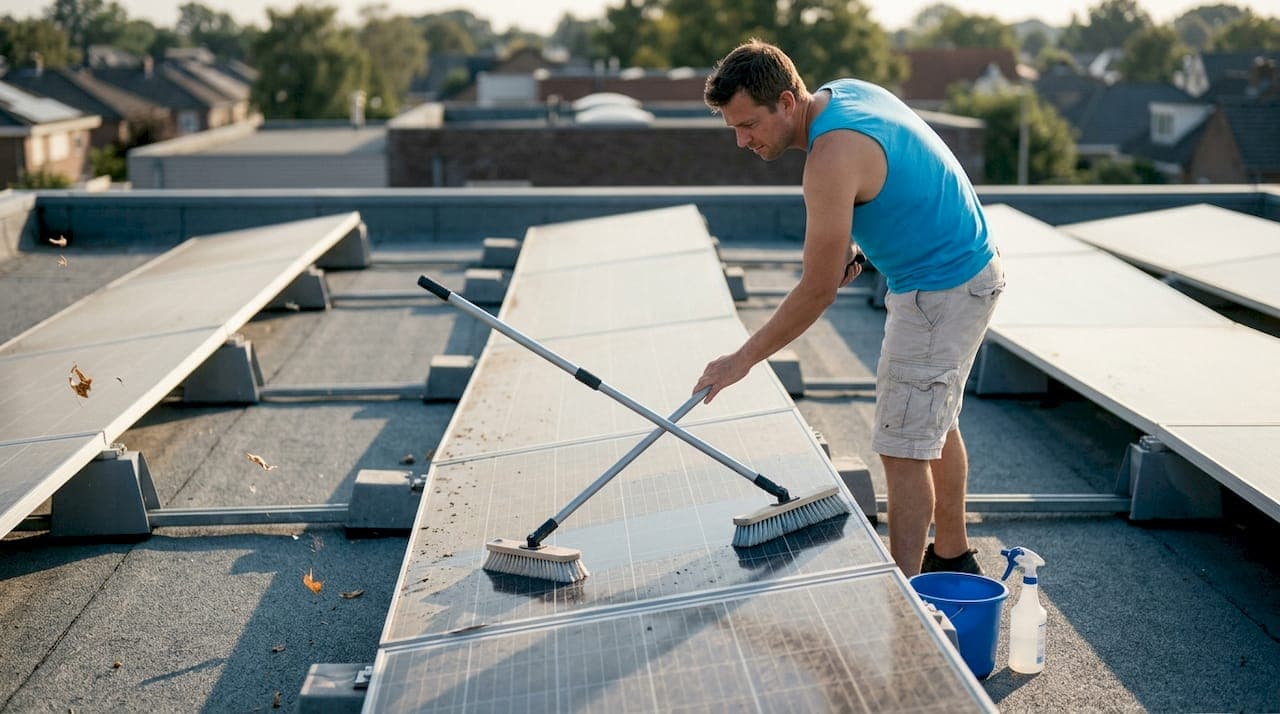
Dirt is quietly stealing your solar output right now. Studies show that routine cleaning can recover 5% to 25% of your system's energy production, yet the number one reason homeowners skip it is fear of scratching the glass. That fear is legitimate. A single abrasive pass with the wrong brush can permanently damage the anti-reflective coating your panels depend on. This guide walks you through cleaning solar panels without scratching them, from selecting the right tools to following a step-by-step process that protects your investment and keeps your warranty intact.
Table of Contents
- Key takeaways
- Best tools for cleaning solar panels without scratching
- Step-by-step process for scratch-free panel cleaning
- Common mistakes that cause scratches and damage
- How often to clean your panels
- My honest take on solar panel cleaning
- Professional cleaning when DIY is not enough
- FAQ
Key takeaways
| Point | Details |
|---|---|
| Dry brush first, always | Removing loose grit before adding water prevents an abrasive slurry that scratches the glass coating. |
| Cool panels, better results | Clean early morning or evening to avoid thermal shock and mineral spotting from rapid evaporation. |
| Mild soap or pure water only | In 90% of cases, pH-neutral soap or deionized water removes debris without leaving residue or damage. |
| Pressure washers void warranties | High-pressure water can permanently damage anti-reflective coatings and trigger manufacturer warranty voids. |
| Monitor output to time cleanings | Production drops tracked in a monitoring app tell you more than a visual check ever will. |
Best tools for cleaning solar panels without scratching
Getting the tools right is half the battle. The wrong choice at the hardware store costs you more than money. It costs you efficiency and potentially your warranty.
What to reach for
Soft nylon bristle brushes with telescoping handles let you cover panel surfaces without pressing too hard. They conform to the glass without dragging grit across it. Pair that with a microfiber cloth for final wiping and a rubber squeegee for drying, and you have everything you need for a non-scratch solar panel wash.
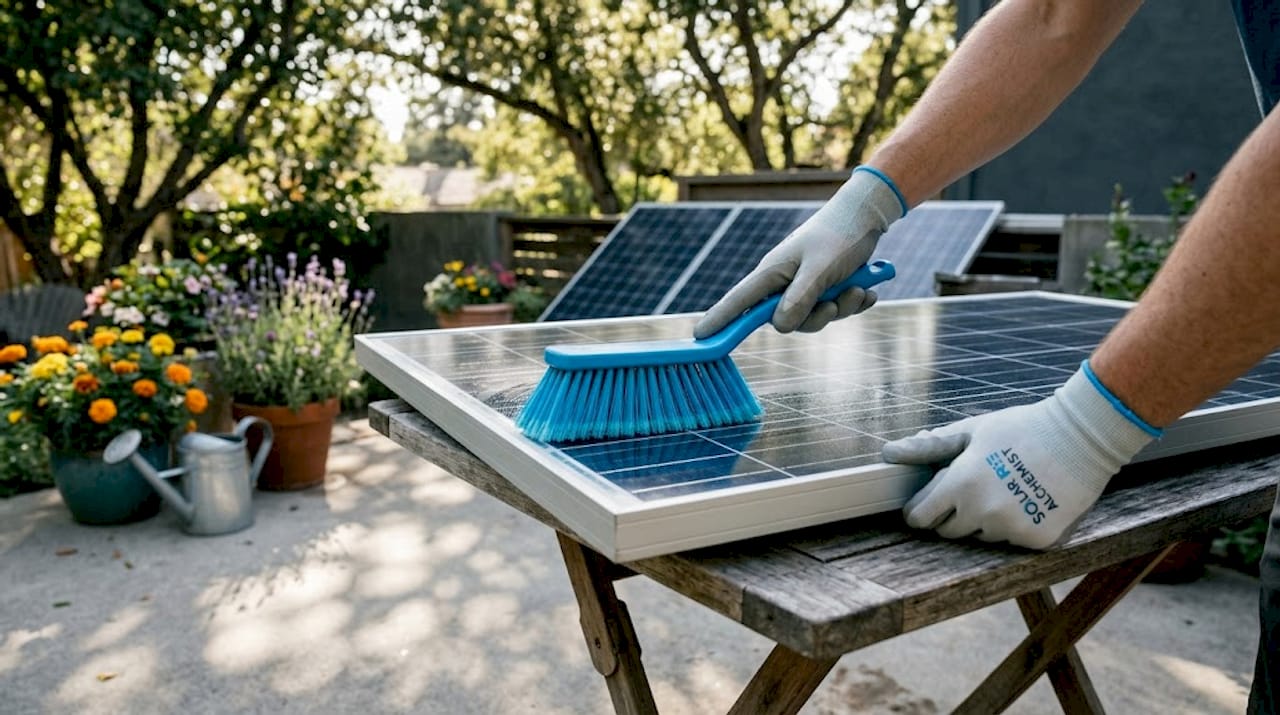
For cleaning agents, pure or deionized water handles most jobs without any soap at all. When you do need a cleaning agent, reach for a mild, pH-neutral, ammonia-free dish soap. A few drops in a bucket is plenty. Nothing stronger. Solaralchemist uses professional-grade deionized water systems for exactly this reason. Tap water with high mineral content leaves spots that bake onto the glass in summer heat.
Pro Tip: Before you buy a brush, run your thumb across the bristles. If they feel rough enough to exfoliate skin, they will scratch glass. You want bristles that feel like a clean paintbrush.
Safe vs. unsafe tools at a glance
| Tool or product | Safe to use? | Why |
|---|---|---|
| Soft nylon bristle brush | Yes | Gentle on glass, no abrasion |
| Microfiber cloth | Yes | Non-scratch, absorbs water well |
| Rubber squeegee | Yes | Removes water without leaving mineral deposits |
| pH-neutral dish soap | Yes | Cleans without residue or coating damage |
| Deionized or purified water | Yes | No minerals to leave hard water spots |
| Pressure washer | No | Damages anti-reflective coatings and can void warranty |
| Steel wool or abrasive sponge | No | Scratches glass permanently |
| Ammonia-based cleaners | No | Degrades the anti-reflective coating over time |
| Hard-bristle brush | No | Creates micro-scratches that reduce light transmission |
| Bleach or harsh chemicals | No | Corrodes frames and degrades seals |
The table above covers the most common mistakes. If a product is not on the safe list, assume it is not safe. The cleaning practices that cause the most damage are usually the ones people believe are "thorough."
Step-by-step process for scratch-free panel cleaning
Knowing the tools is not enough. Sequence matters just as much. Follow these steps in order and you protect both the glass and the electrical components underneath.
-
Choose the right time. Clean in the early morning or late evening. Avoid cleaning in direct sun when panels are hot. Cold water hitting a hot panel creates thermal stress that can cause microscopic cracks in the glass and seal damage around the frame.
-
Inspect from the ground first. Use binoculars or a phone camera with zoom. Note where the heavy soiling is. Bird droppings and pollen patches need extra attention, but start with a full dry pass before focusing on spots.
-
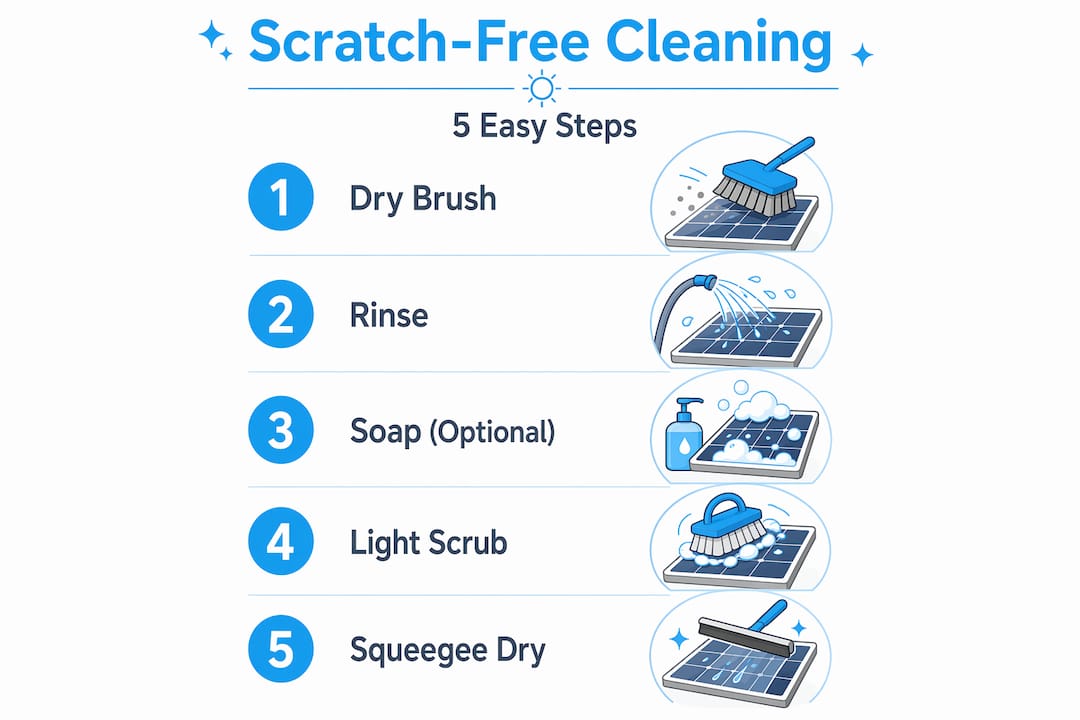
Dry brush the entire surface. Take your soft nylon brush and sweep loose dust, pollen, and debris off the panel before any water touches it. This step is non-negotiable. Dry brushing removes abrasive grit that would form a sandpaper-like slurry the moment water is introduced. Skipping it is the single most common cause of micro-scratches.
-
Mix your cleaning solution. A bucket of lukewarm water with two to three drops of pH-neutral dish soap is your standard solution. If you have access to deionized or purified water, use it as-is without soap.
-
Wet the panel from the top down. Pour or gently spray water from the top edge and let gravity do the work. Do not spray directly at the junction boxes or electrical connectors on the back of the panel.
-
Wash with soft circular strokes. Use your nylon brush or microfiber cloth in overlapping, gentle circular motions. Keep pressure light. You are not scrubbing tile grout. You are lifting a surface film.
-
Rinse thoroughly from top to bottom. A slow, steady pour from a hose with no pressure nozzle is ideal. You want water to sheet off the surface, not hammer it.
-
Squeegee or wipe dry. Use a rubber squeegee or microfiber cloth to remove standing water immediately. Squeegee drying reduces mineral spotting significantly, especially when tap water TDS (total dissolved solids) exceeds 50 parts per million. Standing water evaporates and leaves calcium deposits that become harder to remove with every cycle.
-
Handle stubborn spots with a soak, not force. Lay a wet microfiber cloth over a bird dropping or hardened debris for two to three minutes before gently lifting. Never scrub dry spots. The grit bonded to the surface will scratch the glass if you do.
Pro Tip: If your roof requires ladder access, use a telescoping brush and squeegee from the ground whenever possible. Roof falls are a real risk, and most residential panels can be fully reached from the gutterline with a quality extension handle.
Facility managers running commercial arrays should note that these same steps apply at scale. The biggest operational change is working section by section across the array rather than panel by panel, and using longer extension poles rated for the job.
Common mistakes that cause scratches and damage
Understanding what not to do saves panels, saves warranties, and sometimes saves lives. These are the mistakes Solaralchemist sees most often in the field.
Things to avoid at all costs:
- Using a pressure washer. Even on a low setting, the anti-reflective coating that boosts efficiency by up to 2% can be stripped or damaged. High pressure also forces water into frame seals and junction boxes.
- Cleaning during midday heat. The thermal shock risk is real. Beyond cracking, rapid evaporation during cleaning leaves concentrated mineral deposits faster than you can rinse them off.
- Dry scrubbing a stuck spot. If something is bonded to the glass, soaking is the only safe option. Pressing harder is how scratches happen.
- Using any cleaner containing ammonia, bleach, or alcohol. These chemicals attack both the glass coating and the silicone seals around the frame.
- Walking on panels. This one sounds obvious but happens more than it should during DIY cleaning on low-pitched roofs. Panels are not rated for foot traffic and the cells beneath the glass can crack under localized weight.
- Ignoring the warranty documentation. Improper cleaning can void your manufacturer warranty. If you cannot document that you used approved methods, you may lose coverage for defects that appear later.
Things worth doing every time:
- Check the weather before you start. Wind picks up fresh grit, and rain right after cleaning can undo your work quickly.
- Start at the highest panel and work downward so dirty runoff does not flow over panels you have already cleaned.
- Rinse your brush between panels if cleaning in dusty conditions. Grit accumulates in bristles and transfers panel to panel.
- Review your panel maintenance practices periodically. The glass surface, seals, and frame all age differently, and what works on a new panel may need adjustment on a system that is five or more years old.
How often to clean your panels
Cleaning frequency is not one-size-fits-all. Environment determines the schedule more than anything else.
Most residential systems need cleaning once or twice per year. That baseline holds for temperate climates with regular rainfall and moderate tree cover, which describes most of Wisconsin. Areas with heavy pollen, construction dust, bird activity, or coastal salt spray need attention more often, sometimes every two to three months.
Rain helps but it does not fully clean. Rain partially removes surface dust but does nothing for pollen films, bird droppings, or mineral deposits left behind when hard water evaporates. Relying on rain alone leaves panels operating below their potential most of the year.
The best trigger for cleaning is not the calendar. It is your monitoring data. Production drops tracked via apps give you an objective view of what soiling is actually costing you in kilowatt-hours. When output drops 5% or more below your system's historical average on comparable weather days, that is your cue to clean.
| Environment type | Recommended cleaning frequency |
|---|---|
| Temperate with regular rain (e.g., Wisconsin) | 1 to 2 times per year |
| Suburban with heavy tree cover or pollen | 2 to 3 times per year |
| Coastal or high-salt-air exposure | Every 2 to 3 months |
| Desert or high-dust agricultural area | Every 1 to 2 months |
| Urban with bird activity and pollution | 2 to 4 times per year |
For commercial facility managers, the cost-benefit calculation shifts at scale. A 1% output gain across a 200-panel array adds up fast. Professional cleaning services with deionized water systems pay for themselves in recovered production within a single billing cycle in most cases.
My honest take on solar panel cleaning
I have seen panels cleaned with deck brushes, garden hose nozzles set to "jet," and diluted bleach solutions. Every one of those owners believed they were doing the right thing. None of them knew they were the biggest threat to their own investment.
What I have learned working with solar systems is that the industry undersells the dry brushing step. People think cleaning means water and soap. It actually starts with a dry brush pass that most homeowners skip entirely because it feels redundant. That step is where the real protection happens.
I also think the fear of cleaning is often misdirected. Homeowners worry about using the wrong soap. They should be worrying about cleaning at noon in July when their panels are 140 degrees. Thermal shock does not look like anything obvious. You will not see a crack. You will just notice your system underperforming for years and never know why.
My honest recommendation: use your monitoring app as your guide, not the season. When output drops, clean. When output is steady, wait. And when the job feels complicated because of roof pitch, panel count, or system age, call a professional. The cost of one professional cleaning is nothing compared to the cost of a voided warranty or a scratched anti-reflective coating that cannot be repaired.
— Marquis
Professional cleaning when DIY is not enough

Some systems are too large, too high, or too valuable to risk on a first DIY attempt. Solaralchemist serves homeowners and facility managers across Madison and surrounding Wisconsin communities with professional-grade deionized water cleaning that leaves zero residue and zero scratches. If you are not sure whether your panels need attention, the 8 signs to clean page is the fastest way to get an honest answer before you schedule anything. For homeowners in the Sun Prairie area, the Sun Prairie cleaning service page covers local scheduling and what to expect from a professional visit. Combining your own routine maintenance with an annual professional service is the most reliable way to protect both output and warranty coverage long term.
FAQ
What is the safest way to clean solar panels without scratching?
Use a soft nylon brush for dry brushing first, then wash with pH-neutral soap or deionized water using light, circular strokes. Finish with a rubber squeegee to prevent mineral spotting.
Can I use a pressure washer on solar panels?
No. Pressure washers damage the anti-reflective coating and can force water into electrical seals, permanently reducing efficiency and potentially voiding your manufacturer warranty.
How often should solar panels be cleaned?
Most residential systems need cleaning one to two times per year, though coastal, desert, and high-pollen environments may require cleaning every one to three months depending on soiling levels.
Does rain clean solar panels well enough?
Rain removes loose dust but leaves behind pollen films, bird droppings, and hard water mineral deposits. It is not a substitute for manual cleaning and relying on it alone costs measurable output over time.
Why should I avoid cleaning solar panels in the middle of the day?
Panels can reach temperatures well above 100°F in direct sun. Cold water on a hot panel causes thermal shock, which creates microscopic cracks in the glass and can damage the seals around the panel frame.