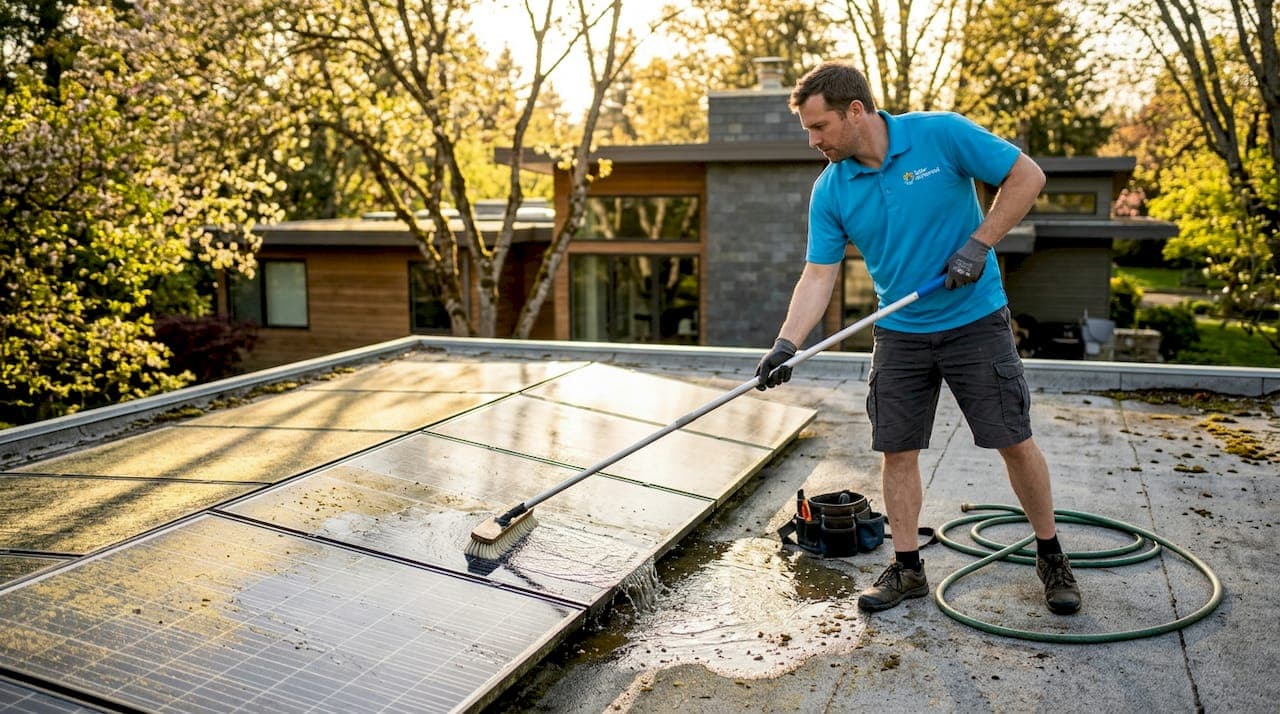
Spring should be your solar system's best season. Longer days, stronger sun angles, and mild temperatures check every box for high production. Yet many homeowners and property managers watch their monitoring apps in frustration as output stays stubbornly flat or even drops compared to winter. Understanding how solar panel cleaning restores spring output is the first step toward fixing a problem that costs real money every week it goes unaddressed. The culprit is almost never a broken system. It is pollen, a sticky, persistent film that rain simply cannot wash away.
Table of Contents
- Key takeaways
- What causes lower solar energy output in spring
- How cleaning restores spring-time energy production
- Effective spring cleaning techniques for homeowners
- Common misconceptions about spring panel cleaning
- Maximizing solar efficiency through seasonal maintenance
- My honest take on spring solar maintenance
- Professional cleaning when spring demands more than a rinse
- FAQ
Key takeaways
| Point | Details |
|---|---|
| Pollen is not rain-soluble | Sticky pollen residue clings to panels after rain, cutting output by 20% or more in heavy-pollen areas. |
| Cleaning has a dual benefit | Removing soiling restores both light transmission and panel cooling, recovering 5%–25% of lost output quickly. |
| Timing matters for ROI | Cleaning before peak pollen season ends (April through June) captures the most valuable generation weeks of the year. |
| Gentle methods protect coatings | High-pressure washing cracks anti-reflective coatings; a soft squeegee and deionized water are the right tools. |
| Monitor output to confirm results | Comparing system data 24 hours before and after cleaning is the only reliable way to measure real recovery. |
What causes lower solar energy output in spring
The industry term for what your panels are dealing with is soiling, which refers to any accumulation of particulate matter on a panel surface that reduces optical transmittance, meaning less sunlight reaches the photovoltaic cells below. Pollen is the dominant soiling agent from April through June across most of North America, and it behaves very differently from ordinary dust.
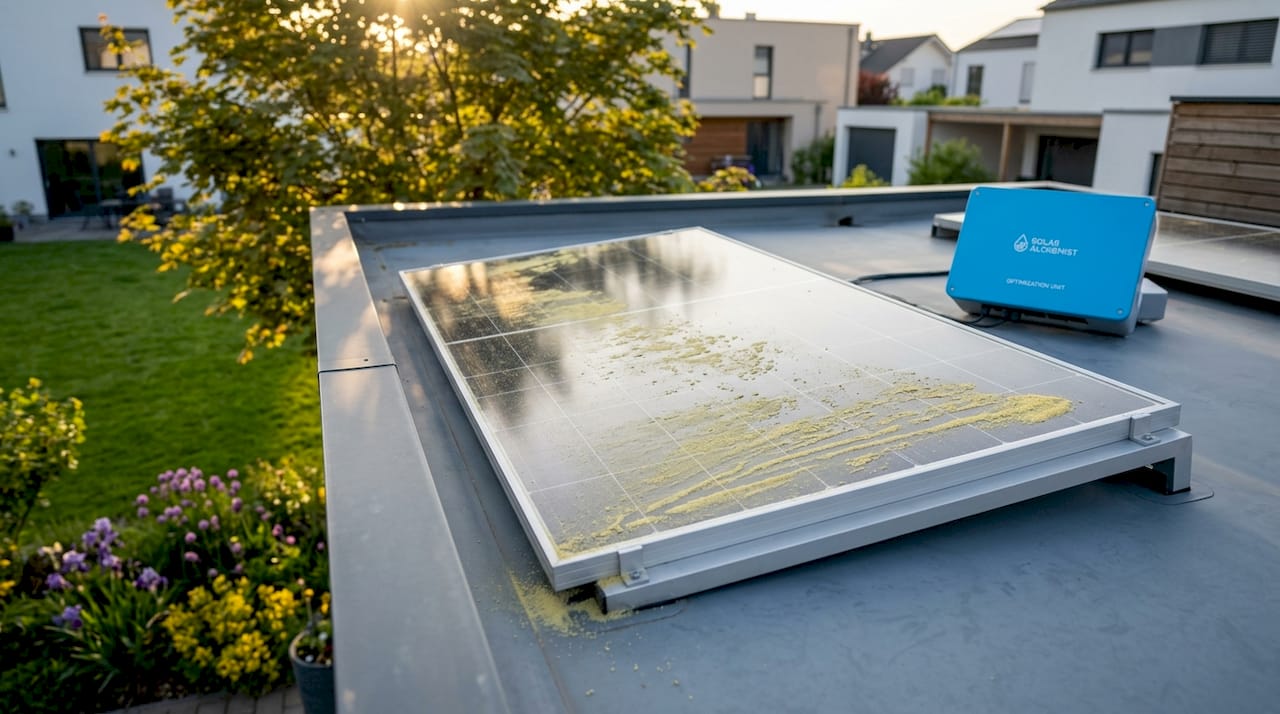
Unlike fine road dust, which sits loosely on glass and washes off with a light rain, pollen grains are sticky by design. Plants engineered them to adhere to surfaces on contact, which is exactly why they cling to your panel glass in a dense, amber film. Pollen soiling raises panel temperature and reduces the light reaching cells, hitting your output from two directions at once.
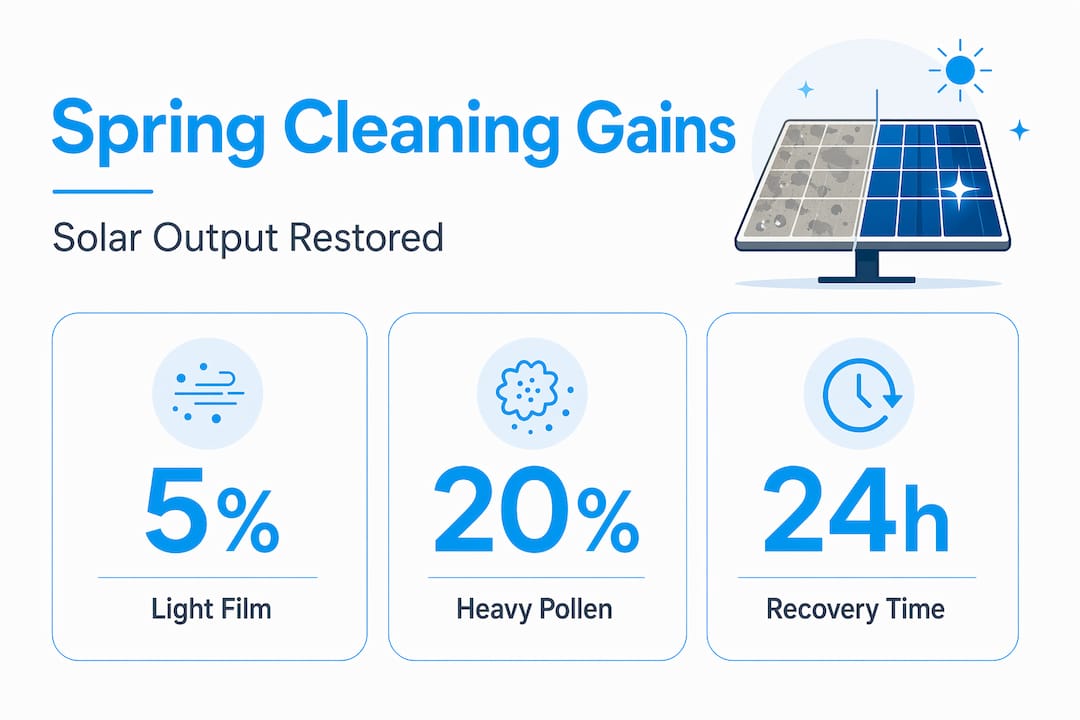
The numbers confirm the scale of the problem. Pollen-heavy regions see output drop 20%+ during peak bloom, with immediate gains of 5%–12% visible right after a proper cleaning. Globally, soiling reduces solar generation 4%–7% annually, and the IEA-PVPS has flagged the cumulative cost to the industry as running into the billions each year.
There is also a thermal dimension most homeowners never hear about. Dust and pollen act as insulators. Thermal modeling shows that dust-induced thermal effects account for up to 4.5% of annual energy loss beyond the transmittance reduction alone. A panel running hotter produces less power per photon, compounding the optical loss with a heat penalty you never see on the surface.
Two forces driving spring losses:
- Optical blocking. Pollen film scatters and absorbs incoming light before it reaches the cells.
- Thermal insulation. The same film traps heat, raising cell temperature and lowering conversion efficiency.
- Rain resistance. Sticky pollen residue persists after rainfall, with European modeling showing a 4%–7% production loss that natural precipitation simply cannot resolve.
How cleaning restores spring-time energy production
When you remove the soiling layer, both problems go away at the same time. Cleaning solar panels in spring restores light transmittance directly, letting the full solar spectrum reach the cells again. At the same time, a clean glass surface dissipates heat far more efficiently, which pulls panel temperature back down and restores the conversion rate your system was rated for.
The recovery is not gradual. Cleaning reclaims 5%–25% of generation within hours of a proper wash, depending on how severe the soiling was before treatment. For a 10 kW system producing 35–40 kWh on a good spring day, a 20% soiling loss means you are leaving 7–8 kWh on the table every sunny day you wait.
Here is where lightly dirty panels catch people off guard. A panel that looks only faintly dusty can still carry a significant optical and thermal penalty because pollen films are semi-transparent. You cannot judge soiling severity by eye. The smear you can barely see in morning light may be cutting your noon production by 10%–15%.
The table below puts the dual recovery effect in perspective:
| Soiling type | Primary output loss | Cleaning recovery mechanism |
|---|---|---|
| Light pollen film | 5%–10% optical loss | Rinsing restores transmittance quickly |
| Dense pollen buildup | 15%–25% optical + thermal loss | Full wash restores both light and cooling |
| Mineral deposits (hard water) | 5%–15% optical loss | Deionized water or professional removal required |
| Mixed debris (pollen + dust) | 10%–20% combined loss | Two-stage rinse and soft squeegee needed |
Pro Tip: After spring cleaning, check your monitoring app at solar noon the following clear day. If output has not climbed noticeably compared to the day before cleaning, a second pass or professional service may be needed to remove residual mineral deposits.
Effective spring cleaning techniques for homeowners
Getting cleaning right protects your investment as much as it recovers your output. The wrong approach can crack anti-reflective coatings, introduce micro-fractures in the glass, or void parts of your warranty. Follow a clear process and the results hold up safely.
- Choose the right time of day. Clean panels in the early morning or late afternoon when they are cool. Pouring cold water on sun-heated glass causes thermal shock, which can propagate micro-cracks over time.
- Start with a plain rinse. Use a standard garden hose on a gentle spray setting to loosen and flush the bulk of pollen and debris. This alone handles light soiling without any scrubbing.
- Use a soft squeegee or microfiber applicator for heavier buildup. A squeegee with a rubber blade, the kind used on window glass, removes sticky pollen film without abrading the surface.
- Switch to deionized water for the final rinse. Tap water leaves mineral spots as it evaporates, which are their own form of soiling. Deionized water dries clean. If you do not have access to a deionized water system, a final slow rinse that you squeegee off works as an alternative.
- Avoid these at all times. High-pressure washers, abrasive scrub pads, harsh detergents, and bleach-based cleaners all damage panel coatings or seals. High-pressure washing risks coating damage that reduces long-term performance far more than a season of pollen ever would.
- Verify results through your monitoring system. Check output data 24 hours after cleaning on a clear day and compare it to a similar clear day before cleaning. A measurable gain confirms the cleaning was effective.
- Escalate persistent stains. If hard water deposits or deep-set residue do not respond to gentle rinsing, persistent soiling warrants professional cleaning with specialized equipment rather than more aggressive DIY force.
Pro Tip: If your panels are roof-mounted at a steep pitch, skip the DIY entirely. Working at elevation with wet surfaces and a hose is genuinely dangerous. Schedule a professional service instead. The cleaning cost is a fraction of what an ER visit or a replacement panel costs.
For a closer look at what the spotless rinse technique actually involves, Solaralchemist has a detailed walkthrough worth reading before your first attempt.
Common misconceptions about spring panel cleaning
The single most damaging myth in residential solar maintenance is that a good spring rainstorm handles the cleaning for you. It does not. Because rain rarely removes pollen film, what often happens after a shower is that existing pollen gets redistributed into an even more uniform, harder-to-detect film. Your panels may look cleaner after rain and still be producing less than before.
A few other misconceptions that cost homeowners real output:
- "I can tell when panels need cleaning by looking at them." Optical loss becomes measurable well before visible soiling appears. Trust your monitoring data over visual inspection.
- "Cleaning once in spring is enough." In areas with heavy oak or pine pollen like much of Wisconsin, one mid-season cleaning may not cover the full April-to-June bloom window. Two cleanings split across the season often deliver better cumulative results.
- "More soap means a better clean." Detergent residue left on panel glass acts as its own soiling layer and can attract more dirt between washes. Stick to plain or deionized water.
- "Annual cleaning costs are hard to justify." Annual professional cleaning runs $150–$500 depending on system size. Compare that to the kilowatt-hours you are recovering and the long-term protection against dirt-induced panel degradation that can cause permanent output loss.
You do not have to see the dirt to lose the output. The biggest soiling losses in spring come from films so thin they look like normal haze on glass. Your monitoring app sees what your eyes miss.
For more on how rain cleans partially and why that partial effect consistently falls short in spring, that piece breaks down the science in plain language.
Maximizing solar efficiency through seasonal maintenance
Spring cleaning is not a standalone event. It fits into a year-round maintenance rhythm that keeps your system performing close to its rated capacity across every season. The goal is to prevent soiling from compounding long enough to cause degradation that goes beyond what a simple wash can fix.
| Region / climate type | Recommended cleaning frequency | Key seasonal priority |
|---|---|---|
| Upper Midwest (Wisconsin, Minnesota) | 2x per year | Spring (pollen), late summer (dust/debris) |
| Southeast (high humidity, pollen) | 2–3x per year | Spring and post-summer storm season |
| Southwest (dry, dusty) | 3–4x per year | Spring and fall before peak sun months |
| Pacific Northwest (high rain, moss risk) | 1–2x per year | Spring and fall (moss and lichen prevention) |
Scheduling cleaning before peak pollen ends locks in the benefit during the highest-value generation window of the year. For a homeowner in the Madison area, that means targeting a cleaning between late April and late May, before oak and grass pollen peaks.
For property managers overseeing multiple systems, the calculus gets even clearer. Standardizing a spring cleaning protocol across all sites reduces variance in expected production and makes year-over-year performance comparisons more reliable. Pairing scheduled cleaning with continuous output monitoring gives you the data you need to spot a panel or string that is underperforming beyond what cleaning can fix, often an early sign of a hardware issue worth catching early.
Proper maintenance also prevents irreversible degradation, including potential-induced degradation linked to persistent soiling, which means your spring cleaning investment protects the system's long-term value, not just this season's output.
My honest take on spring solar maintenance
I have had countless conversations with homeowners who were convinced their inverter was failing or their panels had degraded prematurely. In the majority of those cases, the system was fine. The panels were dirty, specifically pollen-dirty, which is a fundamentally different problem from ordinary dust and one that routine weather simply does not solve.
What I have learned is that the thermal effect of soiling surprises people more than the optical effect once they understand it. Most folks accept that dirt blocks light. Fewer expect that the same dirt layer is quietly cooking their panels and shaving efficiency off the conversion rate on top of the blockage. That dual hit is why a "lightly dusty" panel in May can perform so much worse than it looks like it should.
I also see aggressive cleaning backfire more often than it should. A homeowner who pressure-washes because "the panels were really dirty" trades a soiling problem for a coating damage problem that never fully heals. Gentle methods are not a compromise. They are the right answer from both a physics and a warranty standpoint.
The most useful shift I encourage is moving from visual checks to data-driven decisions. If your monitoring shows a 10% drop versus the same week last year under similar weather, that is your signal to clean, regardless of what the panels look like from the ground. Clean based on output, not appearance, and verify the result the same way. The system tells you everything you need to know if you learn to read it.
— Marquis
Professional cleaning when spring demands more than a rinse

Some spring soiling situations are beyond what a garden hose and a squeegee can fix safely or completely. Mineral-laden hard water deposits, dense multi-week pollen buildup, and roof pitches that make DIY work genuinely hazardous all point to professional service as the smarter call.
Solaralchemist uses professional-grade deionized water systems and specialized soft-contact equipment to remove spring soiling without touching your panel coatings. The result is a spotless surface that maximizes both light transmission and panel cooling, the two levers that drive spring output recovery. If you are not sure whether your system needs a professional visit or a simple rinse, the 8-sign checklist at Solaralchemist walks you through the exact indicators that separate a DIY situation from one that needs expert hands. Do not let the highest-output weeks of the year pass while pollen keeps your system underperforming.
FAQ
How much output can cleaning restore in spring?
Cleaning can recover 5%–25% of lost generation depending on soiling severity, with results visible within 24 hours of a proper wash on a clear day.
Why doesn't spring rain clean my solar panels?
Pollen contains sticky proteins that resist rainfall removal. Rain redistributes the film rather than flushing it, leaving a residue that continues cutting output even after a heavy shower.
How often should I clean solar panels in Wisconsin?
Twice per year covers most Wisconsin systems: once in late April to May during peak pollen season, and once in late summer after dust and debris accumulate. High-pollen areas may benefit from an additional mid-season cleaning.
What is the safest way to clean solar panels at home?
Use a garden hose on a gentle setting, a soft rubber squeegee, and ideally deionized water for the final rinse. Avoid high-pressure washers and abrasive tools, which damage the anti-reflective coating and reduce long-term performance.
How do I know if cleaning actually improved my output?
Compare your monitoring data at solar noon on a clear day before cleaning and again 24 hours after. A measurable production increase under similar conditions confirms the cleaning was effective and quantifies the recovery.