
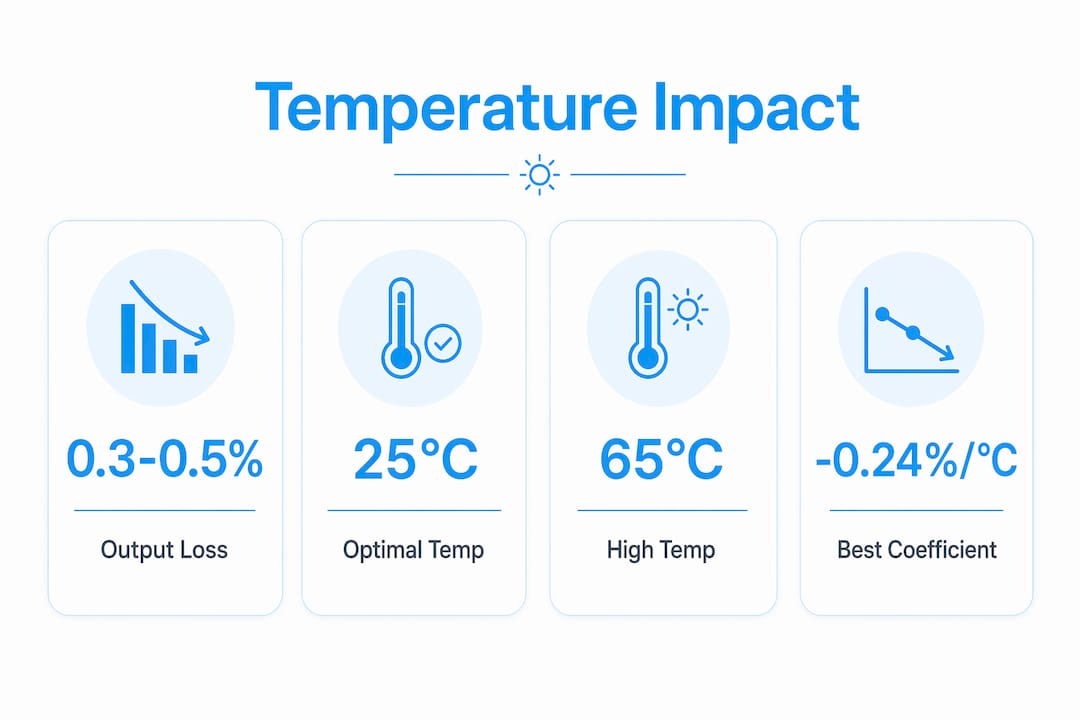
Solar panels lose roughly 0.3% to 0.5% of output for every 1°C rise above 25°C, making temperature one of the most underestimated factors in real-world solar performance. The industry term for this measurement is the temperature coefficient of Pmax, and it appears on every panel datasheet. Most owners focus on wattage ratings and panel count, but a 400W panel on a hot Wisconsin afternoon can deliver closer to 340W. Whether you already own a system or you're comparing panels before buying, understanding how solar panel temp affects output changes how you read specs, set expectations, and protect your investment.
How solar panel temp affects output: the temperature coefficient explained
The temperature coefficient of Pmax is the percentage of power a panel loses for each degree Celsius its cell temperature rises above 25°C. That 25°C figure is the Standard Test Condition (STC) baseline used in every lab rating worldwide. It is not the temperature your roof panels operate at on a July afternoon.
Here is how to calculate the loss yourself:
- Find the temperature coefficient on your panel datasheet (listed as γPmax, typically between -0.24%/°C and -0.50%/°C).
- Subtract 25°C from your panel's actual operating temperature to get the temperature rise.
- Multiply the rise by the coefficient percentage.
- Apply that loss percentage to the rated wattage.
For example, a 400W monocrystalline panel with a coefficient of -0.38%/°C operating at 65°C loses 15.2% output, dropping to roughly 339W. An HJT panel with a coefficient of -0.24%/°C loses about 8.7% under the same conditions, delivering around 365W. That 26W gap per panel adds up fast across a full array.
The effect is symmetric. Cold temperatures below 25°C actually increase output slightly, with voltage rising as cell temperature drops. A panel at 5°C can produce about 7.6% more than its rated wattage. This is why bright, cold spring days often produce your highest daily generation totals.
Voltage drives most of this behavior. Open-circuit voltage (Voc) drops sharply with heat, while current changes very little. The voltage drop shifts the IV curve, pulling the maximum power point down even when sunlight is intense.
| Panel technology | Typical γPmax | Power loss at 40°C rise |
|---|---|---|
| HJT | -0.24%/°C | ~9.6% |
| TOPCon | -0.30%/°C | ~12.0% |
| Mono-PERC | -0.38%/°C | ~15.2% |
| Polycrystalline | -0.42%/°C | ~16.8% |
| Thin-film (CdTe) | -0.25%/°C | ~10.0% |
Pro Tip: Check your panel's datasheet for the γPmax value before assuming standard performance. A difference of 0.10%/°C between two panels translates to hundreds of kilowatt-hours of lost generation over a year in a hot climate.
How real-world temperatures compare to lab conditions
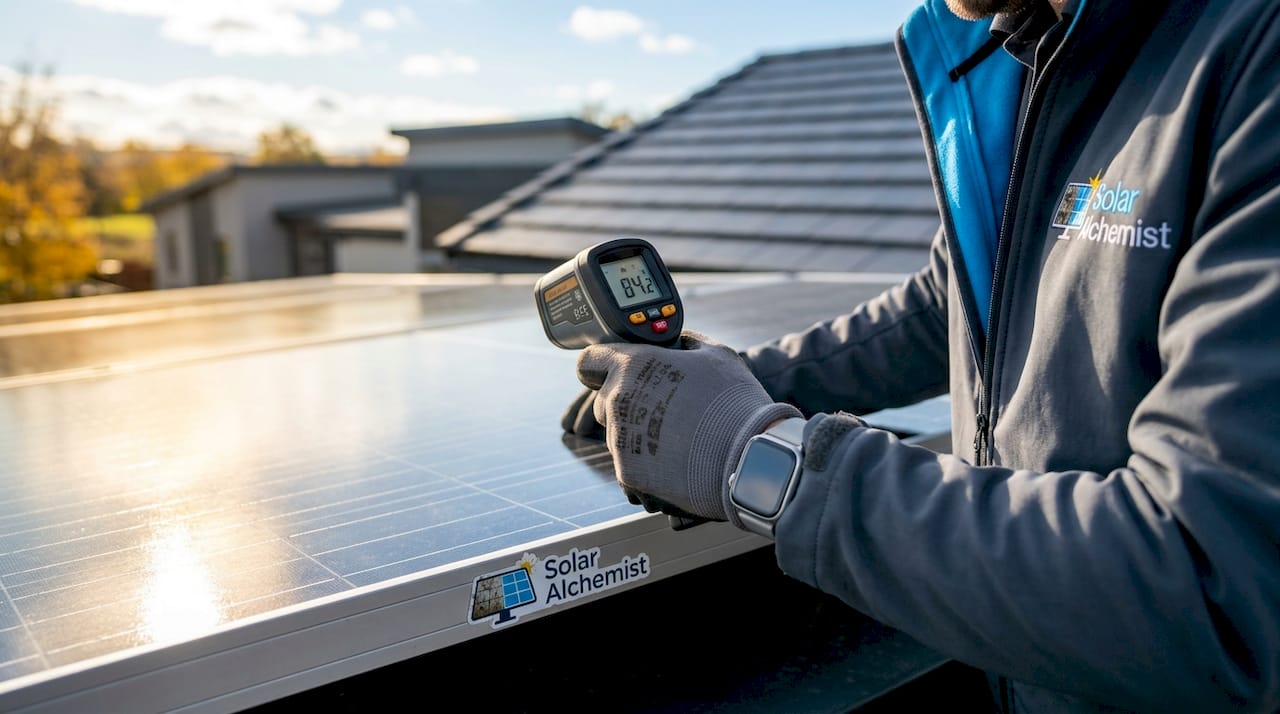
STC ratings are measured at exactly 25°C cell temperature, 1000 W/m² irradiance, and 1.5 air mass. Your roof is not a lab. Panel temperature typically runs 20°C to 35°C above ambient due to solar irradiance absorption and restricted airflow under the module.
On a 30°C summer day in Madison, Wisconsin, your panels can easily reach 55°C to 65°C. That is 30°C to 40°C above STC, which means a standard Mono-PERC panel is already operating at 11% to 15% below its rated output during peak afternoon hours.
System designers use a more realistic metric called Nominal Operating Cell Temperature (NOCT). NOCT averages around 45°C and reflects typical field conditions at 800 W/m² irradiance, 20°C ambient, and 1 m/s wind speed. Using NOCT instead of STC in annual yield predictions gives you a far more accurate picture of what your system will actually produce.
| Ambient temp (°C) | Estimated panel temp (°C) | Approx. output loss vs. STC |
|---|---|---|
| 15 | 35–45 | 4–8% |
| 25 | 45–55 | 8–11% |
| 30 | 55–65 | 11–15% |
| 35 | 65–75 | 15–19% |
Several factors push panel temperature higher or lower. Irradiance intensity is the biggest driver. Mounting style matters significantly: flush-mounted roof panels trap heat underneath, while racking systems with a 4-inch or greater air gap allow convective cooling. Wind speed, roof color, and even the backsheet material all influence how hot a module runs.
Pro Tip: Your highest daily output often occurs on bright, cool days in March or October, not in July. If your monitoring app shows a strong generation day in early spring, that is temperature physics at work, not a fluke.
What panel types perform best in high temperatures?
Not all panels handle heat equally. Technology choice is the single biggest lever you have at the point of purchase for controlling temperature-related losses. HJT (Heterojunction Technology) panels consistently post the lowest temperature coefficients, around -0.24%/°C, because their amorphous silicon layers are less sensitive to thermal carrier recombination. TOPCon panels follow closely at around -0.30%/°C.
Standard Mono-PERC panels, which dominate the residential market due to their lower cost, carry coefficients around -0.38%/°C. Polycrystalline panels, now largely phased out of new installations, run even higher at around -0.42%/°C. Thin-film technologies like cadmium telluride (CdTe) perform well thermally at around -0.25%/°C, though their lower base efficiency limits their appeal for space-constrained rooftops.
The long-term picture is more serious than a single hot afternoon. Panels operating above 60°C show up to 1.5% greater annual yield loss from heat-driven degradation compared to panels in cooler climates. This compounds over a 25-year panel lifetime. Processes like Light-Induced Degradation (LID) accelerate under sustained high heat, meaning the gap between a -0.24%/°C HJT panel and a -0.42%/°C polycrystalline panel widens every year.
Key considerations when comparing panels for hot climates:
- Prioritize panels with a γPmax below -0.30%/°C if you live in a region with sustained summer temperatures above 30°C.
- Check the NOCT value on the datasheet. A lower NOCT means the panel runs cooler under identical field conditions.
- HJT panels from manufacturers like Panasonic (now under Eneos) and REC Group carry some of the lowest coefficients available commercially.
- TOPCon panels from manufacturers like Jinko Solar and LONGi offer a strong balance of thermal performance and cost.
- Thin-film options like First Solar's Series 6 CdTe modules are worth considering for large commercial arrays in desert climates.
How temperature affects voltage, current, and system design
Voltage is where temperature does its damage. As cell temperature rises, the semiconductor bandgap in silicon narrows, reducing the built-in electric field that drives electron flow. The result is a measurable drop in Voc with every degree of heat gain. Current (Isc) changes very little and may even tick upward slightly with temperature, but voltage drop drives the power loss because power equals voltage multiplied by current.
This has direct consequences for how your system is designed:
- String sizing in cold climates: When panels get cold, Voc rises above STC values. If your installer did not account for the lowest expected temperature in Madison, the string voltage could exceed your inverter's maximum input voltage, triggering a shutdown or causing damage.
- String sizing in hot climates: In summer heat, Voc drops. A string sized too conservatively may fall below the inverter's minimum operating voltage, causing the inverter to drop offline during peak afternoon hours.
- Inverter clipping: Systems with high-temperature derating may produce less power than the inverter's rated input, reducing clipping losses but also indicating the array is underperforming its nameplate capacity.
- Performance modeling: Tools like PVsyst and Aurora Solar use temperature coefficients alongside NOCT-based thermal models to predict annual yield. A model built only on STC ratings will overestimate production by 10% to 20% in warm climates.
Pro Tip: Ask your installer to show you the temperature-corrected string sizing calculations before signing off on a design. This single check prevents both cold-weather inverter overvoltage and hot-weather underperformance.
Practical steps to reduce temperature-related output losses
Mounting and airflow are your first line of defense. Thermal management choices including backsheet material, mounting method, and ventilation can shift operating temperature by several degrees Celsius, recovering roughly 1% of output per few degrees of improvement. That is not trivial across a full array over a full summer.
Here are the most effective steps you can take as an owner:
- Maintain a proper air gap. Panels mounted with at least 4 inches of clearance beneath them run measurably cooler than flush-mounted systems. If you are planning a new installation, specify standoff racking.
- Keep panels clean. Dust, pollen, and bird droppings create localized hot spots by blocking cells and forcing neighboring cells to carry excess current. Soiling increases panel temperature and reduces output simultaneously. Regular cleaning removes both problems at once.
- Avoid shading where possible. Partial shade causes bypass diodes to activate, concentrating current through fewer cells and raising local temperatures. Even a small shadow from a vent pipe can create a hot spot that degrades cells over time.
- Choose the right panel at purchase. A lower temperature coefficient is a permanent advantage. Spending slightly more on an HJT or TOPCon panel pays back in every hot hour of every summer for 25 years.
- Schedule periodic inspections. Thermal imaging during a professional maintenance visit can identify hot spots invisible to the naked eye before they cause permanent cell damage.
Orientation and site shading also play a role. West-facing panels receive afternoon sun when ambient temperatures peak. East-facing panels capture morning sun when temperatures are lower, often producing more usable energy per watt of rated capacity in hot climates despite lower total irradiance.
Key takeaways
Solar panel output drops predictably with rising temperature, and the temperature coefficient of Pmax is the single most useful number for quantifying, comparing, and managing that loss.
| Point | Details |
|---|---|
| Temperature coefficient matters | A panel rated at -0.24%/°C loses roughly 40% less heat-related output than one rated at -0.42%/°C. |
| Real temps far exceed STC | Panels run 20°C to 35°C above ambient, meaning STC wattage ratings overstate real-world output on hot days. |
| HJT and TOPCon lead in heat tolerance | These technologies post the lowest temperature coefficients and degrade more slowly in sustained heat. |
| Voltage drives the loss | Voc drops sharply with heat while current barely changes, pulling maximum power output down. |
| Mounting and cleaning reduce losses | Proper air gaps and clean surfaces lower operating temperature and prevent hot spots that compound heat damage. |
Why most owners underestimate the temperature problem
I have seen this pattern repeatedly. A homeowner installs a 10kW system, watches the monitoring app for a few weeks, and then calls wondering why peak output on a 90°F July afternoon is 8.5kW instead of 10kW. The installer quoted them STC numbers. Nobody mentioned that those numbers exist only in a climate-controlled lab.
The temperature coefficient is the most overlooked spec on a solar datasheet, and it costs owners real money every summer. When I look at panel selections across residential installations in the Madison area, the majority are standard Mono-PERC panels chosen primarily on price per watt. That is a reasonable decision if you understand the thermal tradeoff. Most buyers do not.
What I find most interesting is the cold-weather upside. Wisconsin winters actually give local panel owners a thermal advantage that owners in Phoenix never see. Those bright, cold February days when panels are running at 5°C to 10°C are delivering above-rated output. The annual yield picture is more nuanced than "hot climate equals bad for solar."
The technology trend is genuinely encouraging. HJT panels have dropped significantly in price over the past three years, and TOPCon has become the new mainstream standard at the mid-range price point. The thermal performance gap between budget and premium panels is narrowing. For anyone buying in 2026, there is little reason to accept a coefficient worse than -0.35%/°C.
My practical advice: pull the datasheet on any panel you are considering and find the γPmax line. If it is not there or the salesperson cannot produce it, that is a red flag about the quality of the product and the installation company.
— Marquis
Keep your panels running at peak output year-round

Dirty panels do not just lose output from blocked light. Soiling creates uneven heat distribution across cells, raising local temperatures and accelerating the exact degradation processes described in this article. Solaralchemist uses professional-grade deionized water systems and specialized equipment to clean panels safely without leaving residue that traps heat. Based in Madison, Wisconsin, Solaralchemist serves residential and commercial arrays across Dane County with scheduled maintenance programs designed to protect your investment through every season. Check the signs you need a cleaning before your next hot stretch, and contact Solaralchemist to schedule service that keeps your array producing at its thermal best.
FAQ
What is the optimal temperature for solar panels?
Solar panels are rated at 25°C cell temperature under Standard Test Conditions, and output peaks at or below this temperature. Most panels begin losing output above 25°C at a rate of 0.3% to 0.5% per degree Celsius.
How much output do solar panels lose in summer heat?
On a 30°C ambient day, panel temperatures typically reach 55°C to 65°C, causing a standard Mono-PERC panel to lose 11% to 15% of its rated output. HJT panels lose closer to 8% to 10% under the same conditions.
Do solar panels work better in cold weather?
Yes. Cold temperatures below 25°C increase panel voltage and boost output slightly above rated wattage. A panel at 5°C with a -0.38%/°C coefficient can produce about 7.6% more than its STC rating, which is why clear winter and early spring days often show strong generation numbers.
What panel type handles heat best?
HJT panels carry the lowest temperature coefficients of any mainstream silicon technology, around -0.24%/°C, followed by TOPCon panels at around -0.30%/°C. Both outperform standard Mono-PERC panels in high-temperature conditions.
Does dirt on panels make the temperature problem worse?
Soiling blocks cells and creates hot spots where current concentrates through fewer active cells, raising local temperatures and compounding heat-related losses. Keeping panels clean through professional maintenance directly reduces both soiling losses and temperature-driven degradation.