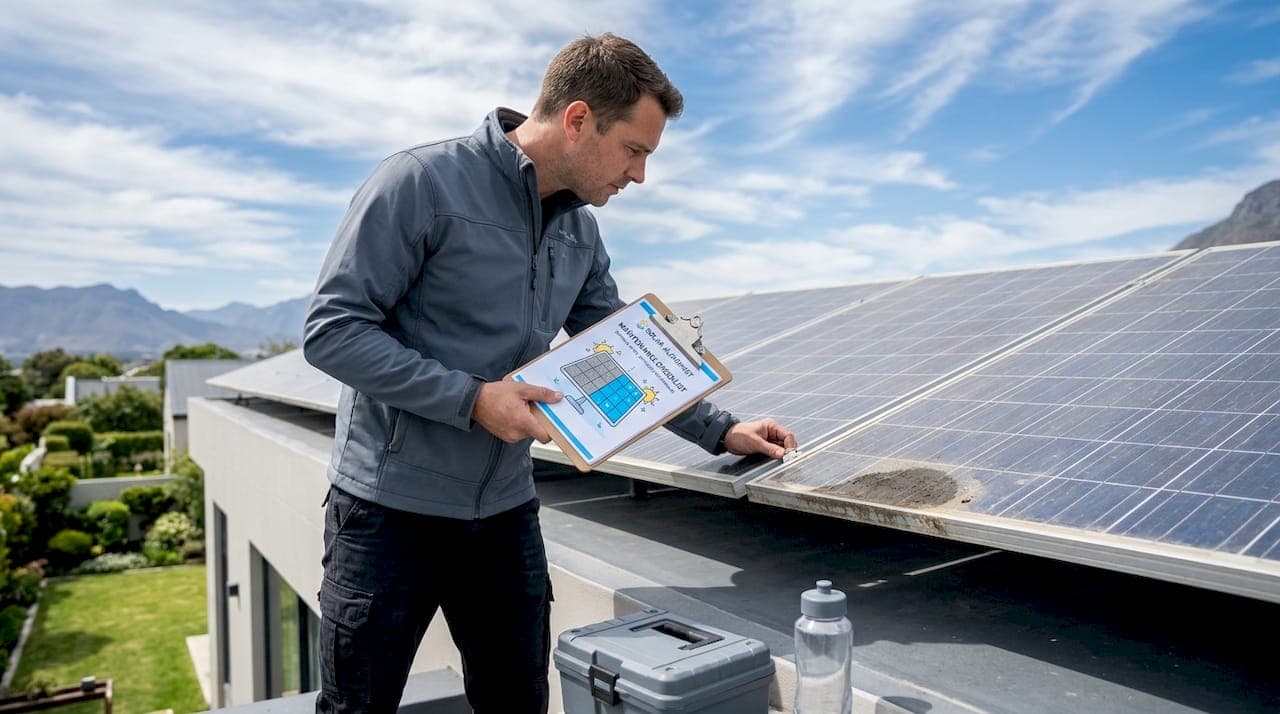
Dirty solar panels are quietly draining your savings right now. Most homeowners don't realize that soiling, the industry term for the buildup of dust, pollen, bird droppings, and pollution on panel surfaces, can cut energy output by 15–25% on average, costing hundreds of dollars annually in lost electricity value. The good news: solar panel cleaning cost savings are very real, and knowing when, how, and how often to clean makes all the difference between money well spent and money thrown away. This guide gives you the numbers, the methods, and the decision framework to maximize every dollar.
Table of Contents
- Key takeaways
- Solar panel cleaning cost savings: what drives the numbers
- How to determine your cleaning frequency and method
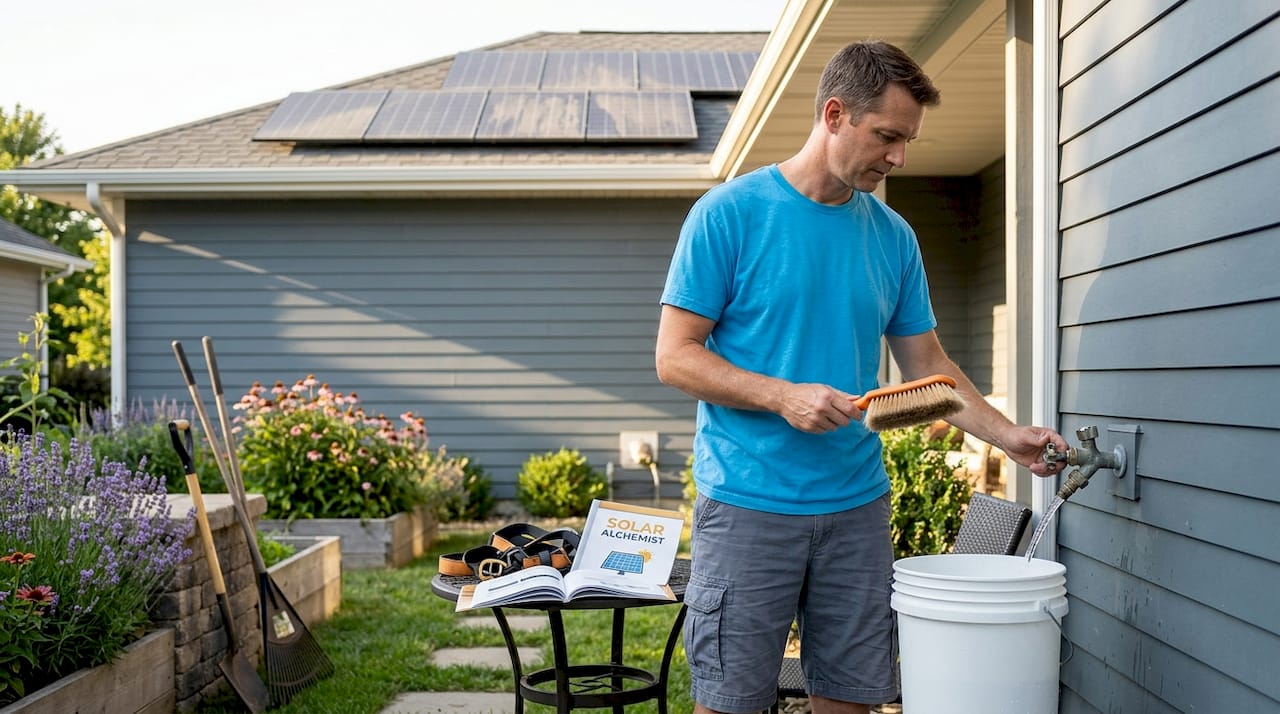
- DIY solar panel cleaning: costs, steps, and safety
- Professional solar panel cleaning: pricing, benefits, and when it pays
- Tracking your actual cleaning ROI
- My honest take on cleaning schedules and savings
- See what Solaralchemist can do for your system
- FAQ
Key takeaways
| Point | Details |
|---|---|
| Soiling losses add up fast | A 20% efficiency loss can cost a typical homeowner roughly $360 per year in lost energy savings. |
| Cleaning frequency should match your environment | Most systems need 1–2 cleanings yearly, but dusty or industrial areas may require 3–4 times annually. |
| DIY is affordable but carries risk | A basic cleaning kit costs under $100 and can recover around 6% output, but steep roofs call for professional help. |
| Deionized water prevents new deposits | Hard tap water leaves mineral streaks that reduce efficiency, so water quality directly affects cleaning results. |
| Monitor production data, not just the calendar | Energy output trends tell you more reliably when a cleaning is due than any fixed schedule can. |
Solar panel cleaning cost savings: what drives the numbers
Understanding the real return on cleaning starts with knowing what you're paying for and what you're getting back. Professional cleaning typically runs $150–$500 per visit for a residential system, with most single-story homes landing between $250 and $350 per cleaning. Per-panel pricing generally falls between $5 and $20, depending on the provider and conditions. If you clean twice per year, budget roughly $390 to $720 annually.
Those numbers only make sense if you know what inefficiency is costing you. A California home losing 20% output from soiled panels loses approximately $360 per year in recoverable savings. For Illinois homeowners, where pollen seasons are heavy and industrial pollution accumulates in northern parts of the state, losses can be similarly steep. If your electric rate is higher than the national average, every percentage point of lost output costs you more.
Several variables shift that cost calculation significantly:
- Panel count and roof access: A 10-panel rooftop system costs far less to clean than a 30-panel array on a steep pitch.
- Local soiling intensity: Properties near farms, construction zones, or highways accumulate grime faster and need more frequent service.
- Water quality: Hard water minerals leave deposits after cleaning that reduce efficiency just like dirt does. Filtered or deionized water is the standard for professional-grade results.
- Regional pricing differences: Urban markets and areas with higher labor costs push professional rates up.
Here is a quick reference for how those factors stack up:
| Factor | Low cost scenario | High cost scenario |
|---|---|---|
| Panel count | 10 panels, ground level | 30 panels, steep pitched roof |
| Water quality | Deionized water system used | Hard tap water, mineral streaks left |
| Soiling level | Light dust, 1 cleaning/year | Heavy industrial or pollen buildup, 3+ cleanings/year |
| Estimated annual cost | $150–$250 | $500–$900+ |
| Estimated savings recovered | $100–$200/year | $300–$500+/year |
How to determine your cleaning frequency and method
The standard cleaning frequency recommendation is 1 to 2 times per year for systems in moderate climates with regular rainfall. That baseline works well for many Wisconsin and northern Illinois homeowners during spring and fall. But it is not a universal answer.
Dusty regions, coastal areas, and locations near industrial activity may need 3 to 4 cleanings annually, according to IEA-PVPS soiling research, which found that soiling causes 4 to 7% energy losses globally and calls for site-specific cleaning strategies. That figure is the floor, not the ceiling, in high-pollution corridors.
Rainfall plays a supporting role, but a limited one. A steady downpour will rinse loose surface dust, but it does not remove stuck-on grime like pollen paste, bird droppings, or oily exhaust residue. Counting on rain to do the job means tolerating real efficiency losses between storms.
Here is how cleaning frequency and method recommendations shift by climate zone:
| Climate zone | Recommended frequency | Best cleaning method |
|---|---|---|
| Moderate, regular rain (Midwest) | 1–2 times/year | Soft brush + deionized water rinse |
| Dry, dusty (Southwest) | 3–4 times/year | Low-pressure hose + microfiber mop |
| Coastal or high humidity | 2–3 times/year | Deionized water + gentle wipe to prevent salt deposit |
| Heavy industrial or agricultural | 3–4+ times/year | Professional service with deionized water system |
Monitoring your system's energy production output is the most reliable way to determine cleaning intervals. When production drops relative to your baseline and weather conditions haven't changed, that is your signal, not the calendar date.
DIY solar panel cleaning: costs, steps, and safety
DIY cleaning is genuinely worth it for homeowners with accessible single-story roofs and ground-mounted systems. One homeowner documented a 6.4% output increase after a simple post-winter clean using a garden hose and a microfiber mop head, avoiding roughly $300 in professional service fees. The upfront tool investment is minimal, typically under $75 to $100 for everything you need.
Here is what a safe, effective DIY cleaning process looks like:
- Gather your tools: Soft microfiber mop or brush, garden hose with low-pressure nozzle, and if possible a filtered water attachment to avoid mineral deposits.
- Clean in the morning or evening: Panels heated by midday sun can crack under cold water contact. Cool temperatures reduce that risk significantly.
- Rinse first: A gentle hose rinse loosens loose debris before any contact cleaning.
- Wipe gently in one direction: Scrubbing in circles leaves micro-scratches over time. One-directional strokes with a soft mop protect the glass coating.
- Avoid detergents: Harsh chemicals can void manufacturer warranties. Plain water or a pH-neutral soap applied sparingly is all you need.
- Check your warranty first: Some manufacturers require professional service to keep the warranty intact. Read the fine print before you climb up.
Safety is the factor that most DIY guides understate. Wet roofs are slippery, and a fall from even a single-story roof is serious. Review residential cleaning safety tips before going up, including using a non-slip ladder, wearing rubber-soled shoes, and never leaning out over the edge to reach far panels.
Pro Tip: If your panels are on a two-story roof or at a pitch steeper than 30 degrees, the financial math almost always favors hiring a professional. A $300 cleaning fee is a much smaller number than an emergency room visit or a homeowner's insurance deductible.
Check this guide on common cleaning mistakes to avoid the errors that cancel out your effort.
Professional solar panel cleaning: pricing, benefits, and when it pays
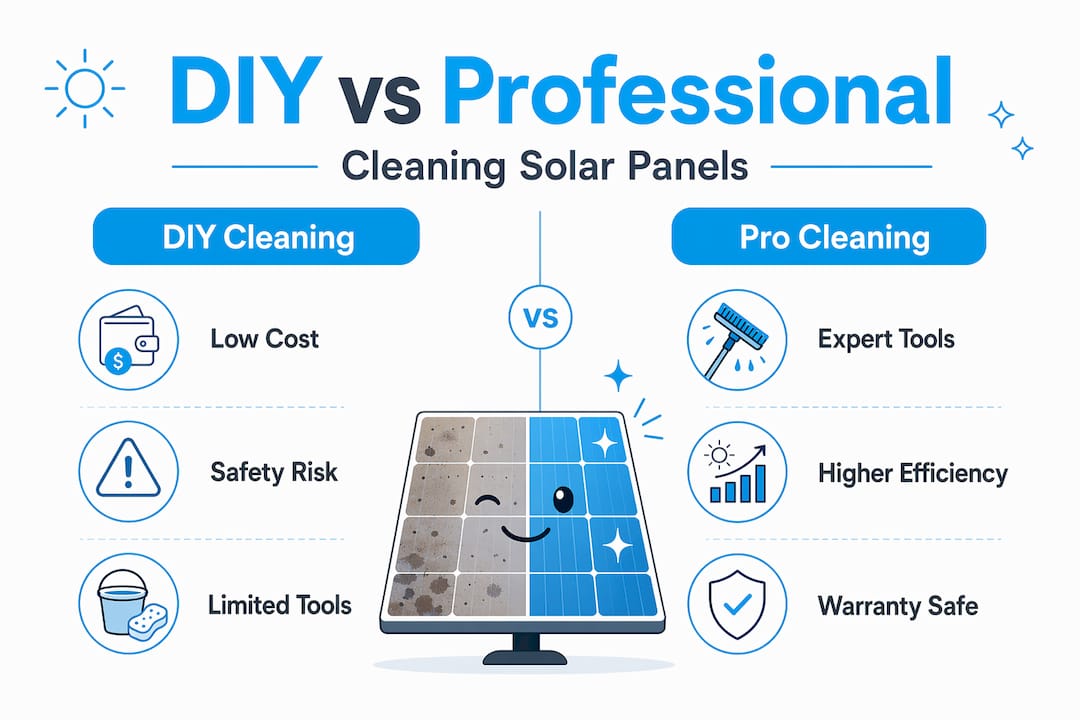
Professional cleaning services offer something DIY cannot: equipment, training, and accountability. The core pricing models you will encounter are per-panel pricing ($5 to $20 per panel), flat per-visit rates ($150 to $500), and annual contracts that bundle two or more cleanings at a slightly reduced rate.
The real advantages of professional service go beyond just convenience:
- Warranty protection: Professionals use the deionized water systems and soft brushes manufacturers specify. No warranty risk.
- Thorough inspection: A trained technician will spot cracked glass, loose wiring connections, or failed seals that you would likely miss.
- Safety on difficult roofs: For steep pitches or multi-story installations, professional crews bring harnesses, stabilizers, and experience.
- Documented performance data: Many services provide before-and-after production comparisons that validate the cleaning's impact on output.
When does professional service deliver the clearest return? Large systems above 20 panels, roofs steeper than 30 degrees, systems near farms or industrial facilities with heavy soiling, and any system still under manufacturer warranty all represent strong cases for hiring out. For commercial systems above 100 kW, 2 to 4 cleanings per year are standard, and the revenue impact of lost efficiency makes professional contracts straightforward to justify.
Pro Tip: Ask any prospective cleaning service whether they use deionized or filtered water. If they say they use tap water and a standard brush, find someone else. Mineral deposits from hard water can undo the efficiency gains you just paid for.
Understanding what a solar O&M contract covers can also help you lock in cleaning costs at predictable rates. A homeowner's O&M guide breaks down what to look for before signing.
Tracking your actual cleaning ROI
Knowing that cleaning restores efficiency is not the same as knowing it in dollars. Here is how to close that gap and confirm your return:
- Record your baseline: Pull your system's monthly production data from your inverter or monitoring app for the 3 months before a cleaning. This is your comparison point.
- Compare production after cleaning: Check output for the same period post-cleaning, controlling for weather as best you can. A meaningful jump confirms soiling was the culprit.
- Calculate the dollar value: Multiply the recovered kilowatt-hours by your current electricity rate. If you recovered 300 kWh at $0.14 per kWh, that is $42 per month in additional value.
- Compare against cleaning cost: Divide your annual cleaning spend by the annual recovered value. If you spent $300 and recovered $480 in energy, your net gain is $180 per year and the ROI is positive.
- Adjust timing going forward: If production data shows minimal dip between cleanings, stretch your interval. If dips are steep and fast, tighten the schedule. Monitoring app insights make this process much faster than manual tracking.
Relying on visual inspection to decide when panels need cleaning consistently leads to poor timing. Production data offers better decision support because soiling's effect on output often builds gradually and becomes invisible to the eye until losses are already significant.
My honest take on cleaning schedules and savings
I've seen homeowners obsess over twice-yearly cleaning schedules on systems that barely need one cleaning per year, and I've seen others go three years without touching their panels and wonder why their bills haven't dropped. The truth is messier and more interesting than most cleaning guides admit.
What I've found is that geography and system placement matter far more than any general recommendation. A panel facing a road that gets resurfaced every summer needs a different schedule than one on the south side of a suburban home surrounded by grass. The best indicator I know is watching your own production data, not a calendar. When your output drops 5 to 8% against a clear-weather baseline, that is when cleaning pays back most clearly.
On the DIY versus professional question: I lean toward professional service for anything on a second story or steep pitch. Not because DIY doesn't work, but because the maintenance longevity of your system depends on consistent, correct technique. One wrong cleaning with abrasive tools or hard water can introduce micro-damage that compounds over years. The savings you think you're capturing can quietly disappear into degraded panel efficiency.
My honest advice: start with your monitoring data, be realistic about your roof's safety profile, and treat cleaning as an investment decision, not a chore on a fixed rotation.
— Marquis
See what Solaralchemist can do for your system

If you're in Wisconsin or northern Illinois and not sure whether your panels are underperforming, Solaralchemist makes it easy to find out. The team uses professional-grade deionized water systems and specialized soft-wash equipment to clean panels safely and thoroughly, with no warranty risk and no hard-water mineral deposits left behind. Whether you're a homeowner with a 10-panel rooftop system in Sun Prairie or a business managing a larger array, Solaralchemist tailors the service to your location and soiling conditions. Start by checking the 8 signs your panels need cleaning to see where your system stands right now.
FAQ
How much money can solar panel cleaning actually save?
Cleaning can recover 15 to 25% of lost efficiency in heavily soiled systems, translating to hundreds of dollars annually depending on your system size and local electricity rate. A typical homeowner losing 20% output may recover roughly $360 per year after cleaning costs.
How often should I clean solar panels in Illinois?
Most Illinois homeowners need 1 to 2 cleanings per year, but properties in northern Illinois near agricultural or industrial areas may benefit from 3 or more cleanings annually due to heavier pollen and pollution accumulation.
Does rain clean solar panels well enough?
Rain removes loose surface dust but cannot clean stuck-on grime like pollen residue, bird droppings, or oily exhaust. Most systems still need manual cleaning at least once per year regardless of rainfall frequency.
Is professional solar panel cleaning worth the cost?
For steep roofs, large systems, or warranty-protected installations, professional cleaning typically delivers a positive ROI through recovered energy output and reduced risk of damage from improper technique or hard-water mineral deposits.
What water should I use when cleaning solar panels?
Deionized or filtered water is strongly recommended. Hard tap water leaves mineral deposits on panel glass that reduce efficiency in the same way dirt does, effectively canceling out part of the cleaning benefit.