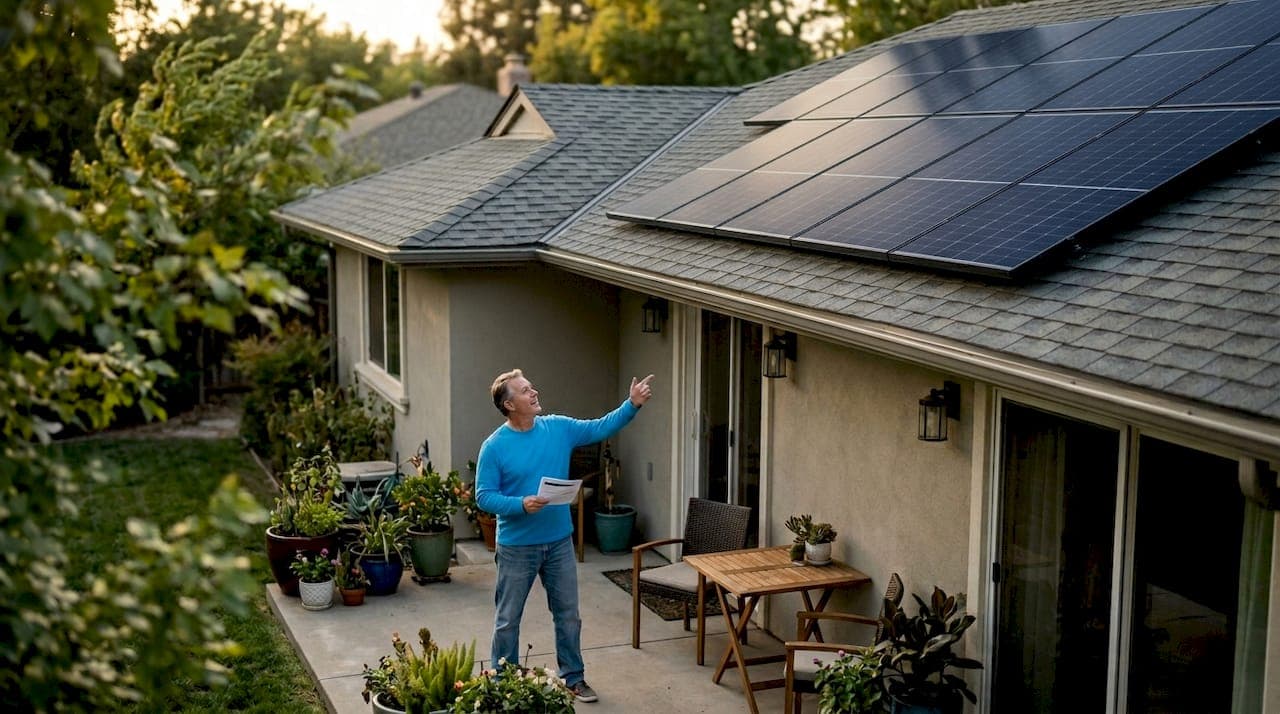
A residential solar lease is a financing arrangement where a third-party provider installs, owns, and maintains a solar system on your home, and you pay a fixed monthly fee to use the electricity it produces. You get the benefits of solar power without buying the equipment outright. The provider handles everything from permitting to repairs, and you simply pay a predictable monthly bill. This model has become one of the most common residential solar financing options for homeowners who want lower energy costs without a large upfront investment.
What is a residential solar lease and how does it work?
A residential solar lease is defined by third-party ownership: the solar company owns the panels on your roof, and you pay to use the power they generate. The provider, companies like Sunrun or SunPower, handles installation, permitting, monitoring, and all repairs. You sign a contract, the panels go up, and your monthly payments begin. You never own the hardware.
Monthly payments under a solar lease are fixed. They do not change based on how much electricity the panels actually produce on a given month. Lease payments typically range from $75 to $200 per month, depending on system size and your local electricity rates. That figure is designed to sit below your current utility bill, so you see savings from day one.
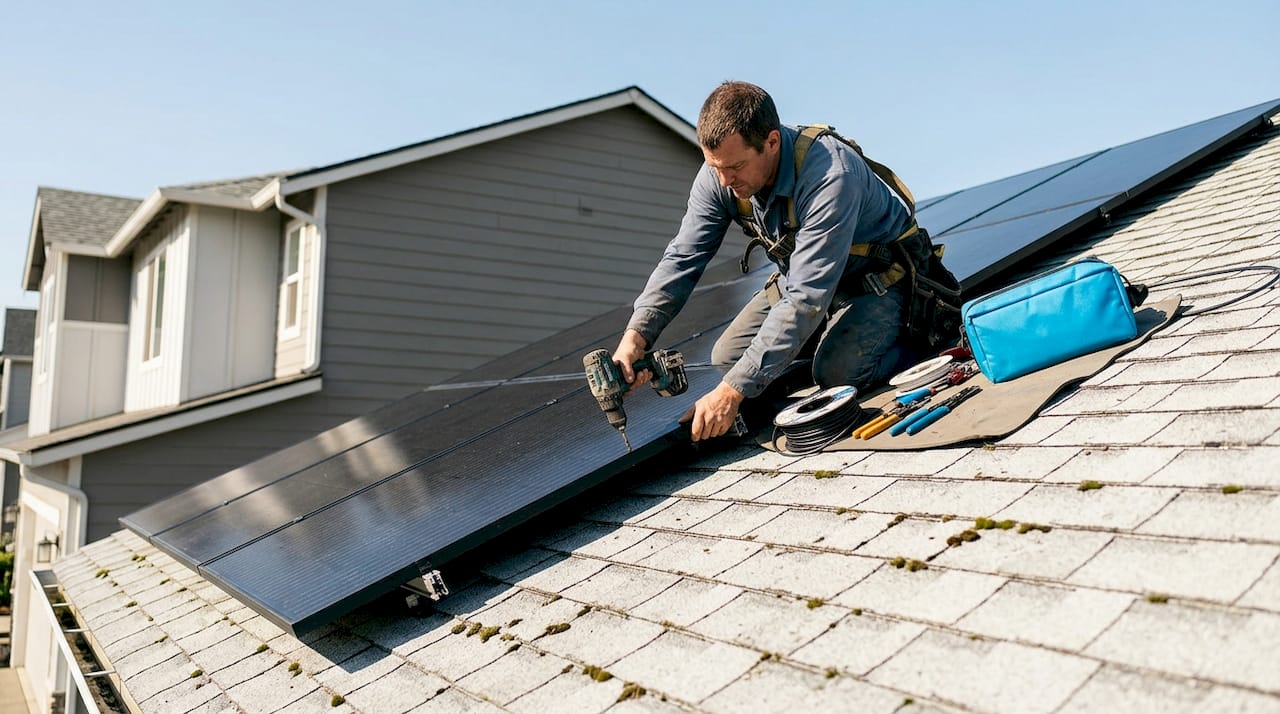
The provider takes on full responsibility for the system. That includes installation, maintenance, and repairs, as well as any battery storage components included in the agreement. If a panel cracks or an inverter fails, the company fixes it at no extra cost to you. This hands-off model appeals to homeowners who want solar without becoming amateur electricians.
Contract length is the detail most homeowners underestimate. Solar lease contracts typically run 20 to 25 years. That is a commitment longer than most car loans and many mortgages. Some agreements include a buyout option partway through, and most have a transfer clause if you sell your home. Read those clauses before you sign anything.
- Fixed monthly payments regardless of production output
- Provider owns, insures, and maintains all equipment
- Contracts typically span 20 to 25 years
- Buyout and transfer options vary by provider and contract
- Payments are structured to be lower than your current utility bill
Pro Tip: Request a sample contract from the provider before your installation appointment. Reading it without sales pressure gives you time to spot escalator clauses and end-of-term conditions that could cost you later.
Solar lease vs. purchase vs. PPA: which option fits you?
Three main paths exist for going solar: a lease, a power purchase agreement (PPA), or outright ownership. Each works differently, and the right choice depends on your financial goals and how long you plan to stay in your home.
A solar lease charges you a fixed monthly fee regardless of how much electricity the system produces. A PPA, by contrast, charges you per kilowatt-hour generated, so your bill fluctuates with production. Both are third-party ownership models, meaning the provider owns the equipment in both cases. The practical difference is predictability: leases give you a flat bill, PPAs tie your cost to actual output.
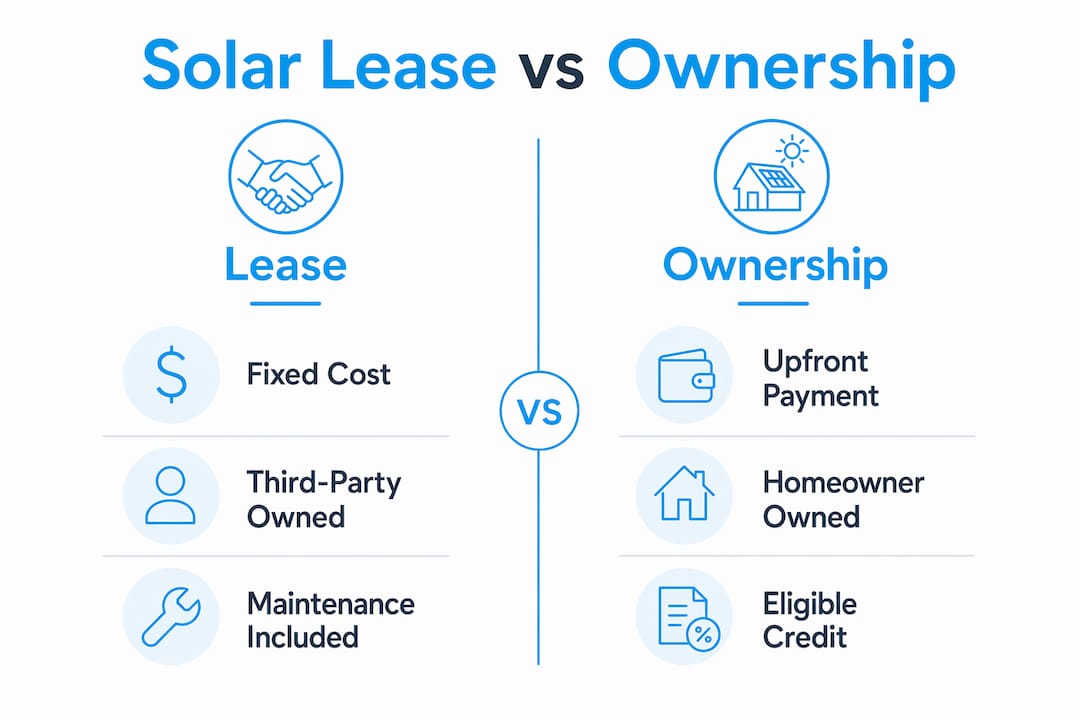
Ownership, whether through cash purchase or a solar loan, puts the equipment in your name. That matters for one significant reason: the federal Investment Tax Credit (ITC). Homeowners who lease cannot claim the federal solar tax credit because the leasing company owns the system and receives those incentives instead. In 2026, the ITC remains a substantial financial benefit for buyers, which makes ownership considerably more attractive for homeowners with the capital or credit to finance a purchase.
| Option | Ownership | Payment structure | Maintenance | Federal tax credit | Typical contract |
|---|---|---|---|---|---|
| Solar lease | Provider | Fixed monthly fee | Provider | Provider claims it | 20 to 25 years |
| PPA | Provider | Per kWh produced | Provider | Provider claims it | 20 to 25 years |
| Cash purchase | Homeowner | One-time upfront | Homeowner | Homeowner claims it | No contract |
| Solar loan | Homeowner | Monthly loan payment | Homeowner | Homeowner claims it | Loan term only |
The table makes the trade-off clear. Leasing and PPAs lower your barrier to entry but transfer the financial upside to the provider. Ownership costs more upfront but delivers greater long-term value, including tax credits and full equity in the system.
What contract terms should homeowners watch for in a solar lease?
The contract is the product. Most homeowner frustrations with solar leases stem from contract clauses about payment escalators, roof responsibility, and transfer rules, not from hardware failures. Understanding what you are agreeing to before signing protects you for the full 20-plus-year term.
Payment escalators are one of the most overlooked clauses. Some residential solar panel contracts include an annual rate increase, often 1 to 3 percent per year, built into the fixed payment. Over a 25-year contract, a 2 percent annual escalator turns a $100 monthly payment into roughly $160 by year 25. That is still potentially below utility rates, but it narrows the savings margin significantly.
Roof maintenance is another friction point. Coordination with the provider is required for any roof work, since the panels belong to them. If your roof needs replacing mid-lease, you must arrange for the provider to remove and reinstall the system, often at your expense. That cost is rarely discussed during the sales process.
State-level consumer protections vary widely. Texas, for example, now requires a 5-business-day right to cancel residential solar lease contracts under the Residential Solar Retailer Regulatory Act, effective September 2025. Not every state offers equivalent protections, so verifying your local rules before signing matters.
Key contract review points before you sign:
- Check for annual payment escalator clauses and calculate the total cost over the full term
- Confirm who pays for panel removal and reinstallation if your roof needs work
- Review the transfer process and any fees if you sell your home before the contract ends
- Identify the buyout price and when that option becomes available
- Verify your state's cancellation window and how to exercise it in writing
Pro Tip: Before signing any residential solar agreement, have a real estate attorney or a solar-specific consumer advocate review the contract. The contract review process costs far less than a decade of unfavorable escalator payments.
Is solar leasing worth it? Benefits and drawbacks for homeowners
Solar leasing is worth it for specific homeowners in specific situations. It is not universally the best choice, and the financial case depends heavily on your tax situation, how long you plan to stay in the home, and what your utility rates look like over time.
The core trade-off of leasing is straightforward: you get easy, low-barrier access to solar power in exchange for surrendering ownership benefits. For a homeowner with limited savings, no appetite for a 25-year loan, or a plan to move within 10 years, leasing can be a rational choice. For a homeowner planning to stay long-term and who qualifies for the federal ITC, ownership almost always delivers better financial returns.
Benefits of solar leasing:
- Zero upfront cost to get panels installed and producing power
- Predictable monthly payments that are typically lower than utility bills
- Provider handles all maintenance, repairs, and monitoring
- No risk of equipment depreciation or technology obsolescence falling on you
- Accessible to homeowners who do not qualify for large solar loans
Drawbacks of solar leasing:
- You cannot claim the federal Investment Tax Credit or most state incentives
- Long contract terms (20 to 25 years) limit flexibility
- Selling your home requires either transferring the lease or buying it out, which can complicate real estate transactions
- Payment escalators can erode savings over time
- You build no equity in the system
One scenario where leasing makes clear sense: a homeowner in a high-rate utility market who plans to stay in the home for at least 10 years, has no federal tax liability to offset with the ITC, and wants zero maintenance involvement. For Wisconsin solar owners, where winter weather and debris affect panel output, the maintenance-free aspect of leasing has real practical value.
Key takeaways
A residential solar lease gives homeowners access to solar power with no upfront cost, but the provider owns the system, claims the tax credits, and controls the contract terms for up to 25 years.
| Point | Details |
|---|---|
| Lease definition | A provider owns and maintains the system; you pay a fixed monthly fee to use the electricity. |
| Payment structure | Monthly costs typically range from $75 to $200 and do not vary with production output. |
| Tax credit loss | The leasing company claims the federal ITC, not the homeowner, reducing long-term financial returns. |
| Contract risks | Escalator clauses, roof coordination requirements, and transfer rules are the most common sources of homeowner disputes. |
| Ownership comparison | Cash purchase or solar loans deliver greater long-term value for homeowners who qualify for tax incentives. |
Why I think most homeowners sign solar leases without reading them
I have reviewed enough solar contracts to know that the sales experience is designed to move fast. The installer is enthusiastic, the savings projections look compelling, and the paperwork feels like a formality. That is exactly the moment to slow down.
The lease itself is where the real terms live. I have seen homeowners locked into 2.9 percent annual escalators that they genuinely did not know existed until year five. I have seen roof replacement projects delayed because the solar provider's removal schedule ran six weeks out. These are not edge cases. They are predictable outcomes of signing a 25-year contract without reading it.
My honest view on leasing in 2026: it is a legitimate option for homeowners who lack the capital or credit for ownership and who are realistic about the trade-offs. The maintenance-free model has genuine value, especially in climates where panels need regular attention. But if you have the financial flexibility to own, the federal ITC and long-term equity make ownership the stronger financial decision in most cases.
The one thing I would tell every homeowner considering a lease: treat the contract review as non-negotiable. Understanding solar panel maintenance expectations under your specific agreement is just as important as understanding the payment terms. Both affect what you actually get out of the system over 20-plus years.
— Marquis
Keep your solar system performing at its best
Whether you lease or own your solar panels, clean panels produce more power. Solaralchemist serves homeowners across Madison, Wisconsin and Dane County with professional-grade solar panel cleaning using deionized water systems that remove mineral deposits, pollen, and debris without scratching your panels or voiding manufacturer warranties.
Leased systems still need cleaning. Your provider maintains the hardware, but dirt and seasonal buildup are your responsibility in most agreements. Solaralchemist helps you protect that investment year-round. Check our guide on when to clean your panels to know exactly when your system needs attention and what signs to watch for before output drops.
FAQ
What is the difference between a solar lease and a PPA?
A solar lease charges a fixed monthly fee regardless of how much electricity the system produces, while a power purchase agreement (PPA) charges per kilowatt-hour generated. Both are third-party ownership models where the provider owns the equipment.
Can I claim the federal solar tax credit with a leased system?
No. Because the leasing company owns the solar equipment, they claim the federal Investment Tax Credit, not the homeowner. Only homeowners who purchase their system outright or through a solar loan qualify for the ITC.
How long do residential solar lease contracts typically last?
Most residential solar lease contracts run 20 to 25 years. Many include a buyout option and a transfer clause for home sales, but terms vary significantly by provider.
What happens to my solar lease if I sell my home?
You typically have two options: transfer the lease to the new buyer or buy out the remaining contract. Both options require coordination with the provider and can complicate or delay real estate transactions if the buyer is unwilling to assume the lease.
Does a solar lease cover maintenance and repairs?
Yes. The provider owns the system and is responsible for all maintenance, monitoring, and repairs throughout the contract term. Homeowners are not responsible for equipment failures, though they are typically responsible for keeping the panels clean.