An effective solar maintenance checklist annual review is the single most reliable way to protect your system's output, preserve your warranty, and stay ahead of costly failures. Solar panels degrade silently. Dirt accumulates, micro-cracks form, and inverter faults develop without triggering any alarm. Homeowners and facility managers who follow a structured yearly checklist catch these issues before they compound. This guide covers every task on that checklist, from DIY cleaning and visual inspections to professional electrical audits and performance data analysis, with timing recommendations built for Wisconsin's climate and beyond.
1. Annual solar maintenance checklist: the full task overview
Every solar maintenance checklist annual review breaks into four categories: cleaning, visual inspection, performance monitoring, and professional servicing. Skipping any one of them creates a blind spot. Panel soiling alone can reduce output by up to 32% over eight months, which means a single missed cleaning cycle costs real money in lost generation. Homeowners who treat maintenance as a once-a-year event rather than an ongoing habit consistently underperform against their installer's original production estimates.
The good news is that annual DIY time runs just 2 to 4 hours when tasks are organized and scheduled in advance. That figure covers monthly monitoring check-ins, two visual walkarounds per year, and one thorough cleaning. Professional inspections add time but are recommended every 3 to 5 years at minimum, with annual professional cleaning delivering the best long-term results.

2. Panel cleaning: frequency, method, and what to avoid
Cleaning frequency is best determined by your local soiling environment, not a fixed calendar. Coastal properties accumulate salt film. Agricultural areas see heavy pollen loads in spring. Urban installations collect exhaust particulate year-round. Each of these environments demands a different cleaning schedule, ranging from annual to quarterly.
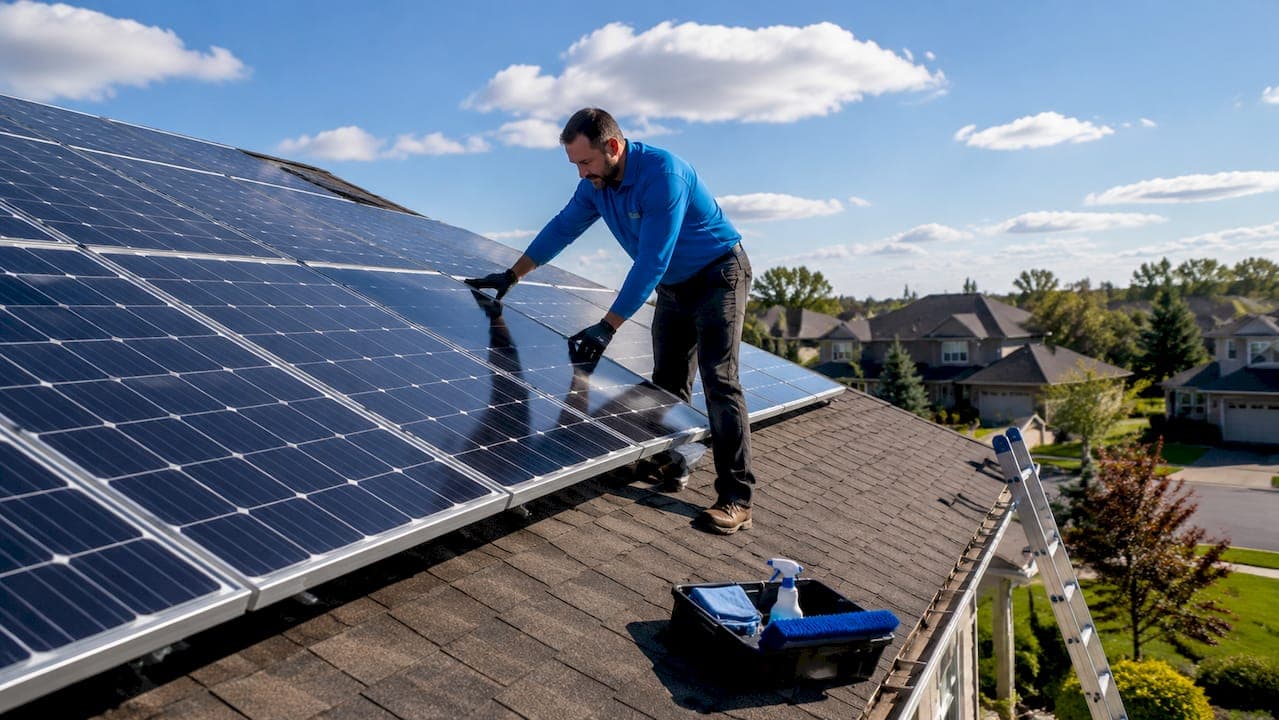
The method matters as much as the frequency. Using a pressure washer or abrasive scrubber damages the anti-reflective coating on panel glass and voids most manufacturer warranties. Safe cleaning uses plain water and a soft brush, or professional-grade deionized water systems that leave no mineral residue. Cleaning from ground level with an extension pole is the safest approach for most residential installations.
Pro Tip: Schedule your annual cleaning in early spring before peak generation season begins, and again in fall if you live in a high-pollen or dusty region. You recover the most lost output by cleaning before summer's highest-sun months.
- Clean with plain water or deionized water only
- Use a soft brush or microfiber pad, never abrasive materials
- Avoid cleaning during peak sun hours when panels are hot
- Work from ground level whenever possible to avoid roof hazards
- Check for common cleaning mistakes before starting any DIY session
3. Visual inspection: what to look for every year
A visual inspection takes less than 30 minutes and catches physical damage before it becomes a system failure. Walk the perimeter of your array and look at each panel face for discoloration, cracks, or delamination. Then check the mounting hardware for rust, loose bolts, or any movement in the racking system. Finally, inspect the roof surface around the array for lifted flashing or compromised seals.
Bird nesting under panels is one of the most overlooked inspection items. Nests trap moisture, block airflow, and create fire risk from debris contact with wiring. Many residential solar panel seasonal checklists skip this entirely. If you see nesting material or droppings concentrated under one section of your array, treat it as a maintenance priority, not a cosmetic issue.
Document what you find with photos dated and stored in a folder alongside your original installation paperwork. This record supports warranty claims and gives your professional inspector a baseline for comparison year over year.
4. Why a professional annual inspection matters
Professional solar inspections are most effective when scheduled in fall, addressing post-summer storm damage and preparing the system for winter efficiency conditions. Fall timing also catches any shading changes from tree growth that occurred over the summer, which directly affects winter output when sun angles are already lower.
A professional inspection covers ground that no homeowner visual check can reach. The scope includes:
- Electrical wiring integrity and terminal tightness at junction boxes
- Isolator switch function and labeling compliance
- Inverter diagnostics and error log review
- Mounting hardware torque verification and corrosion assessment
- Roof penetration seal condition and flashing integrity
- String performance comparison to identify underperforming panel groups
The primary goal of annual professional visits is warranty compliance and preventative safety, catching mounting corrosion and electrical terminal degradation that DIY inspection cannot detect. A failed terminal connection that goes undetected for 12 months does not just reduce output. It creates a fire risk. This is why government solar maintenance compliance guides and municipal solar maintenance compliance checklists both mandate professional electrical audits at defined intervals.
5. Reading your performance data to trigger maintenance
Performance data is the most underused tool in a residential solar panel seasonal checklist. Your inverter's monitoring app, whether that is SolarEdge, Enphase Enlighten, or a third-party platform, generates daily generation records that reveal faults invisible to the naked eye. Comparing annual output to your installer's original estimates is the fastest way to detect hidden issues like micro-cracks and bypass diode failures before they cascade.
Here is a practical four-step process for annual data review:
- Pull your total annual generation figure from your inverter app or utility net metering statement.
- Compare it to your installer's year-one production estimate, adjusted for any documented shading changes.
- If variance is within 10%, your system is performing normally. A variance of 15% or more signals a need for investigation.
- Look at month-by-month data to isolate whether the drop is seasonal (weather-related) or consistent (equipment fault).
A consistent 15% shortfall across all months points to a dirty array, a shading obstruction, or a failing inverter. A shortfall isolated to summer months often indicates inverter throttling from heat. Each pattern points to a different fix, which is why raw generation numbers matter more than vague impressions that "the system seems fine."
6. Maintenance schedules by environment and system type
The right maintenance interval depends on where you live and what kind of system you operate. A single-family home in Madison, Wisconsin faces different soiling conditions than a municipal solar array in a coastal California city. The table below summarizes recommended schedules by environment and system type.
| Environment / System Type | Cleaning Frequency | Professional Inspection | Key Soiling Factor |
|---|---|---|---|
| Residential, low-dust inland | Once per year | Every 3 to 5 years | Pollen, bird droppings |
| Residential, agricultural region | Two to three times per year | Annually | Pollen, dust, crop spray |
| Residential, coastal | Two to four times per year | Annually | Salt film, humidity |
| Municipal or commercial array | Quarterly | Annually | Urban particulate, scale |
| Residential, heavy tree canopy | Two times per year | Every 2 to 3 years | Sap, debris, shading |
Facility managers increasingly favor performance-driven maintenance over fixed calendar schedules because undetected faults cause 6 to 8% generation losses within 90 days. That figure represents a meaningful financial loss on large commercial arrays, which is why data-triggered cleaning and inspection beats arbitrary quarterly scheduling for most municipal solar maintenance compliance checklists.
Pro Tip: If you are unsure which soiling category applies to your property, check your panels after the first rain of spring. If the rain leaves visible streaks or residue rather than cleaning the surface, your soiling rate is high enough to justify at least two cleanings per year.
Calendar-based schedules work well for homeowners who want simplicity. Performance-driven schedules work better for anyone managing multiple systems or operating under a government solar maintenance compliance guide that requires documented output benchmarks. The best approach combines both: set calendar reminders as a floor, and treat any 10% generation drop as an automatic trigger for inspection regardless of schedule.
Key takeaways
A solar system maintained with annual cleaning, consistent data monitoring, and periodic professional inspection outperforms a neglected system by a measurable margin every single year.
| Point | Details |
|---|---|
| Soiling causes major losses | Panel dirt can cut output by up to 32% over eight months without cleaning. |
| Data beats visual checks | A 15% or greater generation drop triggers investigation before visible damage appears. |
| Fall is the best inspection window | Schedule professional inspections in fall to address storm damage and prep for winter. |
| Match cleaning to your environment | Coastal and agricultural sites need two to four cleanings per year, not one. |
| DIY and professional tasks are both required | DIY monitoring and cleaning catch surface issues; professional audits catch electrical and structural faults. |
What I've learned after years of watching solar systems underperform
Most homeowners I talk to assume their solar system is working fine because their utility bill went down. That assumption is the most expensive mistake in residential solar ownership. A system producing 18% below its design estimate still lowers your bill compared to buying all your power from the grid. It just leaves hundreds of dollars of generation on the table every year, silently.
The pattern I see most often is this: a homeowner skips cleaning for two or three years, notices nothing alarming, and then calls us after a professional inspection reveals a failed bypass diode and a panel face coated in a season's worth of agricultural dust. The repair is straightforward. The lost generation over those years is gone permanently.
What actually works is a hybrid approach. Set a spring cleaning appointment as a fixed annual event, the same way you schedule a furnace tune-up before winter. Then spend five minutes each month glancing at your inverter app. If your daily generation on a clear day looks 20% lower than the same week last year, that is your trigger to act. You do not need to understand inverter diagnostics to notice that number is wrong.
The one thing I push back on hardest is the idea that professional inspections are only necessary when something breaks. Electrical terminal degradation, mounting corrosion, and roof seal failure all develop slowly and invisibly. By the time they cause a visible problem, the damage is already done. An annual professional cleaning combined with a professional inspection every three to five years is not overcautious. It is the minimum that protects a $15,000 to $30,000 investment.
— Marquis
Keep your system performing with Solaralchemist

Solaralchemist serves homeowners and facility managers across Madison, Wisconsin and the surrounding region with professional-grade solar panel cleaning and maintenance built around exactly the checklist tasks covered in this article. Every cleaning uses deionized water systems that leave zero mineral residue, protecting your panel coatings and preserving manufacturer warranties. If your system is overdue for a cleaning or you are not sure when your panels need service, Solaralchemist provides a straightforward assessment with no guesswork. Protecting your solar investment starts with one scheduled appointment. Reach out to the Madison solar maintenance team at Solaralchemist to get on the calendar before peak season.
FAQ
How often should solar panels be cleaned annually?
Most residential systems need cleaning once to twice per year, but soiling environment determines the real frequency. Coastal and agricultural properties may need cleaning three to four times per year to prevent output losses.
What does a professional solar inspection include?
A professional inspection covers electrical wiring, inverter diagnostics, isolator function, mounting hardware torque, and roof seal integrity. These checks address safety and warranty compliance that DIY visual inspections cannot reach.
How do I know if my solar panels are underperforming?
Compare your annual generation total to your installer's original production estimate. A variance of 15% or more below that estimate signals a need for professional investigation, whether from soiling, shading, or equipment fault.
Can I clean my solar panels myself?
Yes, with the right method. Use plain water and a soft brush or microfiber pad from ground level. Never use a pressure washer or abrasive scrubber, as both damage the anti-reflective coating and void most warranties.
When is the best time to schedule a professional solar inspection?
Fall is the recommended window for professional inspections. It addresses post-summer storm damage, catches shading changes from summer tree growth, and prepares the system for winter operating conditions.