Reactive solar maintenance is the practice of repairing or servicing solar energy equipment only after a fault, failure, or measurable performance drop occurs. In the industry, this approach is also called corrective maintenance or run-to-failure maintenance, and understanding the distinction matters for any owner managing a solar asset. Panels are cleaned or repaired reactively when output noticeably drops or system alarms activate, meaning no scheduled inspection triggers the work. For solar panel owners and facility managers in Wisconsin and beyond, knowing when reactive maintenance makes sense and when it costs you more than it saves is the foundation of a sound operations and maintenance (O&M) plan.
What is reactive solar maintenance and how does it work?
Reactive maintenance in solar is triggered by a problem, not a calendar. The two most common triggers are a system alarm from your monitoring platform and a visible fault such as cracked glass, a failed inverter, or a sudden production drop. System faults like inverter errors or pronounced power drops initiate reactive repairs after detection in monitoring platforms. That detection gap between when a fault begins and when it is noticed is where reactive maintenance carries its biggest risk.
A typical reactive response follows a predictable sequence:
- Fault detection: A monitoring alert or a manual review of production data flags the problem.
- Diagnosis: A technician reviews error codes or inspects the site to identify the root cause.
- Parts sourcing: Replacement components are ordered, often without prior staging.
- Repair dispatch: A field team travels to the site, completes the repair, and verifies output recovery.
The challenge is that field teams arriving without condition-triggered diagnostics extend repair times and require multiple visits. A single inverter fault that could be resolved in one trip often becomes two or three visits when parts are not pre-staged and diagnostics are done on-site.
Pro Tip: Set production threshold alerts in your monitoring software at 10 to 15 percent below expected output. Catching drops early compresses the reactive response window and limits revenue loss.
How reactive maintenance compares to preventive and predictive approaches
Understanding reactive maintenance fully requires placing it against the two other primary solar maintenance types: preventive and predictive.
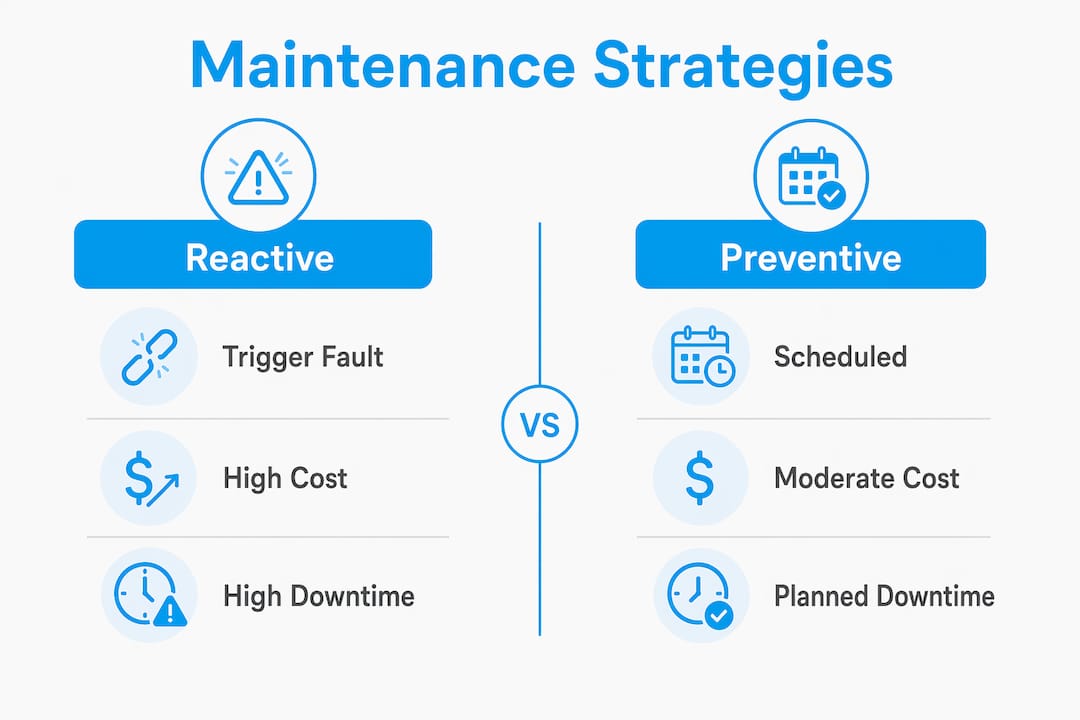
Preventive maintenance follows a fixed schedule regardless of equipment condition. Oil changes on a car are the classic analogy. For solar, this means quarterly cleaning, annual electrical inspections, and torque checks on mounting hardware on a set calendar. Predictive maintenance uses real-time sensor data, thermal imaging, and analytics to service equipment only when data signals an approaching failure. It is the most technically demanding approach and typically requires a solar O&M contract or dedicated asset management software.
The table below summarizes the key differences across all three strategies:
| Strategy | Trigger | Typical cost | Downtime risk | Best suited for |
|---|---|---|---|---|
| Reactive | Fault or failure | Highest per event | High, unplanned | Low-criticality components |
| Preventive | Fixed schedule | Moderate, predictable | Low, planned | Most solar assets |
| Predictive | Data-driven signal | Lowest long-term | Minimal | High-value, critical assets |
Reactive repairs on assets cost 4.8 times more than proactive interventions on average. That multiplier reflects emergency labor rates, expedited shipping on parts, and the cascade damage that accumulates when a fault goes undetected. For a commercial array in Sun Prairie or Madison, a single unplanned inverter replacement can cost more than a full year of preventive service contracts.
Facilities achieve the best ROI when maintenance strategies are tailored per asset criticality, combining reactive, preventive, and predictive maintenance accordingly. No single approach works across every component of a solar system.
When reactive maintenance is the right economic choice
Reactive maintenance is not always the wrong answer. For specific components, a run-to-failure approach is the most economical and sensible strategy available. Facility management guides advise applying reactive maintenance only on assets with minimal safety or compliance risk and rapid, cheap replacement.
The following criteria define when reactive maintenance makes economic sense for a solar asset:
- Low consequence of failure. If a component fails and the rest of the array continues producing at near-full capacity, the urgency and cost of immediate repair drops significantly.
- Fast and inexpensive repair. String fuse replacements, communication module swaps, and minor wiring fixes typically cost under a few hundred dollars and take less than an hour on-site.
- Readily available parts. If the replacement component is a standard item stocked by local distributors, there is no expedited shipping cost and no extended downtime.
- No safety or warranty implications. Some manufacturers void warranties if scheduled inspections are skipped. Confirm your panel and inverter warranty terms before defaulting to reactive-only service.
Examples of solar components where reactive maintenance is commonly justified include individual string fuses, monitoring communication modules, and minor junction box repairs. By contrast, inverters, racking systems, and the panels themselves carry enough consequence of failure and replacement cost that reactive-only treatment is a financial liability. A commercial solar maintenance schedule that classifies assets by criticality makes this decision systematic rather than reactive in the worst sense.
Hidden costs and challenges of a purely reactive approach
The most dangerous aspect of reactive maintenance is not the repair cost itself. It is the compounding effect of delayed detection. Reactive O&M responds to alerts and failures as they occur, unlike proactive O&M which anticipates degradation. That delay is where the real financial damage accumulates.
A single soiled string left unaddressed for 60 days does not just lose 60 days of output. It can accelerate hotspot formation, degrade cell efficiency permanently, and trigger a warranty dispute with your panel manufacturer.
The hidden costs of over-relying on reactive maintenance include:
- Unplanned downtime revenue loss. Every hour your array produces below capacity is revenue you cannot recover. For a 100 kW commercial system in Wisconsin, even a 15 percent output drop over 30 days represents a measurable financial loss.
- Emergency labor premiums. Technicians dispatched outside scheduled windows typically bill at higher rates. Weekend or after-hours calls compound this further.
- Cascade damage. A failed bypass diode that goes undetected can overheat adjacent cells. What starts as a $50 component failure can escalate to panel replacement.
- Warranty complications. Manufacturers like SolarEdge and Enphase require documented maintenance records. Gaps caused by a reactive-only approach can invalidate claims.
Certain small faults like tracker misalignment or communication errors remain unnoticed until production drops, forcing reactive maintenance but detectable earlier with proper monitoring. The irony is that many reactive maintenance events are preventable with basic monitoring hygiene. Understanding how soiling affects business revenue is one of the clearest illustrations of this compounding effect.
Pro Tip: Review your inverter's event log monthly, even if no alarms have triggered. Low-level faults that do not cross alert thresholds often appear in logs weeks before they cause a production drop.
Best practices for integrating reactive maintenance into your O&M plan
A purely reactive approach is a liability. A purely preventive approach wastes labor on components that did not need service. The most effective solar panel upkeep practices combine both, with reactive maintenance reserved for appropriate asset classes and triggered by real data rather than guesswork.
The following practices define a well-integrated reactive maintenance program:
- Use monitoring to generate condition-based work orders. Platforms like SolarEdge monitoring, Enphase Enlighten, or third-party SCADA tools can automatically create work orders when production crosses a defined threshold. This converts reactive response from a manual, delayed process into a near-automatic one.
- Schedule rapid inspections after weather events. Thermographic scans within 48 hours after hail prevent yield loss often missed by reactive maintenance schedules. A post-storm inspection protocol should be a standing item in every O&M plan.
- Pre-stage common replacement parts. Keeping a small inventory of string fuses, communication modules, and standard connectors on-site or with your service provider eliminates the multi-visit problem that drives up reactive repair costs.
- Classify assets before assigning maintenance strategy. Build a simple asset register that labels each component as critical, important, or low-risk. Apply reactive maintenance only to the low-risk category.
- Integrate cleaning schedules based on soiling data, not fixed calendars. Solar panel soiling rates should guide cleaning schedules rather than fixed calendars, since reactive cleaning after yield drops leads to avoidable losses. Wisconsin owners face distinct seasonal soiling patterns from pollen, bird activity, and winter debris that a data-driven schedule addresses more accurately than a quarterly default.
For owners who want a practical starting point, reviewing why large solar arrays need cleaning schedules explains the production math behind scheduled versus reactive cleaning in concrete terms.
Key takeaways
Reactive solar maintenance costs the most per event and works best only for low-criticality components with fast, inexpensive repairs and no warranty implications.
| Point | Details |
|---|---|
| Reactive maintenance definition | Corrective maintenance triggered by faults or production drops, not scheduled inspections. |
| Cost premium | Reactive repairs average 4.8 times the cost of proactive interventions per event. |
| When it makes sense | Use reactive strategy only for low-risk components with cheap, fast, readily available repairs. |
| Biggest hidden risk | Cascade damage and warranty voids from delayed fault detection compound the initial repair cost. |
| Best integration approach | Combine monitoring-triggered reactive response with scheduled preventive cleaning and inspections. |
Reactive maintenance in practice: my honest assessment
I have seen facility managers default to reactive maintenance not because it is the right strategy, but because it feels like the path of least resistance. No contract to sign, no scheduled visits to coordinate, no upfront cost. The bill only arrives when something breaks. That logic holds for a lawnmower. It does not hold for a $200,000 commercial solar array.
What I find most underappreciated is the asset classification step. Most owners treat their entire solar system as a single asset. In reality, a string fuse and a central inverter are not in the same risk category, and managing them with the same maintenance philosophy is where the real waste happens. Reactive maintenance is a legitimate tool when applied to the right components. The mistake is applying it by default to everything.
Industry data describes solar O&M evolving from reactive to continuous, analytics-driven intelligent maintenance systems. That shift is real, and it is accelerating. Owners who build asset classification and monitoring into their O&M plans now will spend less on emergency repairs and more on predictable, budgeted service. The reactive maintenance question is not whether to use it. It is knowing exactly where it belongs in your system.
— Marquis
Keep your solar system producing at its peak

Most reactive maintenance events in residential and commercial solar systems trace back to one root cause: deferred cleaning and inspection. Solaralchemist serves solar panel owners across Madison, Sun Prairie, and the greater Wisconsin area with professional-grade deionized water cleaning systems and scheduled maintenance programs designed to prevent the faults that trigger costly reactive repairs. Whether you need a one-time post-storm inspection or a year-round maintenance plan, Solaralchemist brings the technical expertise to keep your array producing at full capacity. Check our cleaning schedule guide to find out if your panels are overdue, and contact us to build a maintenance strategy tailored to your system.
FAQ
What is reactive solar maintenance in simple terms?
Reactive solar maintenance is the practice of repairing or servicing solar equipment only after a fault or production drop occurs. No scheduled inspections precede the work. The repair is triggered by a system alarm or a visible failure.
How does reactive maintenance differ from preventive maintenance?
Preventive maintenance follows a fixed schedule regardless of equipment condition, while reactive maintenance responds only after a problem appears. Preventive approaches reduce unplanned downtime; reactive approaches carry a higher per-event cost and greater risk of cascade damage.
Is reactive maintenance ever the right choice for solar panels?
Reactive maintenance is justified for low-criticality components with fast, inexpensive repairs and no safety or warranty implications. String fuses and communication modules are common examples. Inverters and panels themselves carry too much consequence of failure for a reactive-only approach.
How much more does reactive maintenance cost compared to preventive?
Reactive repairs average 4.8 times the cost of proactive interventions, accounting for emergency labor, expedited parts, and cascade damage. Over a multi-year period, that premium makes a reactive-only strategy one of the most expensive O&M choices available.
What triggers a reactive maintenance response in a solar system?
The most common triggers are inverter fault alerts from monitoring platforms like SolarEdge or Enphase Enlighten and visible production drops that cross a defined threshold. Physical damage from weather events such as hail or high winds also initiates reactive repair dispatch.