
How southern Wisconsin utility rates affect solar savings is determined primarily by three factors: retail electricity prices, fixed monthly charges, and the net metering policies set by local utilities like We Energies and Alliant Energy. Wisconsin residential electric rates average 17.1¢/kWh as of mid-2026, well above the solar levelized cost of energy (LCOE) of 7–11¢/kWh. That gap is the engine behind solar's financial case here. But rising fixed fees and weak export credits are narrowing the savings window, and homeowners who ignore those details often end up disappointed with their payback timelines.
How do Southern Wisconsin utility rates affect solar savings?
The financial case for solar rests on one simple principle: the more you pay per kilowatt-hour, the more you save by generating your own power. Wisconsin's 17.1¢/kWh average rate clears the profitability threshold that most solar analysts place around 15¢/kWh. Every kilowatt-hour your panels produce replaces one you would have bought at retail price.

The problem is that utility bills are not just variable energy charges. They contain several components, and each one affects your solar math differently.
Retail energy rate
This is the per-kilowatt-hour charge you avoid when your panels produce power. At 17.1¢/kWh, a 10 kWh sunny afternoon saves you $1.71 that day. Over a year, that adds up fast.
Fixed monthly charges
Both We Energies and Alliant Energy charge a fixed monthly fee regardless of how much electricity you use or generate. Alliant's fixed charge runs approximately $16/month in 2026. That fee does not disappear when your panels cover 100% of your variable consumption. It creates a billing floor that limits how low your bill can actually go.
Net metering and export credits
When your panels produce more power than you use in real time, the excess flows back to the grid. Utilities compensate you for that export, but not at retail rates. Export credits run approximately 3.17¢/kWh, compared to the 16–19¢/kWh retail rate you avoid when you consume solar power directly. That gap is enormous. A kilowatt-hour you use yourself is worth five times more than one you export.
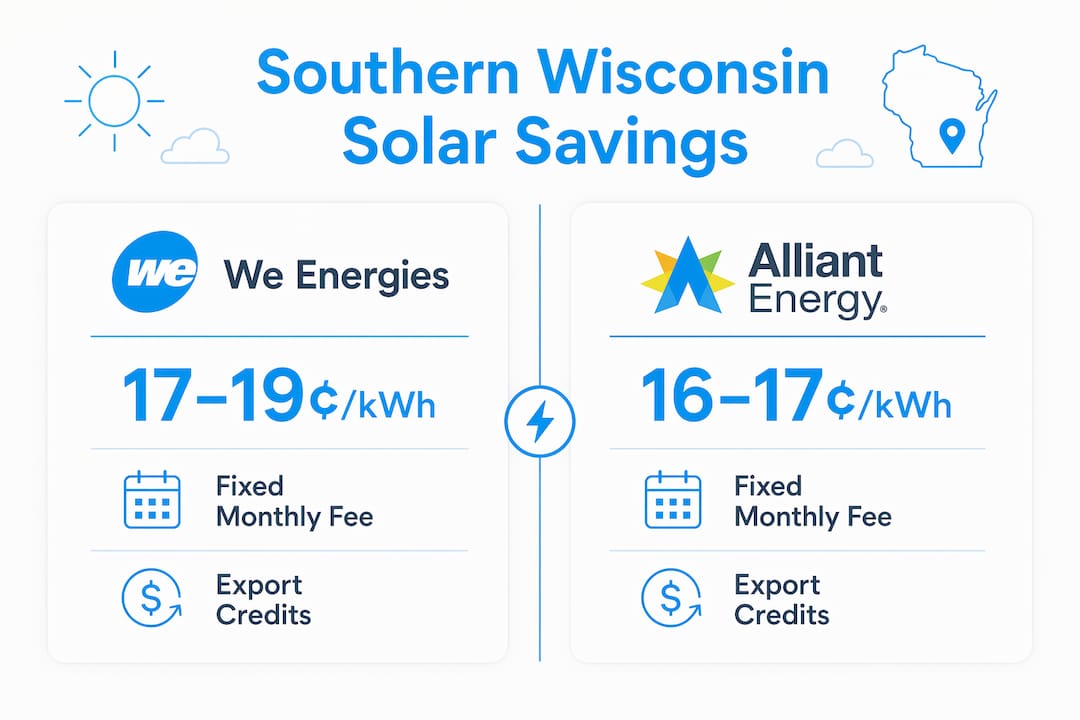
| Rate Component | We Energies | Alliant Energy |
|---|---|---|
| Retail energy rate | ~17–19¢/kWh | ~16–17¢/kWh |
| Fixed monthly charge | ~$10–12/month | ~$16/month |
| Export credit (net metering) | ~3.17¢/kWh | ~3.17¢/kWh |
Pro Tip: Size your system to cover your daytime consumption first, not your total annual usage. Exporting excess power at 3¢ while buying back at 17¢ is a losing trade.
What is the solar payback period in Southern Wisconsin in 2026?
Payback period is the industry term for how long it takes your energy savings to repay your installation cost. Southern Wisconsin payback ranges from 8.4 years under We Energies to 10.4 years in Waukesha County, depending on the utility serving your property. That two-year spread comes almost entirely from differences in rate structures and fixed charges.
Alliant Energy's higher fixed monthly fee hits harder than it looks. If your solar system eliminates your variable energy charge entirely, you still owe that $16 every month. Over a year, that is $192 you cannot recover through generation. Multiply that across a decade and it meaningfully extends your payback.
Rising fixed charges and flattening variable rates systematically undermine the financial benefits of residential solar. Consumers lose control over their bills not because solar stops working, but because the utility rate structure shifts savings away from the variable portion that solar directly offsets.
Shifts to higher fixed charges and flattening variable rates are a documented national trend, and Wisconsin utilities are following it. The practical effect is that solar systems sized for maximum annual generation increasingly overshoot what homeowners can actually benefit from financially.
Key factors that lengthen payback in Southern Wisconsin:
- High fixed monthly fees that solar cannot offset
- Low export credit rates (3.17¢/kWh) on excess generation
- System oversizing that pushes more production into low-value exports
- Utility-specific tariff differences between We Energies and Alliant Energy
Understanding your specific utility's rate design before you sign an installation contract is not optional. It is the single most important step in projecting accurate savings.
What steps maximize solar savings under current Southern Wisconsin rate structures?
The most effective response to Southern Wisconsin's rate structure is to treat self-consumption as the primary goal. Right-sizing solar systems to match hourly consumption profiles rather than annual totals keeps more of your generation at the valuable retail rate and less flowing to the grid at 3¢.
Load shifting is the practical tool for achieving that. It means running high-draw appliances during peak solar production hours, typically 10:00 AM to 3:00 PM.
- Run your dishwasher at noon. A dishwasher cycle uses roughly 1–2 kWh. Running it at midday consumes solar power directly instead of buying grid power in the evening.
- Charge your electric vehicle during the day. EV charging is one of the largest controllable loads in a home. Shifting it to solar hours can absorb several kilowatt-hours of production that would otherwise export at 3¢.
- Pre-cool or pre-heat your home. Set your thermostat to do its heaviest work between 11:00 AM and 2:00 PM when solar output peaks.
- Consider battery storage. A home battery captures midday surplus and discharges it in the evening, replacing grid purchases at the full retail rate. Given low export credit rates, storage often delivers better returns than exporting.
- Audit your annual maintenance schedule. Dirty panels lose output quietly. Annual maintenance keeps your system producing what your savings projections assumed.
Pro Tip: Before signing with any installer, confirm they are registered with Focus on Energy. Only qualifying installations receive the rebate, and not every contractor meets the program's requirements.
How do Southern Wisconsin solar incentives improve the overall investment?
Utility rate savings are only part of the financial picture. Southern Wisconsin solar incentives reduce the upfront cost of your system, which directly shortens payback regardless of what your utility charges per kilowatt-hour.
The Focus on Energy rebate offers $600 per kilowatt installed, capped at $2,400 per household in 2026. On a 4 kW system, that is the full $2,400 back before you generate a single kilowatt-hour. That reduction comes straight off your payback calculation.
Wisconsin also provides 100% property tax and sales tax exemptions on qualifying solar installations. The property tax exemption means the added home value from your solar system does not increase your annual tax bill. The sales tax exemption saves you 5% on the equipment purchase price.
The federal Investment Tax Credit remains at 30% through 2032. On a $20,000 system, that is $6,000 back as a direct tax credit. Combined with the Focus on Energy rebate and Wisconsin's tax exemptions, a typical Southern Wisconsin homeowner can reduce net system cost by a substantial margin before calculating any energy savings.
| Incentive | Benefit | Who Qualifies |
|---|---|---|
| Focus on Energy rebate | $600/kW, max $2,400 | Wisconsin residential customers |
| Federal ITC | 30% of system cost | Federal taxpayers through 2032 |
| Property tax exemption | 100% of added home value | Wisconsin solar owners |
| Sales tax exemption | 5% on equipment | Wisconsin solar purchasers |
These incentives do not change your utility's rate structure. But they lower the cost basis your savings must recover, which makes even a 10-year payback period look more attractive when the net investment is significantly smaller.
Key Takeaways
Southern Wisconsin utility rates shape solar savings through retail energy prices, fixed monthly fees, and export credit rates, making self-consumption the highest-value strategy for local homeowners.
| Point | Details |
|---|---|
| Retail rate drives savings | Wisconsin's 17.1¢/kWh average makes solar financially viable above the 15¢/kWh profitability threshold. |
| Fixed charges create a billing floor | Monthly fixed fees (~$16 for Alliant) limit how low your bill can go regardless of solar output. |
| Export credits are low | Exported power earns only ~3.17¢/kWh versus 17¢+ retail, making self-consumption far more valuable. |
| Incentives reduce net cost | The Focus on Energy rebate, 30% federal ITC, and Wisconsin tax exemptions significantly cut upfront investment. |
| System sizing matters | Right-sizing to match hourly consumption, not annual totals, maximizes savings under current rate structures. |
What I've learned from watching Southern Wisconsin solar economics shift
The conventional advice for going solar has always been "bigger is better." Install as much capacity as your roof allows, generate as much as possible, and let the utility credit you for the rest. That logic made sense when net metering paid close to retail rates. It does not hold up in Southern Wisconsin today.
The utility rate vs. solar cost dynamic has shifted. Export credits at 3¢ while retail sits at 17¢ means oversized systems are effectively subsidizing the utility. Homeowners I talk to are often surprised to learn their installer sized their system for maximum generation without accounting for how little that exported power actually earns.
The fixed charge issue is the one that concerns me most long term. A $16 monthly floor today can become $20 or $25 in five years as utilities continue pushing costs into fixed fees. That trend directly erodes the savings case for solar without changing a single panel on your roof. The homeowners who will fare best are the ones who built their savings strategy around self-consumption and load management from day one, not around net metering credits.
My honest recommendation: run your numbers utility-specific, not state-average. The difference between a We Energies and an Alliant Energy payback period is two full years. That is not a rounding error. And if you are in Alliant territory, a battery storage system deserves serious consideration even if the upfront cost feels steep. The weather and seasonal factors affecting Wisconsin solar output make self-consumption optimization even more critical during shoulder seasons when production dips.
— Marquis
Keeping your system performing at the level your savings depend on
Solar savings projections assume your panels are producing at rated capacity. Dirt, pollen, bird droppings, and Wisconsin's seasonal grime all cut into that output quietly, often before you notice it on your utility bill.
Solaralchemist serves homeowners and businesses across Southern Wisconsin with professional-grade solar panel cleaning using deionized water systems that leave no residue and no risk of panel damage. A system that underperforms by even a small margin compounds lost savings across every billing cycle. If you are not sure whether your panels need attention, the signs you need cleaning guide walks through exactly what to look for. Solaralchemist also offers cleaning services in Reedsburg and surrounding communities throughout the region.
FAQ
What utility rate makes solar financially viable in Wisconsin?
Local utility rates above 15¢/kWh generally cross the profitability threshold for solar systems. Wisconsin's average of 17.1¢/kWh clears that mark, making solar economically sound for most Southern Wisconsin homeowners.
How long is the solar payback period in Southern Wisconsin?
Payback ranges from 8.4 years for We Energies customers to 10.4 years in Waukesha County, depending on the utility's rate structure and fixed charge levels.
What is the Focus on Energy solar rebate in 2026?
The Focus on Energy rebate pays $600 per kilowatt installed, capped at $2,400 per household. Only installations completed by registered contractors qualify for the rebate.
Why does net metering matter for solar savings in Wisconsin?
Net metering determines what you earn for excess solar power sent to the grid. Wisconsin utilities currently pay approximately 3.17¢/kWh for exports, compared to the 16–19¢/kWh retail rate, which makes self-consumption far more valuable than exporting.
Does Wisconsin offer tax exemptions for solar installations?
Wisconsin provides a 100% property tax exemption on the added home value from solar and a 5% sales tax exemption on qualifying solar equipment purchases, reducing both upfront and long-term costs.