
Municipal solar panel cleaning procurement is the process of selecting, contracting, and managing professional cleaning services for solar installations on public buildings to protect energy output and public investment. Dirty panels lose between 5% and 25% of their energy output, with severe soiling pushing losses to 30%. That performance gap translates directly into wasted taxpayer dollars. This guide covers every stage of the procurement process, from method selection and contract structure to compliance requirements and multi-site coordination, so procurement officers can make decisions that hold up under public scrutiny.
What methods are available for municipal solar panel cleaning?
Municipal facilities managers have three main cleaning approaches: manual, robotic, and hybrid systems. Each carries distinct cost profiles, labor requirements, and performance outcomes. Choosing the wrong method for your site type is the most common procurement mistake.
Manual cleaning
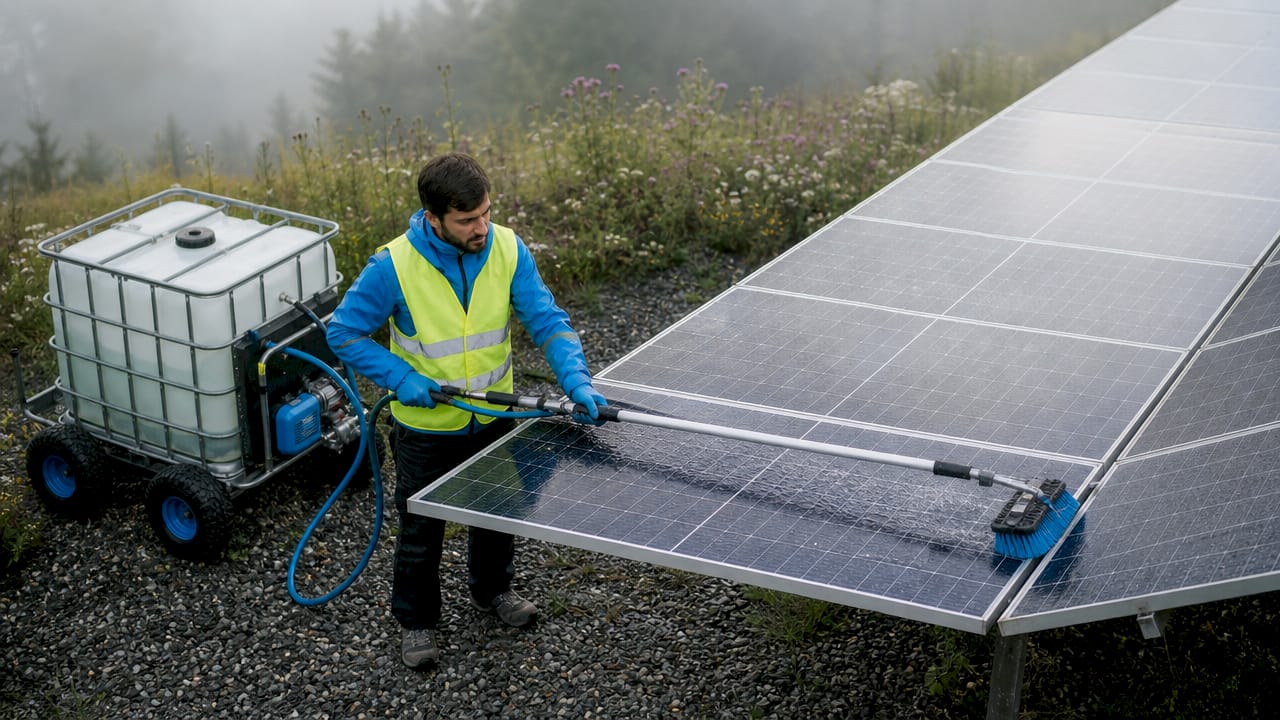
Manual cleaning uses trained technicians with soft brushes, water-fed poles, and purified water systems. Professional cleaning visits cost $150–$500 per visit, or $5–$20 per panel depending on array size and site complexity. Manual cleaning works well for smaller rooftop arrays on municipal buildings like libraries, fire stations, and community centers. The limitation is labor intensity. Costs scale linearly with panel count, making manual methods expensive for large ground-mounted arrays.
Robotic cleaning systems
Robotic cleaners are autonomous or semi-autonomous units that traverse panel rows using brushes or air jets. Robotic systems reduce O&M costs by 30–40% and increase energy generation by 6–15% in high-soiling environments. The per-MW annual cost for robotic cleaning dropped to $2,400 in 2026 from $4,000 in 2022. That cost reduction makes robotic systems competitive for any municipal array above 500 kW. Tracker-based robots that follow single-axis trackers are now entering the market and are worth specifying in forward-looking procurement documents.
Water-based vs. dry cleaning
Water quality is a non-negotiable specification point. Tap water with TDS above 50 ppm causes mineral buildup and long-term panel damage. Procurement documents must require deionized or demineralized water for all wet cleaning operations. Dry cleaning uses brushes or air systems and works in water-scarce regions or during drought restrictions. Dry methods are less effective on heavy soiling like bird droppings or pollen accumulation.
| Method | Cost Range | Best Use Case | Water Required |
|---|---|---|---|
| Manual (wet) | $5–$20 per panel | Small rooftop arrays | Deionized water |
| Robotic (automated) | $2,400/MW annually | Large ground-mounted arrays | Minimal or none |
| Hybrid | Varies by site | Mixed municipal portfolios | Deionized water |
| Dry brush/air | Lower per visit | Water-restricted sites | None |
Pro Tip: Require bidders to document their water source and TDS level in their technical proposal. Vendors who cannot confirm deionized water use should be disqualified from evaluation.
How to structure a procurement process for public solar cleaning
Public solar panel maintenance falls under public works regulations in most states. That classification triggers specific legal requirements that must appear in your solicitation documents from day one.
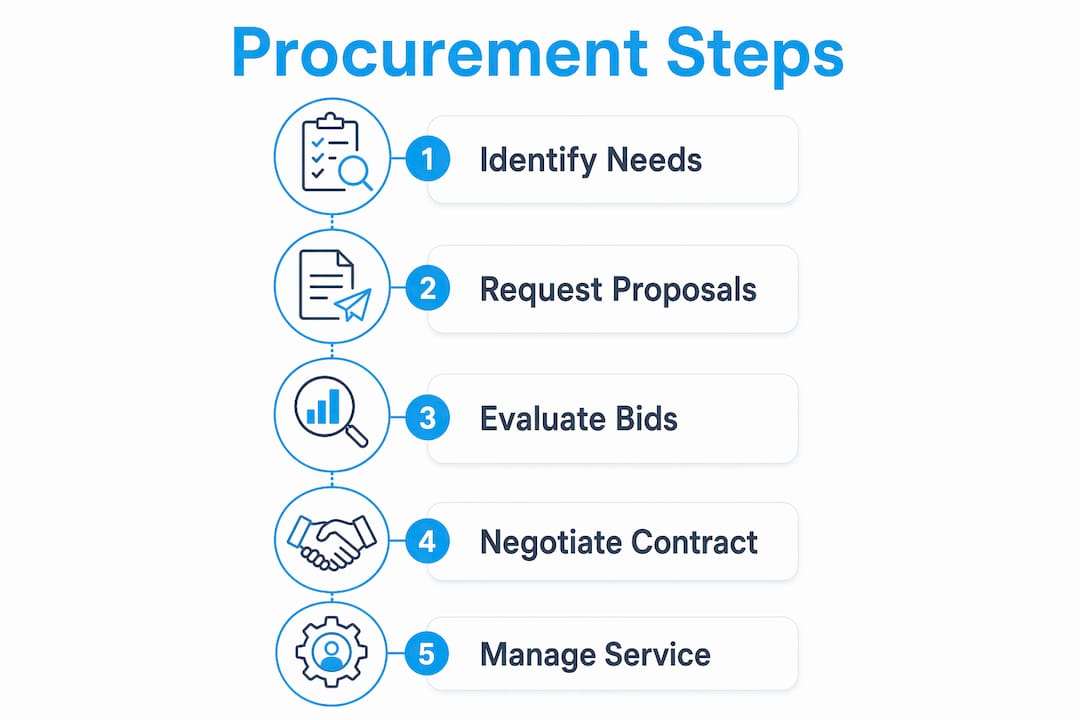
The procurement process for government solar maintenance contracts follows these steps:
- Define scope and site inventory. List every municipal site with solar, total panel count, array type (rooftop vs. ground-mount), and access constraints. Incomplete scope documents produce unreliable bids.
- Conduct a pre-bid site visit. Coordinated site visits before bid submission enable bidders to prepare realistic proposals aligned with site-specific needs. Schedule a mandatory walkthrough at least 14 days before the bid deadline.
- Mandate prevailing wage and certified payroll. Public works solar cleaning requires prevailing wage compliance, certified payroll submission, and detailed reporting per public sector contract standards. Omitting these requirements exposes the municipality to legal risk.
- Specify cleaning standards. Require deionized water, soft non-abrasive brushes, and no chemical detergents unless pre-approved. Reference manufacturer cleaning guidelines for the panel brand installed at each site.
- Define contract duration and renewal terms. A two-year base contract with two one-year renewal options gives vendors enough runway to invest in site-specific equipment while preserving municipal flexibility.
- Set performance metrics. Require post-cleaning inspection reports, before-and-after energy output comparisons, and photographic documentation for every visit.
- Establish evaluation criteria. Score bids on technical approach (40%), price (35%), relevant public sector experience (15%), and references (10%). Weighting technical approach highest protects panel longevity.
| Evaluation Criterion | Weight | What to Look For |
|---|---|---|
| Technical approach | 40% | Deionized water, equipment specs, safety plan |
| Price | 35% | Total cost over contract term |
| Public sector experience | 15% | Prior government solar cleaning contracts |
| References | 10% | Verifiable municipal or utility clients |
Pro Tip: Include a clause requiring vendors to submit a cleaning contract negotiation checklist or equivalent documentation showing how they handle scope changes and emergency cleanings.
What do municipal solar cleaning projects cost?
Cost-effective solar cleaning starts with understanding what drives the price. Panel count, site accessibility, cleaning frequency, and method all affect the final number.
Key cost drivers for municipal solar maintenance:
- Panel count and array size. Larger arrays lower the per-panel cost but raise the total contract value. A 200-panel rooftop array at $10 per panel costs $2,000 per visit. A 2,000-panel ground-mount at $7 per panel costs $14,000 per visit.
- Cleaning frequency. Standard guidelines recommend 2–4 cleanings per year for commercial systems. Municipalities in dusty or pollen-heavy regions like the Midwest should budget for the higher end of that range.
- Method selection. Robotic systems carry higher upfront costs but deliver ROI within 12–18 months for most projects. Manual contracts are cheaper to start but cost more over a five-year horizon for large arrays.
- Contract scope. Multi-site contracts covering an entire municipal portfolio typically yield lower per-visit pricing than single-site agreements. Bundle sites whenever possible.
Municipalities should build cleaning costs into their capital improvement plans and annual operations budgets separately. Treating solar cleaning as a discretionary line item leads to deferred maintenance and compounding energy losses. The Curitiba City Hall experience shows that periodic maintenance during dry periods significantly improves energy autonomy and offsets electricity costs for municipal buildings. That outcome is repeatable anywhere with a consistent cleaning schedule.
For long-term budget forecasting, use the $2,400 per MW annual robotic cost as a baseline for large arrays and $15 per panel annually for manual cleaning of smaller sites. Adjust upward for sites with heavy soiling from nearby construction, agriculture, or high bird activity.
How to coordinate solar cleaning across multiple municipal sites
Multi-site coordination is where most municipal solar programs lose efficiency. Without a clear operational framework, vendors miss access windows, facilities staff are caught off guard, and cleaning quality becomes inconsistent.
Effective coordination requires:
- A single point of contact at each facility. Assign a facilities manager or building supervisor to each site who can grant access, confirm safety clearances, and sign off on completed work.
- A master cleaning schedule published at contract start. Share the full-year schedule with facilities management, public works, and the vendor before the first cleaning visit. Integration with facilities management is critical to avoid disruption and maintain compliance during cleaning operations.
- Site-specific safety protocols. Rooftop arrays require fall protection plans. Ground-mount arrays near public spaces need perimeter controls during cleaning. Require vendors to submit a site-specific safety plan before mobilizing.
- Reporting standards for every visit. Require vendors to deliver a written report within 48 hours of each cleaning. Reports should include panel count cleaned, water quality readings, any damage observed, and post-cleaning energy output data if available.
- Data-driven schedule adjustments. Modern procurement uses site-specific soiling data to shift from fixed annual schedules to condition-based cleaning. Install basic soiling sensors or use inverter performance data to trigger cleanings when output drops more than 5% below baseline.
"Coordinated site visits before bid submission enable bidders to prepare realistic proposals aligned with site-specific needs and constraints."
Review the facility management coordination guide from Solaralchemist for a detailed scheduling framework built specifically for municipal operations teams.
Key Takeaways
Effective municipal solar panel cleaning procurement protects energy output, controls long-term costs, and keeps public solar assets compliant with public works regulations.
| Point | Details |
|---|---|
| Specify deionized water | Require TDS-verified water in all solicitation documents to prevent panel damage. |
| Mandate public works compliance | Include prevailing wage and certified payroll requirements from the first draft. |
| Use data to set frequency | Shift from fixed schedules to condition-based cleaning using inverter output data. |
| Bundle sites for savings | Multi-site contracts lower per-visit costs and simplify vendor management. |
| Evaluate technical approach first | Weight technical method at 40% of bid score to protect long-term panel performance. |
Robotics, data, and the future of public solar maintenance
The procurement officers I respect most are the ones who stopped treating solar cleaning as a janitorial line item. They treat it as an energy asset management decision. That shift changes everything about how you write a solicitation.
Robotic cleaning is the development I watch most closely right now. The cost curve is moving fast. At $2,400 per MW annually, robotic systems are no longer a premium option. For any municipal array above 500 kW, the five-year math almost always favors robotic over manual. What procurement documents rarely reflect yet is the predictability benefit. Manual contracts have variable costs tied to labor availability and site conditions. Robotic systems turn O&M into a fixed, forecastable expense. That matters enormously for municipal budget cycles.
The other shift I see coming is the move from scheduled cleaning to condition-triggered cleaning. Fixed two-times-per-year schedules made sense when we had no visibility into soiling rates. Now, inverter monitoring data and low-cost soiling sensors give you real-time performance signals. The best procurement documents I have reviewed in 2026 include a performance trigger clause: if output drops more than a defined threshold, the vendor mobilizes within a set number of days. That clause alone can recover energy losses that a fixed schedule would miss entirely.
My advice to procurement officers: visit the vendor selection guide before you draft your next RFP. The evaluation criteria that worked in 2022 do not reflect the technology options available now. Write your next contract for where the technology is going, not where it has been.
— Marquis
Solaralchemist's approach to public sector solar cleaning
Municipalities across Wisconsin trust Solaralchemist for professional-grade solar panel cleaning built around public sector requirements. Solaralchemist uses deionized water systems and specialized equipment designed to protect panel surfaces while maximizing energy recovery.
Solaralchemist serves municipal and commercial clients throughout the Madison, Wisconsin region, including communities in DeForest, Watertown, and surrounding areas. Every service plan includes documented reporting, certified water quality, and scheduling built around your facilities team's calendar. Not sure when your arrays need attention? The signs you need cleaning resource walks through eight performance indicators that signal it is time to act. Contact Solaralchemist to request a site assessment or a proposal tailored to your municipal portfolio.
FAQ
What is municipal solar panel cleaning procurement?
Municipal solar panel cleaning procurement is the formal process of selecting and contracting professional cleaning services for solar arrays on public buildings. It includes scope definition, vendor evaluation, compliance requirements, and contract management.
How often should municipal solar panels be cleaned?
Standard guidelines recommend 2–4 cleanings per year, but condition-based scheduling using inverter output data produces better results. Sites near agriculture, construction, or high bird activity typically need the higher end of that range.
What compliance requirements apply to public solar cleaning contracts?
Public works solar cleaning contracts must include prevailing wage rates, certified payroll submission, and detailed safety protocols. Omitting these requirements creates legal exposure for the municipality.
Does deionized water matter for solar panel cleaning?
Tap water with TDS above 50 ppm leaves mineral deposits that reduce panel efficiency over time. Procurement documents should require deionized or demineralized water for all wet cleaning operations.
When do robotic cleaning systems make financial sense for municipalities?
Robotic systems deliver ROI within 12–18 months for most projects and reduce O&M costs by 30–40%. For municipal arrays above 500 kW, robotic cleaning is typically more cost-effective than manual contracts over a five-year period.