
Solar panel cleaning contract negotiation is the process of securing clear, fair agreements with service providers that maintain your system's performance and protect your investment. Poorly written contracts are the single biggest reason commercial solar operators lose money on maintenance. Soiling losses alone reduce energy output by 3–8% annually, and industrial or roadside sites can exceed 10%. The difference between a contract that recovers that output and one that creates billing disputes comes down to specificity. This guide gives facility managers, sustainability coordinators, and procurement professionals the exact framework to negotiate solar panel maintenance agreements that deliver results.
What key elements should be included in solar panel cleaning contracts?
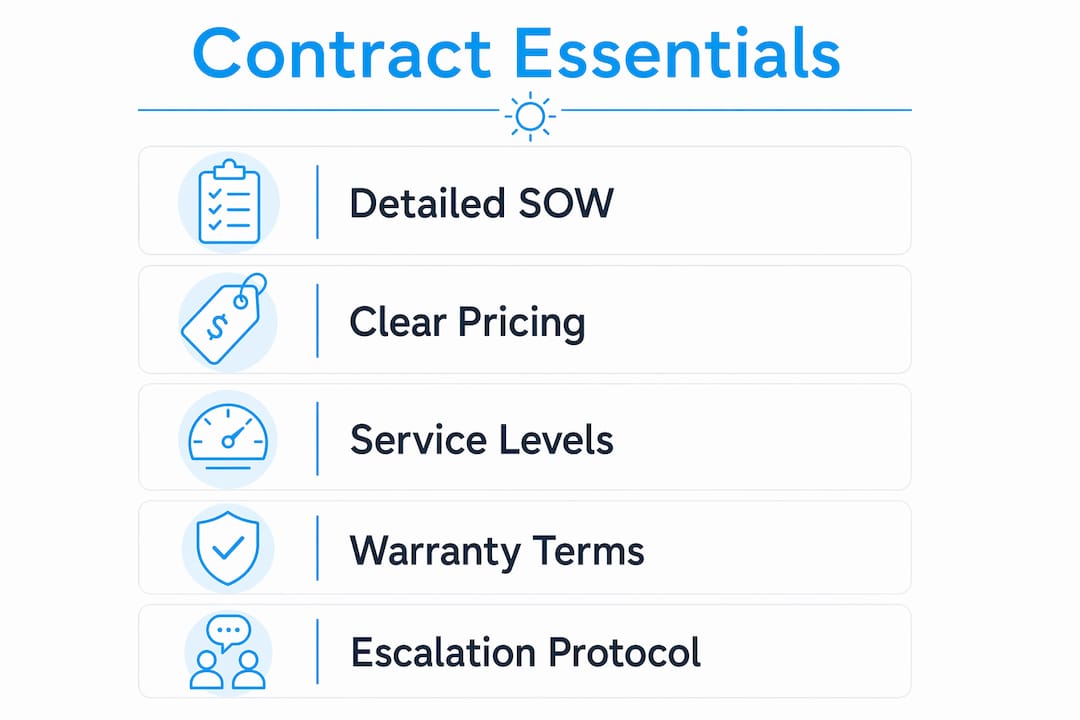
A solar panel cleaning contract must define scope, scheduling, pricing, liability, and exit terms in explicit language. Vague contracts are the primary source of service gaps. A clear Scope of Work specifying cleaning methods, water quality, and safety protocols is the foundation that holds any provider accountable. Without it, you have no legal basis to dispute substandard work.
The industry term for this document structure is a Service Level Agreement (SLA), and it should sit at the center of every solar panel upkeep contract. An SLA defines not just what gets done, but how well and how fast. Every commercial cleaning agreement should include the following components:
- Scope of Work (SOW): Specify cleaning method (deionized water, soft brushes, no abrasives), panel type, and whether inverters or racking are included.
- Scheduling and frequency: Commercial rooftop systems typically require cleaning every 12 to 24 months, with heavily soiled sites cleaned annually. Lock this into the contract explicitly.
- Pricing structure: State whether pricing is per kW, per panel, or per visit. Include mobilization fees and any surcharges for access equipment.
- SLA response times: Define turnaround for emergency cleanings after weather events or construction dust exposure.
- Cancellation clause: Require a 30-day cancellation provision with no penalty for standard termination.
- Liability and insurance: Require the provider to carry general liability and workers' compensation certificates. Confirm coverage limits in writing.
Pro Tip: Request a sample SLA from any provider before signing. If they cannot produce one, that tells you everything about how they manage service accountability.
The warranty consideration is often overlooked. Some solar manufacturers void panel warranties if cleaning is performed with tap water or abrasive tools. Your contract must specify that the provider uses deionized water systems and non-abrasive equipment to keep your manufacturer warranty intact.
How do pricing models and payment terms work in solar panel cleaning contracts?
Pricing for solar cleaning services follows two primary models: per-kW capacity pricing and per-panel pricing. Commercial contracts price by system capacity rather than per panel to reduce administrative complexity and align costs with actual energy generation. Per-panel pricing works for smaller arrays under 50 kW, but it becomes unwieldy at scale.

Comparing pricing models
| Pricing model | Best for | Typical use case |
|---|---|---|
| Per kW (capacity-based) | Systems 50 kW and above | Commercial rooftop, ground-mount arrays |
| Per panel | Systems under 50 kW | Small commercial, multi-tenant buildings |
| Per visit (flat fee) | Irregular or one-off cleanings | Post-construction, storm response |
Standard commercial solar maintenance contracts range from $2 to $4 per kW per year for baseline agreements, with premium tiers reaching $4 to $8 per kW per year. Mid-market systems in the 50 to 500 kW range typically settle near the lower end of that range. These figures give you a concrete benchmark when evaluating proposals.
What gets included in that price matters as much as the number itself. Water logistics directly affect contract costs. Rooftop water access, use of water trailers, and deionized water systems each carry different cost implications. A provider who quotes a low per-kW rate but bills separately for water trailer mobilization can end up more expensive than a higher-quoted competitor with all-inclusive pricing.
Key financial terms to negotiate and confirm in writing:
- Billing frequency: Monthly retainer, per-visit invoicing, or annual lump sum. Monthly retainers work best for multi-site operators.
- Automated billing: Confirm whether the provider uses automated payment systems and what the dispute resolution process looks like.
- Change orders: Define the approval process for any work outside the original SOW. Require written authorization before additional charges apply.
- Price adjustment protocol: Contracts should define how and when pricing can change, with advance written notice required. Avoid open-ended escalation clauses.
Pro Tip: Ask for a full cost breakdown before signing, including water source, consumables, equipment, and travel. Financial transparency clauses that define every cost inclusion prevent surprise fees and build trust in the vendor relationship.
What negotiation strategies maximize value in solar panel cleaning agreements?
Negotiating cleaning services for commercial solar requires a different mindset than standard facility procurement. You are not buying a commodity. You are buying technical expertise, equipment capability, and accountability. Prioritizing the lowest bid over demonstrated competence is the most common and costly mistake organizations make.
Follow this sequence when negotiating solar panel maintenance agreements:
- Define your SOW first. Write your own scope before issuing a request for proposal. Providers who respond to a detailed SOW give you comparable bids. Providers who write their own scope give you incomparable ones.
- Request references from comparable sites. Ask specifically for commercial accounts with similar system sizes and soiling conditions. Call those references.
- Verify insurance certificates directly. Do not accept a summary. Request the actual certificate of insurance from the provider's insurer and confirm it is current.
- Negotiate schedule flexibility. Flexible scheduling provisions accommodate seasonal demand spikes and event-related cleaning needs. Get this in writing, not as a verbal assurance.
- Include performance metrics. Require the provider to deliver a post-cleaning report with before-and-after production data where available. Performance ratio (PR) guarantees create measurable accountability.
- Limit initial contract length. Start with a 12-month agreement with renewal options. Avoid multi-year lock-ins until you have verified service quality firsthand.
- Use competitor offers as leverage. Obtain at least three bids. Use the range to negotiate pricing transparency and inclusions, not just to drive the price down.
Negotiating for value and reliability rather than lowest cost produces more sustainable service partnerships. A provider who cuts corners on deionized water or skips safety protocols to win on price will cost you more in warranty claims and panel degradation than the savings justify.
Pro Tip: Include an escalation protocol in the contract. Define who to contact if service quality drops, what the response timeline is, and what remedies apply if the provider fails to meet SLA terms.
What technical and logistical considerations affect contract terms?
Technical factors directly shape what belongs in a solar panel cleaning contract, and ignoring them creates risk that shows up in panel degradation, voided warranties, or unexpected costs. The most overlooked technical requirement is thermal shock protection.
Panels must not be cleaned during mid-day heat because cold water applied to hot glass causes micro-cracking that accelerates degradation over time. Contracts must specify that cleaning occurs in early morning or evening hours only. This single clause protects your panels from a failure mode that is invisible until it shows up in a performance audit years later.
Other technical and logistical terms that belong in every contract:
- Panel tilt and soiling rate: Systems with less than 10 degrees of tilt accumulate soiling faster and may require more frequent cleaning intervals. Your contract should account for this in the scheduling terms.
- Access equipment: Ground-mount arrays, elevated rooftops, and carport structures each require different equipment. Specify who supplies it and who bears the cost.
- Water trailer logistics: If the site lacks rooftop water access, a water trailer is required. Define cost responsibility and access permissions in the contract.
- Warranty alignment: Confirm that the provider's methods comply with your panel manufacturer's maintenance guidelines. Ask for written confirmation.
"Independent service providers offer more objective performance reporting, focusing on system-wide inspection rather than surface cleaning alone. This unbiased approach improves early detection of underperformance and protects warranty claims." — Solar Tech Support
Aligning cleaning schedules with your broader solar energy maintenance program, including inverter inspections and monitoring reviews, maximizes the value of each service visit. A provider who only cleans panels without noting visible damage or performance anomalies is delivering half the value you should expect.
How to review and finalize solar panel cleaning contracts effectively?
Contract review is where most procurement errors get caught, or missed. A signed contract with gaps is harder to fix than a negotiation that takes an extra week. Follow this process before any solar panel upkeep contract goes to signature:
- Cross-check the contract against your original RFP or proposal. Every service promised verbally or in writing during the sales process must appear explicitly in the contract. If it is not in the document, it does not exist.
- Confirm all SOW elements are present. Cleaning method, water type, frequency, access requirements, and reporting obligations should all be stated, not implied.
- Verify the cancellation clause. A fair contract includes a 30-day written notice provision for either party. Clauses that require 90 days or impose financial penalties for standard termination are red flags.
- Document pricing, SLAs, and penalties. Every number in the contract should match the proposal. Confirm that penalty clauses for missed SLAs are present and proportionate.
- Set up onboarding protocols. Define the first-service walkthrough process, site access procedures, and the primary point of contact on both sides before work begins.
- Establish a contract record system. Store the signed agreement, insurance certificates, and all amendments in a centralized location. Schedule a contract review at the six-month mark to assess performance against SLA terms.
Pro Tip: Never rely on email threads as a substitute for contract amendments. Any change to scope, pricing, or schedule should be documented as a formal written amendment signed by both parties.
Key takeaways
Effective solar panel cleaning contract negotiation requires a detailed Scope of Work, transparent pricing, and enforceable SLAs before any agreement is signed.
| Point | Details |
|---|---|
| Lead with a detailed SOW | Specify cleaning method, water type, and access requirements to prevent service gaps. |
| Benchmark pricing by capacity | Commercial contracts typically range from $2 to $8 per kW per year depending on service tier. |
| Include thermal shock protection | Require early morning or evening cleaning times to prevent panel micro-cracking. |
| Negotiate flexible exit terms | A 30-day cancellation clause protects you from poor-performing vendors without financial penalty. |
| Verify performance reporting | Require post-cleaning production data and PR ratio documentation to enforce accountability. |
Why the details in your contract matter more than the price
I have reviewed a lot of solar panel maintenance agreements, and the pattern is consistent. Organizations that focus the negotiation on price end up with contracts that look fine on paper and fail in practice. The provider shows up with tap water and a pressure washer, cleans at noon in August, and submits an invoice that matches the agreed rate. Nothing in the contract prevents any of that.
The businesses that get real value from their cleaning contracts are the ones that spend time on the SOW before they ever talk to a vendor. They know their panel tilt, their soiling rate, their access constraints, and their manufacturer's maintenance requirements. When they sit down to negotiate, they are not reacting to a proposal. They are evaluating whether a vendor can meet a standard they already defined.
The other mistake I see regularly is treating the contract as a one-time event. A signed agreement is the start of a vendor relationship, not the end of a negotiation. The organizations that get the best long-term service are the ones that schedule quarterly check-ins, document every service visit, and treat the SLA as a living accountability tool. That approach also gives you leverage at renewal time. You have data. They know you are paying attention.
One more thing worth saying directly: the cheapest bid is almost never the best value in commercial solar maintenance. A provider who cannot explain their water quality standards or show you their insurance certificate is a liability, not a savings. The cost of one warranty claim or one panel replacement will exceed years of savings from a discounted cleaning rate.
— Marquis
How Solaralchemist supports your solar panel cleaning contract
Solaralchemist is Madison, Wisconsin's specialized solar panel cleaning and maintenance provider, built specifically for commercial and organizational solar investments. The team uses professional-grade deionized water systems and purpose-built equipment to protect panels, preserve warranties, and maintain peak energy output year-round. If you are preparing to negotiate a cleaning contract or evaluating your current agreement, the signs your panels need cleaning resource is a practical starting point for understanding service frequency. For organizations ready to work with a provider that brings technical depth and full contract transparency to every engagement, visit Solaralchemist's service page to learn more or request a consultation.
FAQ
What should a solar panel cleaning contract always include?
Every contract must include a detailed Scope of Work, cleaning frequency, pricing structure, SLA response times, liability insurance requirements, and a cancellation clause. Missing any of these creates accountability gaps that are difficult to enforce after signing.
How is pricing typically structured in commercial solar cleaning contracts?
Commercial contracts price by system capacity, typically per kW, rather than per panel. Standard agreements range from $2 to $8 per kW per year depending on service tier and site complexity.
Why does cleaning time of day matter in a contract?
Cleaning panels during mid-day heat causes thermal shock, which leads to micro-cracking in the glass. Contracts must specify early morning or evening cleaning windows to prevent this type of panel degradation.
How often should commercial solar panels be cleaned?
Commercial rooftop systems typically require cleaning every 12 to 24 months, with heavily soiled or industrial sites cleaned annually. Your contract should set the interval based on your site's specific soiling rate and panel tilt.
What is the biggest negotiation mistake organizations make?
The most common error is prioritizing the lowest bid over contract specificity. A vague contract with a low rate creates more financial risk through service gaps, warranty issues, and unexpected fees than a well-structured agreement at a fair market rate.