
Solar panel safety compliance is the full set of standards, codes, and regulatory requirements that govern how solar energy systems are installed, operated, maintained, and decommissioned to protect people and property. For facility managers and solar panel owners, understanding what is solar panel safety compliance means knowing which rules apply at every stage of your system's life. The core framework in the United States draws from NEC Article 690, UL 3741, IEC 61730, IEC 62446, and OSHA regulations. Together, these standards address electrical safety, fire resistance, firefighter protection, documentation, and worker safety. Compliance is not a one-time checkbox. It is a continuous obligation that follows your system from the permit application through final decommissioning.
What is solar panel safety compliance and why does it matter?
Solar panel safety compliance is defined as adherence to the technical, legal, and procedural requirements that make a photovoltaic system safe for users, installers, and emergency responders. The industry term used by regulators and standards bodies is "PV system safety qualification." Both phrases describe the same obligation, and you will encounter both in permit applications and inspection reports.
The stakes are concrete. A non-compliant system can void your manufacturer warranty, disqualify you from utility interconnection, and expose you to liability if a fire or electrical incident occurs. IEC 62446 defines commissioning and documentation requirements for grid-connected systems, and insurers and utilities increasingly require proof of compliance before activating a system. Compliance is therefore both a safety floor and a financial protection.
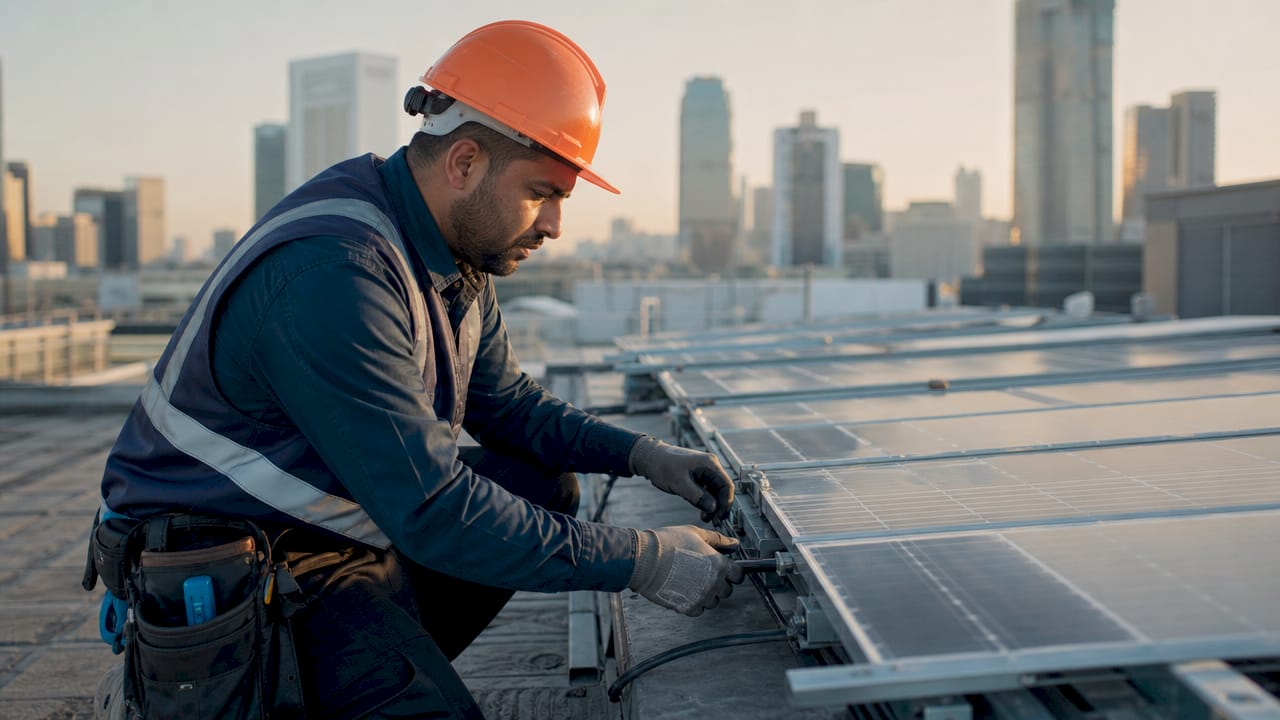
Facility managers carry a heavier burden than residential owners because commercial arrays are larger, more complex, and subject to additional OSHA workplace safety rules. A rooftop array on a warehouse, for example, must satisfy NEC Article 690 electrical requirements, local building codes, OSHA fall protection standards, and utility interconnection agreements simultaneously.
What are the primary safety risks in solar installations?
Solar installations carry four distinct categories of risk: electrical shock, fire, physical injury during installation, and structural failure. Each category has a corresponding compliance requirement designed to reduce it.
Electrical shock is the most immediate hazard. PV arrays generate DC voltage even when the grid is disconnected, which creates a persistent shock risk for firefighters and maintenance workers. NEC 690.12 requires conductors inside the array to be reduced to 30V or less within 30 seconds of rapid shutdown activation. That rule exists specifically to protect first responders who may cut into a roof during a fire.
Fire risk is addressed through module-level fire resistance ratings. IEC 61730 categorizes photovoltaic module fire resistance into Classes A, B, and C, with Class A being the highest rating. Most commercial installations in the U.S. require Class A modules. Choosing a lower-rated module to cut costs is a compliance violation that can also invalidate your property insurance.
Physical risks during installation fall under OSHA regulations, which require fall protection systems for roof work above six feet, proper personal protective equipment (PPE), and lockout/tagout procedures before any electrical work begins.
- Electrical shock from energized DC conductors
- Fire ignition from arc faults or damaged wiring
- Falls during panel installation or maintenance
- Structural overload from improperly mounted arrays
- Arc flash during inverter or combiner box work
Pro Tip: Before any maintenance crew accesses your rooftop array, verify that your rapid shutdown system is functional and that all workers have confirmed the array is de-energized using a calibrated DC voltmeter.
Which standards govern solar panel safety compliance in the U.S.?
Four primary frameworks define solar panel regulations in the United States. Each covers a different phase or aspect of system safety.
NEC Article 690 is the foundational electrical code for PV systems in the U.S. It covers conductor sizing, overcurrent protection, grounding, labeling, and rapid shutdown. 99% of U.S. jurisdictions require building and electrical permits for grid-tied solar under NEC Article 690. That near-universal adoption means there is no jurisdiction where you can legally skip the permit process.
UL 3741 was developed to define the electrical hazards firefighters face during PV system emergencies. UL 3741 verifies PV system safety through testing that replicates emergency scenarios, including the electrical resistance of firefighter gear and the human body. Systems that pass UL 3741 testing qualify as an alternative compliance pathway for NEC 690.12 rapid shutdown requirements.
IEC 61730 governs module-level safety qualification, including mechanical integrity, electrical insulation, and fire resistance classification. It is the international standard that module manufacturers must meet before their products can be sold in most markets.
IEC 62446 covers what happens after installation. It defines the commissioning tests, documentation packages, and periodic inspection schedules that grid-connected systems must follow. Failure to comply with IEC 62446 can void warranties and increase liability risks. That makes it one of the most financially consequential standards for facility managers.
| Standard | Scope | Key requirement |
|---|---|---|
| NEC Article 690 | U.S. electrical installation | Conductor sizing, rapid shutdown, labeling |
| UL 3741 | Firefighter safety testing | Verify safe voltage levels under emergency conditions |
| IEC 61730 | Module safety qualification | Fire resistance Class A, B, or C rating |
| IEC 62446 | Commissioning and documentation | Inspection records, test reports, periodic audits |
| OSHA 29 CFR 1926 | Worker safety during installation | Fall protection, PPE, lockout/tagout |
SEIA's development of national standards like SEIA 401 adds another layer by addressing ethical sourcing, proper installation practices, and responsible decommissioning. SEIA 401 is increasingly referenced by state regulators and large commercial buyers as a procurement requirement.
How do you maintain compliance across the system lifecycle?
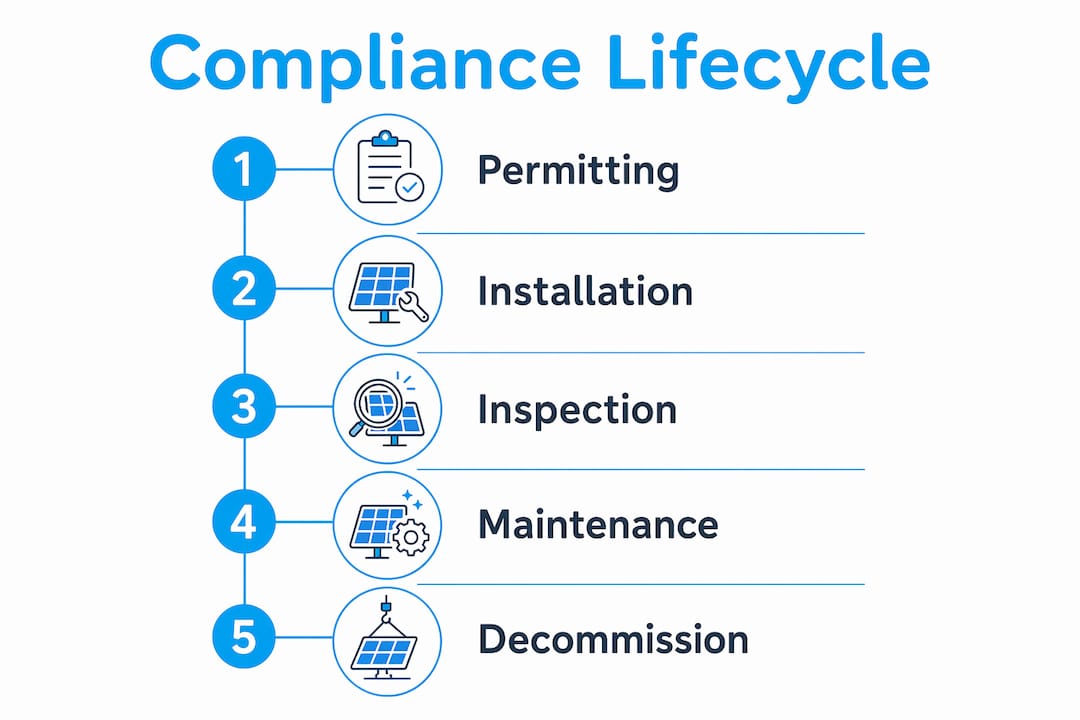
Solar panel installation safety is only the starting point. Compliance for solar systems must be actively maintained through every phase of operation.
-
Obtain all required permits before installation begins. Building and electrical permits are mandatory in virtually every U.S. jurisdiction. Skipping this step does not just risk a fine. It can require you to remove and reinstall the entire system at your own cost.
-
Complete and retain commissioning documentation per IEC 62446. This includes insulation resistance test results, open-circuit voltage measurements, and string current readings. Maintaining comprehensive commissioning and inspection records supports warranty claims and satisfies regulatory audits. Treat these records as permanent assets, not temporary paperwork.
-
Schedule routine inspections and cleaning. Soiled panels are not just a performance issue. Accumulated debris can trap heat, degrade encapsulant materials, and create localized hot spots that increase fire risk. An annual solar maintenance checklist should include visual inspection of wiring, mounting hardware, and junction boxes alongside cleaning.
-
Review your utility interconnection agreement annually. Interconnection agreements specify maximum system output, protection relay settings, and reporting requirements. Exceeding PV string length limits or modifying the inverter configuration without notifying the utility can trigger permit rejection and disconnect your system from the grid.
-
Plan for end-of-life disposal from day one. Solar panels may be classified as hazardous waste at end of life due to leachable toxic heavy metals like lead and cadmium, requiring disposal under the Resource Conservation and Recovery Act (RCRA). Facility managers who ignore this face significant regulatory penalties.
Pro Tip: Store your IEC 62446 commissioning package in both a physical binder on-site and a cloud backup. Auditors, insurers, and utilities may request these records with little advance notice.
What compliance pitfalls cause inspection failures?
The most common solar safety violations are not exotic edge cases. They are predictable errors that a prepared facility manager can avoid entirely.
Common NEC Article 690 violations causing inspection failures include exceeding voltage limits, missing rapid shutdown systems, undersized conductors, and improper labeling. Each of these is a separate line item on a standard inspection checklist, and each one can result in a failed inspection and costly rework.
- Missing or non-functional rapid shutdown systems. This is the single most cited violation in commercial inspections. The system must be installed, labeled, and tested before final inspection.
- Undersized conductors. Using wire that is too small for the calculated current creates a fire hazard and violates NEC 690 conductor sizing rules.
- Unlabeled disconnects. Every disconnect switch must be permanently labeled with its function, voltage, and current rating. Missing labels are an automatic inspection failure.
- Absent ground fault protection. Ground fault protection devices are required on all grounded PV systems. Omitting them is both a code violation and a serious shock hazard.
- Ignoring utility interconnection limits. Exceeding PV string length limits is a common trigger for permit rejection. Always verify your string configuration against the interconnection agreement before installation.
Noncompliance consequences extend beyond failed inspections. An out-of-compliance system can void your equipment warranty, disqualify your installation from state incentive programs, and leave you personally liable if an incident occurs. Insurance companies are increasingly auditing solar installations, and a compliance gap discovered after a fire or injury claim can result in a denied payout.
Key takeaways
Solar panel safety compliance is a multi-stage obligation governed by NEC Article 690, UL 3741, IEC 61730, and IEC 62446, and it requires active management from permitting through end-of-life disposal.
| Point | Details |
|---|---|
| Compliance starts at permitting | Building and electrical permits are required in virtually every U.S. jurisdiction before installation begins. |
| Rapid shutdown is non-negotiable | NEC 690.12 requires array conductors to drop to 30V or less within 30 seconds to protect firefighters. |
| Documentation protects your investment | IEC 62446 commissioning records support warranty claims, insurance audits, and utility agreements. |
| Routine maintenance is a compliance act | Regular inspection and cleaning reduce fire risk and satisfy ongoing safety obligations. |
| End-of-life planning is legally required | Panels containing lead or cadmium may require disposal under RCRA hazardous waste rules. |
Why compliance is harder than most owners expect
Facility managers should view safety compliance as a dynamic, ongoing process spanning installation through decommissioning. I have seen too many owners treat the permit approval as the finish line. It is not. It is the starting gun.
The part that catches people off guard is how many different standards apply simultaneously, and how they shift at each phase. NEC 690 governs your installation. IEC 62446 takes over post-commissioning. RCRA enters the picture at end of life. None of these frameworks talk to each other in plain language, and none of them send you a reminder when something changes.
What I find most underappreciated is the documentation burden. IEC 62446 records are not bureaucratic busywork. They are your legal defense if a fire investigator, insurer, or regulator questions your system's condition. Facility managers who treat these records as a living asset, updating them after every inspection and cleaning, are the ones who sail through audits. The ones who let records lapse are the ones who face denied claims.
My honest advice: build compliance into your maintenance calendar the same way you schedule HVAC service. Solar safety standards are not static. The NEC updates on a three-year cycle, and state adoption lags vary. Staying current requires active attention, not passive assumption.
— Marquis
Solaralchemist supports your compliance through expert maintenance
Professional cleaning and inspection are not just performance measures. They are part of your ongoing safety compliance obligation.
Solaralchemist serves facility managers and solar panel owners across Madison, Wisconsin and the surrounding region with professional-grade deionized water cleaning systems and thorough visual inspections. Dirty panels develop hot spots that accelerate material degradation and increase fire risk, two outcomes that compliance standards are specifically designed to prevent. Our team documents each service visit, giving you records that support your IEC 62446 maintenance log and satisfy insurer requests. If you are unsure whether your system is meeting its solar panel cleaning standards, Solaralchemist provides the expert assessment and hands-on service to keep your array safe, clean, and fully operational. Learn more about how professional solar maintenance protects your investment year-round.
FAQ
What is solar panel safety compliance?
Solar panel safety compliance is adherence to the codes, standards, and regulations that govern safe installation, operation, and decommissioning of photovoltaic systems. In the U.S., the primary framework includes NEC Article 690, UL 3741, IEC 61730, and IEC 62446.
Is a permit required for every solar installation?
Building and electrical permits are required in virtually every U.S. jurisdiction for grid-tied solar systems. Skipping permits can result in forced removal of the system and disqualification from utility interconnection.
What does rapid shutdown compliance require?
NEC 690.12 requires that conductors inside the PV array be reduced to 30V or less within 30 seconds of rapid shutdown activation. This protects firefighters who may access the roof during an emergency.
How often should solar panels be inspected for compliance?
IEC 62446 requires periodic inspections after commissioning, with most commercial systems inspected annually. Each inspection should include electrical testing, visual checks of wiring and mounting, and updated documentation.
Are solar panels considered hazardous waste at end of life?
Panels containing lead or cadmium may qualify as hazardous waste under RCRA if they fail toxicity testing. Facility managers must evaluate disposal requirements before decommissioning and follow EPA guidelines for proper handling.