
Solar panel vendor qualification is the systematic evaluation of vendors against technical certifications, operational standards, and financial criteria to confirm their products are reliable, bankable, and compliant. For solar installers, energy consultants, and procurement teams, this process separates vendors who meet IEC standards and independent lab benchmarks from those who only appear to on paper. Skipping it exposes projects to performance failures, warranty disputes, and disqualification from federal funding. The industry is now moving toward ANSI/SEIA operational excellence standards that expand qualification well beyond product specs, making a structured approach to solar vendor assessment criteria more critical than ever.
What is solar panel vendor qualification, and why does it matter?
Solar panel vendor qualification is defined as the formal process of verifying that a supplier meets documented technical, operational, and contractual requirements before they are approved for procurement. The industry term for this process is "supplier qualification" or "vendor qualification," and it applies to both initial approval and ongoing performance monitoring. Qualification protects projects from component failures, supply chain disruptions, and financial losses tied to underperforming equipment.
The stakes are concrete. Nearly 49% of organizations faced vendor-related operational disruptions in 2024. That figure reflects what happens when procurement teams rely on reputation alone instead of structured evaluation. A qualified vendor is one whose certifications are current, whose factory practices match their certified samples, and whose financial and operational track record supports long-term project commitments.

Qualification also determines funding eligibility. Government-backed projects of 300 MW or more require formal RFQ submissions with Supply Chain Plans. Failure to submit those plans leads to disqualification from federal funding opportunities. That requirement alone makes vendor qualification a procurement prerequisite, not an optional review.
What certifications and technical standards define solar vendor qualification?
The baseline for any qualified solar module starts with two IEC certifications. IEC 61215 covers design qualification and type approval, while IEC 61730 addresses safety requirements. IEC 61215 testing includes 200 thermal cycles from -40°C to +85°C and 1,000 hours of damp heat exposure. These tests simulate decades of real-world stress in a controlled environment.
Beyond the baseline, supplementary certifications address specific environmental risks:
- IEC 61701 tests resistance to salt mist corrosion, relevant for coastal and offshore installations.
- IEC 62716 evaluates ammonia resistance, critical for agricultural and rural sites.
- IEC 62804 covers potential-induced degradation (PID) resistance, one of the most common failure modes in the field.
Certifications alone do not tell the full story. Independent lab scorecards from organizations like Kiwa PVEL, DNV, and TÜV go further by ranking modules on real-world performance metrics. Independent lab scorecards prioritize discovering specific product issues that financial ratings overlook entirely, including LeTID (light and elevated temperature-induced degradation) and PID susceptibility. A module can hold valid IEC certifications and still rank poorly on a Kiwa PVEL scorecard.
Pro Tip: Always verify that the certification on file matches the exact model number you are purchasing. Manufacturers sometimes certify one configuration and ship another. Request the test report and cross-check the bill of materials.
When reviewing certifications, confirm the issue date and expiration. Certifications lapse, and a vendor presenting a five-year-old IEC 61215 certificate for a current product line is presenting incomplete documentation.
How do factory audits and BOM verification strengthen qualification?
A certification confirms that a sample passed a test. A factory audit confirms that the product being manufactured today matches that sample. Factory audits verify that the production bill of materials (BOM) matches the certified sample, preventing substitution of lower-grade components at scale. This distinction matters because manufacturers sometimes swap components during mass production without updating their certification documentation.
BOM verification is the process of comparing the components listed in the certified test unit against the components actually used in current production. The components that most commonly get substituted include:
- Encapsulant films, which affect moisture resistance and long-term degradation rates.
- Backsheets, where lower-grade materials increase fire risk and UV degradation.
- Junction boxes and bypass diodes, which directly affect performance under partial shading.
- Cell suppliers, since cell quality varies significantly between manufacturers.
Contractual measures reinforce audit findings. Embedding a Quality and Inspections Requirement Exhibit into supplier contracts legally obligates vendors to provide documentation and submit to audits. Pre-production inspections catch substitutions before manufacturing begins. Production-line inspections catch them during the run. Both are standard practice in large-scale procurement.
Pro Tip: Build random BOM audits into your ongoing procurement contracts, not just the initial qualification phase. Component substitution is most likely to occur after the initial order, once a vendor assumes the relationship is established.
For solar installers evaluating vendor selection criteria, factory audits are the most direct way to verify that what was certified is what gets delivered.
What operational and financial criteria belong in vendor qualification?
Technical compliance is necessary but not sufficient. A vendor who produces certified modules but cannot deliver on time, maintain financial stability, or meet supply chain transparency requirements creates project risk just as surely as a vendor with poor test scores.
Operational KPIs form the measurable backbone of this evaluation. Top procurement teams target 99%+ equipment availability annually, with delivery adherence tracked against contractual timelines. A vendor consistently missing delivery windows or reporting equipment downtime above 1–2% signals supply chain fragility.
The Tier 1 classification is the most misunderstood metric in solar procurement. Tier 1 status measures a manufacturer's bankability, meaning their ability to secure project financing. It does not measure module quality, reliability, or technical performance.
Tier 1 status is a financial rating, not a technical endorsement. A Tier 1 manufacturer can produce modules that fail independent lab testing. Procurement teams that treat Tier 1 as a quality proxy skip the technical due diligence that prevents LeTID, PID, and field failures.
The 2026 ANSI/SEIA standards push qualification further into operational excellence territory. The updated framework covers ethics, consumer protection, environmental responsibility, and technical competence across residential installation, commercial installation, and operations and maintenance. This shift means qualifications for solar suppliers now include organizational conduct, not just product performance.
Automation is accelerating this evolution. Qualification programs increasingly monitor compliance and credentials in real time, reducing the manual review burden and catching lapses before they affect active projects. Procurement teams that rely on annual manual reviews are already behind the standard.
How to apply vendor qualification in procurement and contract management
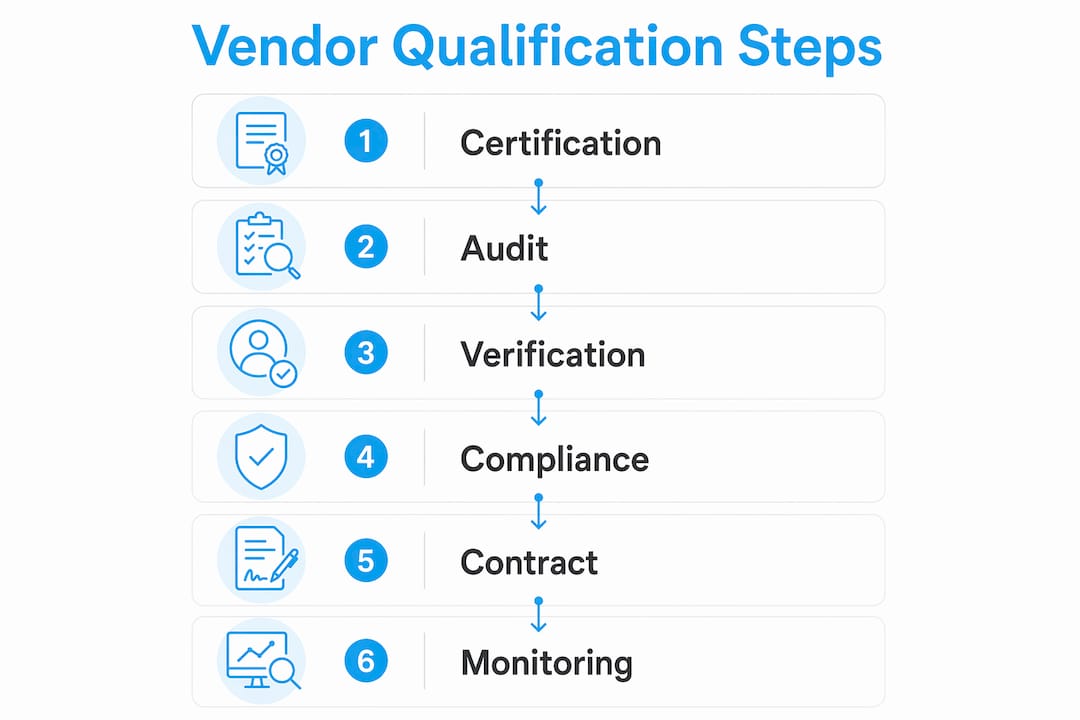
A structured qualification workflow prevents gaps between vendor approval and ongoing performance accountability. The process runs in five stages:
- Documentation request. Collect IEC 61215 and IEC 61730 certificates, independent lab scorecards, BOM documentation, and factory audit reports. Verify that all documents match the specific model numbers under consideration.
- Technical review. Cross-reference certifications against independent lab rankings from Kiwa PVEL, DNV, or TÜV. Flag any models with known failure modes or degraded scorecard positions.
- Factory audit. Conduct or commission a pre-production audit to confirm BOM alignment. For large orders, add a production-line inspection.
- Contract embedding. Insert a Quality and Inspections Requirement Exhibit into the supplier agreement. Contracts should require flash test reports per container to confirm module quality at delivery. Include SLAs with defined penalties for non-compliance.
- Ongoing monitoring. Track delivery adherence, equipment availability, and certification renewal dates. Trigger re-qualification when a vendor introduces a new product line or changes manufacturing locations.
Third-party platforms that aggregate certification data, audit histories, and scorecard results reduce the manual workload significantly. These tools allow procurement teams to compare vendors across multiple criteria without building internal databases from scratch.
Pro Tip: Treat qualification as a living process, not a one-time gate. Vendors change component suppliers, shift production to new facilities, and introduce new product lines. Each change warrants a fresh review of BOM documentation and certification status.
For teams managing contractual negotiation alongside procurement, embedding qualification requirements into the supplier agreement from day one is far easier than retrofitting them after a problem surfaces.
Qualification also connects directly to solar panel safety compliance, since the same certifications that qualify a vendor also define the safety baseline for the installed system.
Key Takeaways
Solar panel vendor qualification requires verified IEC certifications, independent lab scorecards, factory BOM audits, and enforceable contractual QA obligations to protect project quality and funding eligibility.
| Point | Details |
|---|---|
| IEC certifications are the baseline | IEC 61215 and IEC 61730 are the minimum technical requirements for any qualified solar module. |
| Tier 1 is not a quality metric | Tier 1 status measures bankability, not technical performance or field reliability. |
| BOM audits prevent substitution | Factory audits confirm that production components match the certified sample, not a cheaper alternative. |
| Contracts must enforce QA | Embedding a Quality and Inspections Requirement Exhibit legally obligates vendors to provide documentation and accept audits. |
| Qualification is continuous | New product lines, facility changes, and certification renewals all trigger re-qualification under current best practices. |
Why Tier 1 thinking is costing projects more than people admit
The industry has a Tier 1 problem. Procurement teams, project financiers, and even experienced installers treat Tier 1 status as a shortcut through the qualification process. I have seen projects approved on the strength of a manufacturer's Tier 1 classification alone, with no independent lab scorecard review and no BOM audit. Those projects are not protected. They are just financed.
The uncomfortable reality is that Tier 1 status is a financial analyst's tool, not an engineering tool. It tells you whether a bank will lend against a manufacturer's modules. It tells you nothing about whether those modules will resist PID in a humid climate, maintain output after 10 years of thermal cycling, or arrive with the same encapsulant that passed the original IEC test. Those answers come from Kiwa PVEL scorecards, factory audits, and BOM verification.
The 2026 ANSI/SEIA operational excellence push is the most significant structural change to vendor qualification in years. It forces the conversation beyond product specs and into organizational conduct, supply chain ethics, and environmental accountability. That is the right direction. But it also means qualification workflows built even two years ago are already incomplete.
The teams doing this well treat qualification as a continuous process with defined triggers for re-review. They embed audit rights into contracts before signing, not after a problem surfaces. They use independent lab data to challenge vendor claims rather than accept them. That approach takes more time upfront. It saves far more time and money when a field failure does not happen.
— Marquis
Solaralchemist and the qualification process
Solar procurement does not end at vendor approval. The panels that pass qualification still need consistent maintenance to perform at the level the qualification process assumed.
Solaralchemist serves solar installers, energy consultants, and commercial operators across Madison, Wisconsin and the surrounding region. Using professional-grade deionized water systems and specialized equipment, Solaralchemist maintains the output efficiency that your procurement process worked to secure. Dirty panels undercut the performance benchmarks your vendor qualification was built around. If you are managing arrays in the area, professional panel cleaning keeps your system producing at the level your qualified equipment was rated for. Solaralchemist also serves clients in DeForest and surrounding communities throughout Dane County.
FAQ
What is the minimum certification required for solar panel vendor qualification?
IEC 61215 (design qualification) and IEC 61730 (safety) are the baseline certifications required for any qualified solar module. Both must match the specific model number being procured, not just the manufacturer's broader product line.
Does Tier 1 status qualify a solar panel vendor?
Tier 1 status qualifies a vendor for project financing, not for technical performance. It measures bankability and does not replace IEC certification review, independent lab scorecards, or factory audits.
How often should vendor qualification be repeated?
Qualification is not a one-time event. Re-qualification is triggered when a vendor introduces a new product line, changes manufacturing facilities, or when existing certifications approach expiration.
What is a BOM audit in solar procurement?
A BOM (bill of materials) audit compares the components in a vendor's current production units against the components in their certified test sample. It prevents manufacturers from substituting lower-grade materials after initial approval.
What do the 2026 ANSI/SEIA standards add to vendor qualification?
The 2026 ANSI/SEIA framework expands qualification to include ethics, consumer protection, environmental responsibility, and technical competence across installation and operations and maintenance categories.