
A solar array is defined as two or more solar panels electrically connected to generate more power than any single panel can produce alone. Arrays scale from roughly 3 kW for a typical home up to megawatts for utility-scale power plants. A single panel produces 250–500 watts on its own. That output is not enough to run a household. Connecting panels into an array multiplies that output to meet real energy demands. Whether you are sizing a rooftop system in Madison, Wisconsin, or evaluating a solar carport for a commercial parking lot, understanding what a solar array is gives you a foundation for every decision that follows.
What is a solar array and how does it generate electricity?
A solar array generates electricity through the photovoltaic effect. Each solar cell inside a panel absorbs sunlight and releases electrons, creating a flow of direct current (DC) electricity. Panels group dozens of cells together, and a solar array combines multiple panels to reach the voltage and current levels a home or business actually needs.
The DC electricity produced by the array cannot power standard appliances directly. An inverter converts that DC output into alternating current (AC), which is what your outlets, lights, and appliances use. Arrays produce DC electricity; the inverter is the critical bridge between the panels and your electrical panel.
Array output scales with the number of panels and how they are wired. Panels wired in series increase voltage. Panels wired in parallel increase current. Most residential systems use a combination of both to hit the target wattage while staying within inverter specifications.
- Sunlight hits the solar cells inside each panel.
- Cells produce DC electricity through the photovoltaic effect.
- Panels combine that output across the array.
- The inverter converts DC to AC for use in your home or business.
- Excess power flows to the grid or to battery storage.
Pro Tip: If your inverter is undersized for your array, it will clip peak production on sunny days. Always match inverter capacity to your total array output, not just your average daily load.
What are the different types of solar arrays?
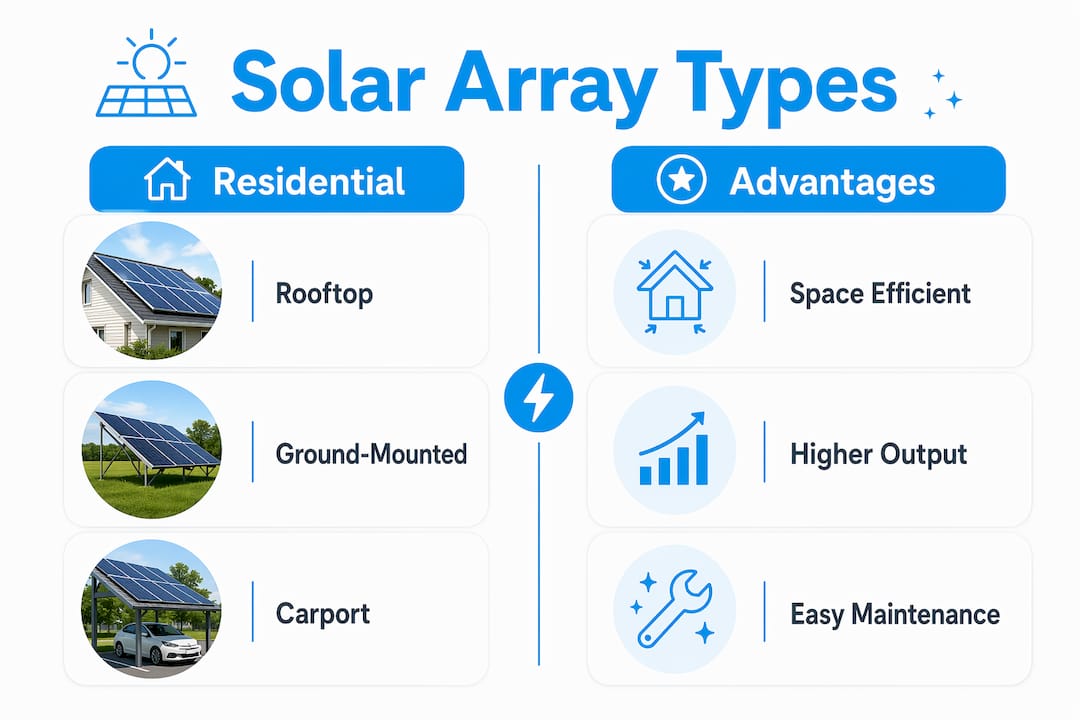
Three installation types cover the vast majority of residential and commercial projects: rooftop arrays, ground-mounted arrays, and solar carport arrays. Each serves a different situation, and the right choice depends on your available space, roof condition, and goals.
Rooftop arrays
Rooftop arrays are the most common residential choice. They mount directly on an existing roof structure, which keeps installation costs lower because no separate foundation is needed. Permitting is generally simpler for rooftop systems than for freestanding structures. The main limitation is roof space and orientation. A south-facing roof with minimal shading is ideal in the Northern Hemisphere.
Ground-mounted arrays
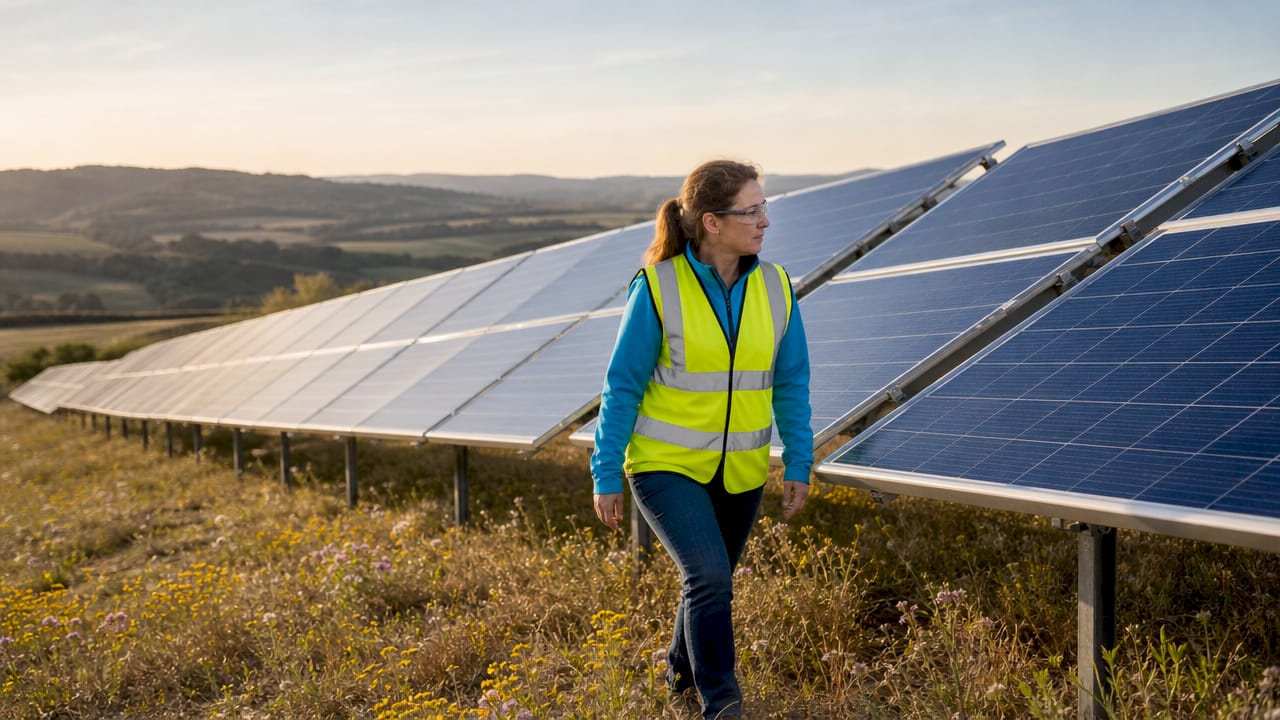
Ground-mounted systems work well when roof space is limited, the roof faces the wrong direction, or the property has open land available. These arrays sit on metal frames anchored into the ground. They are easier to clean and maintain because technicians can walk around them freely. Commercial and agricultural operations often choose ground-mounted systems because they can scale to hundreds of kilowatts without roof constraints.
Solar carport arrays
A solar carport array is a freestanding canopy structure that holds solar panels over a parking area. It generates electricity while simultaneously shading parked vehicles. Solar carports can generate 300–500 kWp for a 100-space parking lot, making them a serious power source for commercial properties. The trade-off is cost: carports typically run 50%–100% more than equivalent ground-mounted arrays because of the structural engineering and foundations required.
| Array type | Best for | Key advantage | Key challenge |
|---|---|---|---|
| Rooftop | Homes and small businesses | Lower cost, uses existing structure | Limited by roof size and condition |
| Ground-mounted | Farms, large commercial sites | Scalable, easy to maintain | Requires open land |
| Solar carport | Commercial parking lots | Dual use: power and vehicle shade | Higher construction cost |
Pro Tip: Rooftop arrays benefit from simpler permitting in most municipalities. If you are comparing rooftop versus carport for a commercial project, budget extra time for structural engineering reviews and planning approval on the carport option.
How do you determine the right solar array size?
Array sizing starts with your energy consumption. Pull your last 12 months of electricity bills and find your average monthly kilowatt-hour (kWh) usage. That number drives everything else.
Key factors that affect array size:
- Energy consumption: Higher monthly kWh use means more panels.
- Roof or land space: Physical limits cap how large the array can be.
- Local sunlight hours: Madison, Wisconsin averages fewer peak sun hours than Phoenix, Arizona, so a Wisconsin array needs more panels to hit the same output.
- Budget: Larger arrays cost more upfront but reduce or eliminate your electricity bill faster.
- Future load: Adding an electric vehicle or heat pump after installation will require more capacity.
Residential arrays typically fall in the 3 kW to 10 kW range. A 6 kW system with roughly 15–20 panels covers the average American household's electricity needs in most climates. Commercial systems run from tens of kilowatts into the megawatt range depending on the facility.
A simple rule of thumb: divide your average monthly kWh usage by the number of peak sun hours per day in your location, then divide by 30 days. That gives you a rough kilowatt target. From there, divide by the wattage of your chosen panel to get a panel count. A solar installer will refine this estimate with shading analysis and site-specific data.
Pro Tip: Always size your array for your future energy use, not just today's bills. If you plan to add EV charging or a heat pump within five years, build that load into your initial design. Expanding an array later costs more per watt than getting the size right the first time.
What are the advantages and challenges of solar carport arrays?
Solar carport arrays offer a benefit that no rooftop or ground-mounted system can match: they turn a parking lot into a power plant without consuming additional land. For retailers, hospitals, universities, and office parks, that is a compelling proposition.
The practical benefits go beyond electricity generation:
- Vehicle protection: Shading reduces cabin temperatures by up to 15°C in summer, which is a tangible comfort benefit customers and employees notice immediately.
- EV charging integration: Carport structures are natural anchor points for electric vehicle charging stations, letting businesses serve EV drivers while generating the power to charge them.
- LED lighting: Installing LED lighting during carport construction costs significantly less than retrofitting it later. New builds should include lighting in the initial design.
- Heat island reduction: Shaded pavement absorbs less heat, lowering ambient temperatures around the building.
The challenges are real and should not be underestimated. Carports require full planning permission and structural engineering review, unlike most rooftop arrays. Foundations must support the canopy against wind and snow loads. That engineering adds cost and timeline. Some jurisdictions also classify carports as new construction, which triggers additional building code requirements.
"Commercial solar carport adoption is driven by monetizing large parking areas and delivering tangible benefits like shade and EV charging. The parking lot stops being a cost center and starts generating revenue." — SurgePV
One emerging option worth knowing: advanced solar canopies with rotating panels can track the sun throughout the day, producing more energy than fixed arrays. Tracking systems add mechanical complexity and maintenance requirements, but they are worth evaluating for large commercial installations where maximizing output per square foot matters.
Key Takeaways
A solar array is the core unit of any solar energy system, and choosing the right type, size, and configuration determines how much value it delivers over its lifetime.
| Point | Details |
|---|---|
| Solar array definition | Multiple panels wired together to produce more power than a single panel can generate alone. |
| How arrays work | Panels produce DC electricity; an inverter converts it to AC for home or business use. |
| Three main types | Rooftop, ground-mounted, and solar carport arrays each suit different spaces and goals. |
| Sizing your array | Base panel count on monthly kWh usage, local sun hours, and future energy loads. |
| Carport trade-offs | Carports cost 50%–100% more than ground arrays but add vehicle shade and EV charging potential. |
What I have learned from working with solar arrays every day
The most common mistake I see is homeowners and business owners sizing their array for today's electricity bill and ignoring what comes next. An EV in the driveway or a new heat pump can add 3,000–5,000 kWh per year to your load. If your array is already maxed out on roof space, you have no room to grow. Size for where you will be in five years, not where you are today.
The second thing I see constantly is underestimating maintenance. A dirty array is a slow array. Dust, pollen, bird droppings, and hard water deposits all reduce light absorption. In Wisconsin, spring pollen and fall debris are the two biggest performance killers. Regular panel cleaning and maintenance is not optional if you want your array to perform at its rated capacity year after year.
Solar carports are genuinely exciting for commercial clients, but I always tell them to get the structural engineering quote before falling in love with the concept. The power generation numbers look great on paper. The foundation and permitting costs can shift the payback period significantly. Go in with clear numbers, not just enthusiasm.
The long-term economics of solar are strong. The upfront cost is real, but so is the 25-year production warranty on most modern panels. The owners who get the most value are the ones who treat their array like the investment it is: right-sized, professionally installed, and consistently maintained.
— Marquis
How Solaralchemist keeps your array producing at full capacity
Your solar array is only as effective as the panels feeding it. Dirt, mineral deposits, and organic debris accumulate on panel surfaces and quietly cut your energy output without triggering any alarm.

Solaralchemist provides professional solar panel cleaning for residential and commercial arrays across Madison, Wisconsin and the surrounding area. Using deionized water systems and specialized equipment, the team removes buildup safely without scratching panel surfaces or voiding manufacturer warranties. If you are not sure whether your panels need attention, the signs your panels need cleaning page walks you through eight clear indicators. Protecting your array investment starts with keeping it clean. Learn about Solaralchemist's services and schedule a cleaning for your home or business today.
FAQ
What is the difference between a solar panel and a solar array?
A solar panel is a single unit containing multiple photovoltaic cells that produces 300–500 watts. A solar array is a group of panels wired together to generate the higher output needed for a home or business.
How many panels does a typical residential solar array need?
Most residential arrays use 10–20 panels to reach the 3 kW to 10 kW range needed for average household electricity use. The exact count depends on panel wattage, local sun hours, and your monthly energy consumption.
What is a solar carport array?
A solar carport array is a freestanding canopy structure that mounts solar panels over a parking area, generating electricity while shading vehicles. It costs more than rooftop or ground-mounted systems but adds vehicle comfort and EV charging integration.
Do solar arrays work on cloudy days?
Solar arrays produce electricity on cloudy days, but output drops significantly compared to direct sunlight. Panels still capture diffuse light, so the array generates some power, just at a reduced rate.
How often should a solar array be cleaned?
Most arrays benefit from cleaning one to two times per year, with additional cleanings after heavy pollen seasons or storms. Dirty panels lose measurable output, so regular maintenance protects your return on investment.