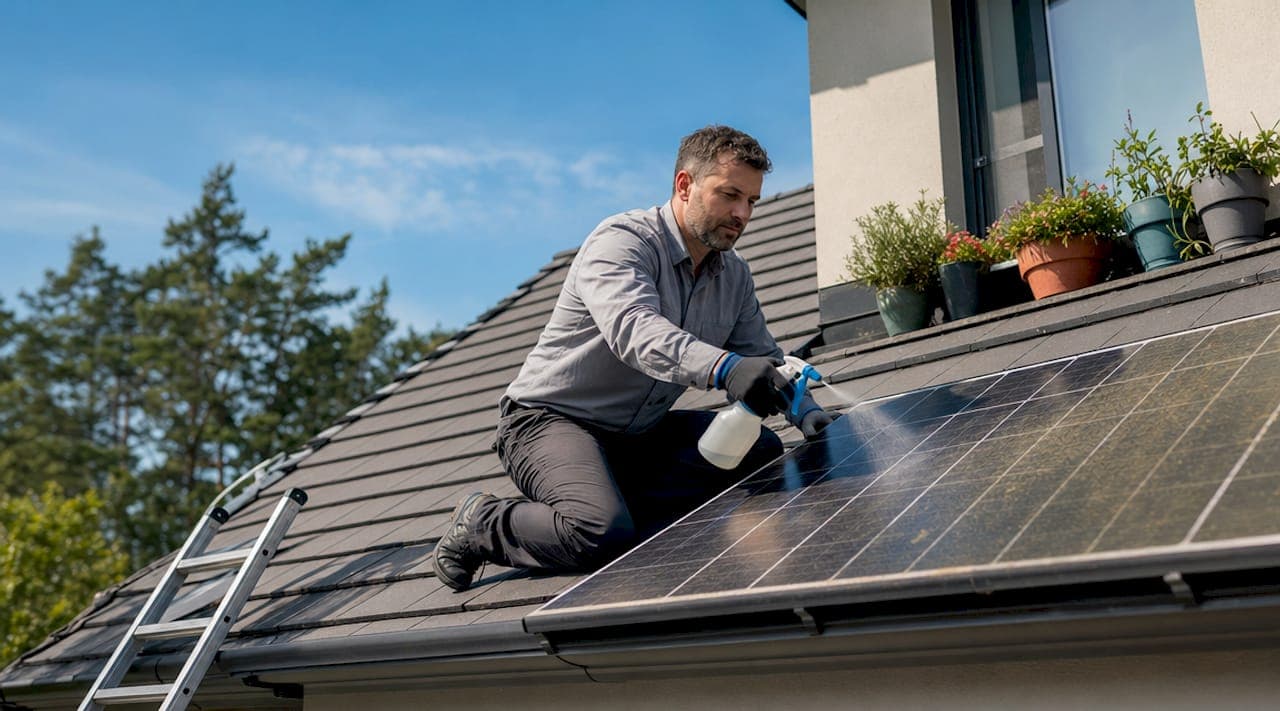
Solar panel soiling is defined as the accumulation of dust, pollen, bird droppings, pollution deposits, and other airborne debris on the surface of photovoltaic (PV) modules, which blocks incoming sunlight and reduces electricity generation. According to the IEA-PVPS, soiling causes 3-7% average annual energy loss globally, with losses exceeding 30% in extreme climates. That translates to an estimated €4-7 billion in lost revenue for the global PV industry every year. For homeowners and property managers in Wisconsin and beyond, understanding what solar panel soiling is and how to address it is the difference between a system that pays for itself on schedule and one that quietly underperforms for years.
What is solar panel soiling and how is it measured?
Soiling loss is quantified using two core metrics: the Soiling Ratio (SR) and Soiling Loss (SL). The formula is straightforward. SL = 1 minus SR. So if your SR drops to 0.95, you have a 5% energy production loss from soiling alone. Cleaning events reset the SR back toward 1.0, which is why scheduled maintenance directly restores output.
The industry uses two primary measurement approaches. The first is paired reference modules, where one clean panel is compared against a soiled panel under identical conditions. The second is optical sensors, such as the DustIQ from Kipp & Zonen, which measure light scattering caused by particle deposits on a glass surface. Each method has real trade-offs that matter for how you interpret your system's data.
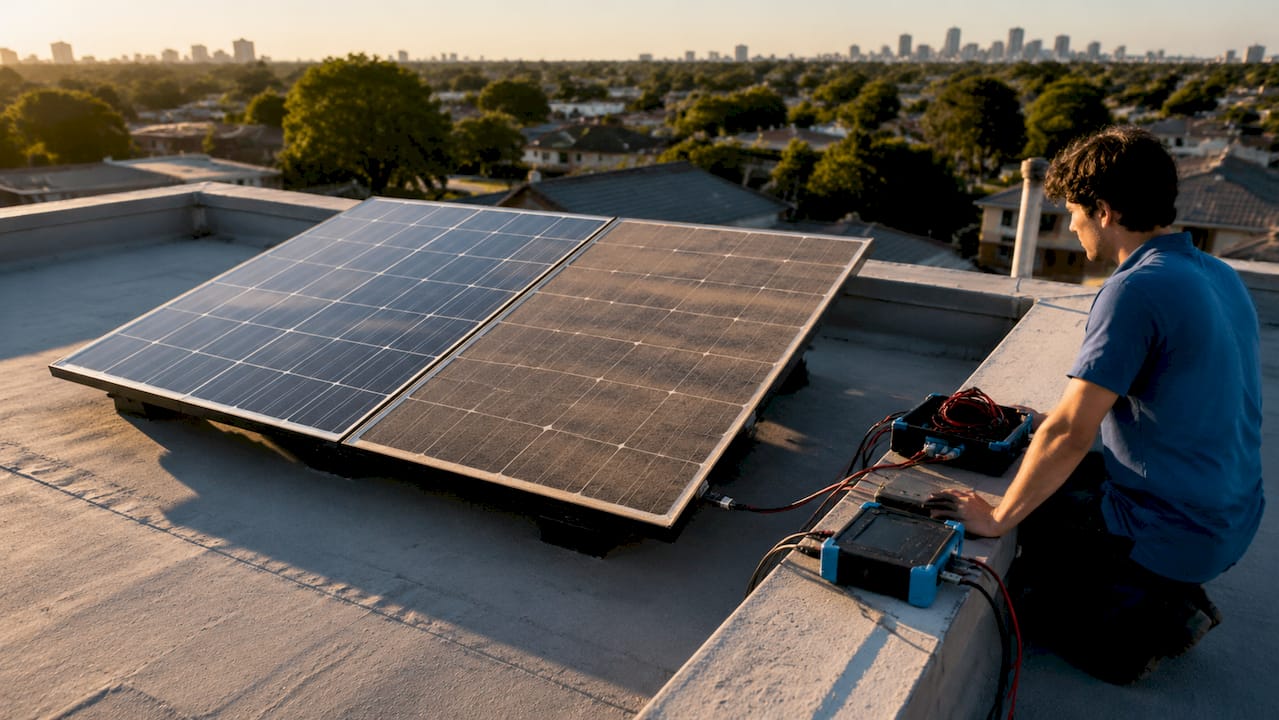
Pro Tip: Never make cleaning decisions based on a single soiling reading. Instantaneous measurements can mislead because weather events, shading, and inverter variability all distort short-term data. Track trends over weeks, not hours.
| Method | Pros | Cons |
|---|---|---|
| Paired reference modules | Low cost, widely used | Prone to tilt and shading errors |
| Optical sensors (e.g., DustIQ) | Continuous, real-time data | Higher upfront cost |
| Long-term monitoring | Most accurate trend data | Requires consistent data logging |
Reference-based measurements are prone to error from differences in tilt, inverter performance, and shading. This means many residential soiling estimates are less reliable than homeowners assume, and optical sensors or long-term trend analysis from platforms like Solargis provide a more accurate picture.
What are the common types of solar panel soiling?
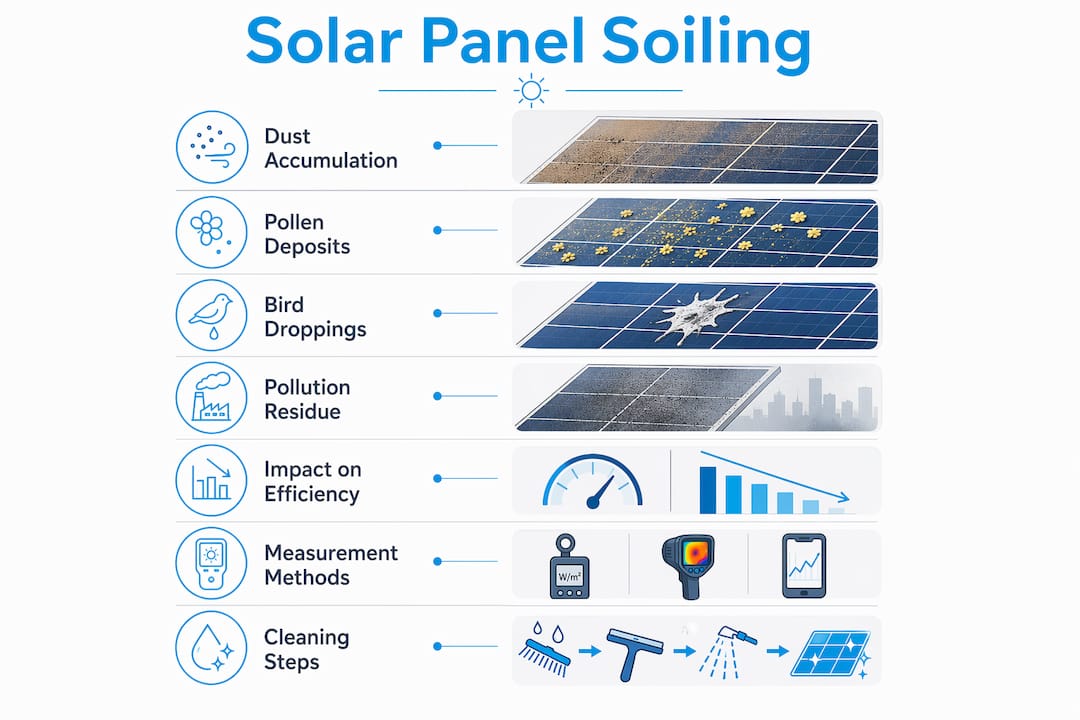
Solar panel soiling types vary significantly in composition, severity, and the cleaning method required to remove them. Identifying the type of soiling on your panels is not just academic. It directly determines how you clean and how urgently you need to act.
The most common soiling categories include:
- Dust and sand: The most widespread type globally, especially in arid climates. Fine particles settle uniformly and typically respond well to rinsing with deionized water.
- Pollen: Seasonal and sticky. Pollen bonds to glass surfaces and resists simple rinsing, particularly in spring months across the Midwest.
- Bird droppings: Highly acidic and localized. Bird droppings cause hot spots and cell damage disproportionate to their coverage area, even at less than 2% surface coverage. They require immediate removal.
- Pollution and soot deposits: Common in urban and industrial areas. These particles are fine, oily, and bond chemically to glass, making them resistant to rain.
- Ash: Found near wildfire zones or industrial sites. Ash causes higher losses per unit mass than general dust. Even 0.1 g/m² of accumulation can trigger a 7.5% efficiency drop.
- Organic growth: Lichen, moss, and algae appear in humid climates or shaded panels. They are slow to develop but cause permanent surface etching if left untreated.
Location shapes soiling composition as much as any other factor. Coastal properties deal with salt spray. Rural properties near agricultural land face heavy pollen and soil dust. Urban installations accumulate combustion byproducts and tire particulate. Each environment demands a different maintenance approach.
Pro Tip: Look at the pattern of soiling, not just the presence of it. Uniform gray film suggests dust or pollen. Dark streaks near panel edges indicate pollution runoff. White or chalky spots are often mineral deposits from hard water or light rain. Identifying the type first saves you from using the wrong cleaning method and potentially scratching your panels. Check out solar panel soiling types identification to avoid the most common errors.
What impact does soiling have on solar panel output?
The financial impact of soiling on solar panels is larger than most homeowners expect, and it compounds silently over time. Moderate soiling covering 5-15% of a panel surface causes a 20-50% efficiency drop. Heavy soiling above 15% coverage pushes losses beyond 50%. These are not edge cases. They are documented outcomes from real residential and commercial systems.
"Soiling is not a minor inconvenience. At moderate coverage levels, it can cut your system's output in half. For a 10 kW residential system, that means losing the equivalent of thousands of kilowatt-hours annually before you even factor in seasonal variation."
The table below shows how soiling coverage correlates with output loss:
| Soiling coverage | Estimated efficiency loss |
|---|---|
| Less than 5% | 5-10% |
| 5-15% (moderate) | 20-50% |
| Greater than 15% (heavy) | 50% or more |
| Extreme environments | Up to 30% annual average |
Beyond raw output, soiling creates three compounding financial problems. First, it increases operations and maintenance costs because neglected soiling requires more aggressive and expensive cleaning. Second, it shortens system lifespan. Bird droppings and organic growth cause surface damage that degrades panel efficiency permanently. Third, it introduces revenue forecasting uncertainty. When soiling is unmonitored, energy production becomes unpredictable, which matters especially for property managers running commercial arrays or participating in net metering programs.
The financial impact on business revenue from soiling is well-documented, and the IEA-PVPS estimates industry-wide losses at up to $8 billion annually. For an individual property owner, even a 5% loss on a mid-sized system adds up to hundreds of dollars per year in foregone savings.
How to clean and prevent solar panel soiling effectively
Effective prevention of solar panel soiling starts with understanding that rain is not a substitute for cleaning. Light rain in urban or industrial areas can actually bind dust and pollutants into a hardened caking layer that is harder to remove than dry dust. This is one of the most common misconceptions among solar owners who assume their panels self-clean.
Here is a practical cleaning and prevention framework:
- Assess your soiling type first. Dust and pollen respond to a gentle rinse with deionized water. Bird droppings and pollution deposits require specialized removal techniques to avoid scratching the glass or pushing acidic material into micro-cracks.
- Use deionized water. Tap water leaves mineral deposits that accumulate over time and reduce transmittance. Deionized water rinses clean without residue, which is why professional services like Solaralchemist use it as standard.
- Clean at the right time of day. Early morning or late afternoon cleaning prevents thermal shock from cold water hitting sun-heated glass. It also reduces water evaporation, which can leave streaks.
- Set a cleaning schedule based on your environment. Properties near agricultural land or under heavy tree cover may need cleaning every 4-6 weeks during peak seasons. Low-soiling environments may need only 2-3 cleanings per year. A seasonal maintenance schedule removes the guesswork.
- Monitor your system output. A sudden drop in production that does not correlate with weather is often the first sign of significant soiling. Check your inverter data weekly and compare against historical baselines.
- Inspect after weather events. Dust storms, heavy pollen seasons, and nearby construction all spike soiling rates. Inspect panels within 48 hours of any major event.
Pro Tip: The 7 signs your panels need cleaning include visible film on the glass, production drops of 10% or more versus the same period last year, and visible bird activity near your array. Do not wait for a dramatic output drop. By then, some soiling damage may already be permanent.
Climate change is making proactive maintenance more urgent. Soiling risks are increasing due to more frequent dust storms and extended droughts, which are pushing soiling into regions previously considered low-risk. Wisconsin homeowners who installed panels a decade ago and never needed regular cleaning may find that their maintenance assumptions no longer hold.
Key takeaways
Solar panel soiling reduces energy output through particle accumulation, and the financial losses scale directly with how long soiling goes unaddressed.
| Point | Details |
|---|---|
| Soiling causes measurable losses | Global average losses run 3-7% annually, with extreme cases exceeding 30%. |
| Soiling type determines cleaning method | Bird droppings, ash, and organic growth each require different removal approaches. |
| Light rain can worsen soiling | In urban areas, rain binds pollutants into a hardened layer that resists rinsing. |
| SR monitoring beats single readings | Track Soiling Ratio trends over weeks for accurate, actionable data. |
| Proactive cleaning protects ROI | Scheduled maintenance prevents compounding losses and extends panel lifespan. |
Why soiling deserves more respect than most homeowners give it
I have seen panels in Madison-area neighborhoods that have not been cleaned in three or four years. The owners assume their system is performing fine because the inverter still shows output. What they do not realize is that they have no baseline to compare against. A system producing 18 kWh per day sounds healthy until you learn it was designed to produce 24 kWh under current conditions.
The thing that surprises most people I work with is how non-linear soiling damage is. It is not a slow, steady decline. A single season of neglect during a high-pollen spring, followed by a light rain that cakes everything in place, can drop a system's output by 15-20% almost overnight. Then that caked layer bakes onto the glass through a Wisconsin summer, and now you are looking at a professional cleaning job instead of a simple rinse.
I also want to push back on the idea that monitoring tools are only for large commercial arrays. A $200 smart energy monitor from a brand like Emporia Energy or a built-in monitoring platform from SolarEdge or Enphase gives any homeowner the trend data they need to catch soiling before it becomes expensive. The cost of one missed cleaning cycle almost always exceeds the cost of the monitor itself.
The climate angle matters too. Soiling is dynamic, not static. What worked as a maintenance schedule five years ago may leave your panels underperforming today. Adjust your approach as your local environment changes, and do not assume that because you live in a rainy climate, soiling is not your problem.
— Marquis
Ready to protect your solar investment?
If you have read this far, you now know more about soiling than most solar panel owners ever learn. The next step is applying that knowledge before your system loses another season of output.

Solaralchemist serves homeowners and property managers across Madison, Wisconsin and surrounding communities, using professional-grade deionized water systems and specialized equipment to safely remove every soiling type covered in this article. Whether you are dealing with caked pollen, bird dropping hot spots, or years of accumulated pollution film, the right cleaning method matters. Start by checking when your panels need cleaning to assess your situation, or explore professional cleaning in Madison, WI to schedule a service visit. Your panels were built to last 25 years. Make sure they produce at full capacity for all of them.
FAQ
What is solar panel soiling?
Solar panel soiling is the accumulation of dust, pollen, bird droppings, pollution, and other debris on PV module surfaces that blocks sunlight and reduces electricity output. The IEA-PVPS estimates it causes 3-7% average annual energy loss globally, with losses exceeding 30% in extreme environments.
What is the soiling ratio and why does it matter?
The Soiling Ratio (SR) measures how much energy a soiled panel produces compared to a clean one, with a value of 1.0 meaning no loss. A drop of 0.05 in SR equals a 5% production loss, so tracking SR trends over time is the most reliable way to schedule cleaning.
Does rain clean solar panels effectively?
Rain provides partial cleaning in low-pollution rural areas, but in urban or industrial environments, light rain binds dust and pollutants into a hardened caking layer that is harder to remove than dry dust. Professional cleaning with deionized water is the only reliable method for these conditions.
How often should solar panels be cleaned?
Cleaning frequency depends on your location, soiling type, and local climate. High-soiling environments near agriculture, construction, or heavy tree cover may need cleaning every 4-6 weeks during peak seasons, while low-soiling areas may need only 2-3 cleanings per year.
Are bird droppings worse than regular dust on solar panels?
Bird droppings cause disproportionate damage relative to their coverage area. Even at less than 2% surface coverage, their high acidity creates localized hot spots that damage solar cells and can cause permanent efficiency loss if not removed promptly.