
A photovoltaic cell is a semiconductor device that converts sunlight directly into electric current through the photovoltaic effect. This process requires no moving parts, no combustion, and no fuel. Understanding photovoltaics starts with one core fact: light carries energy in packets called photons, and those photons can knock electrons loose inside certain materials. When that happens inside a carefully engineered cell, the result is usable electricity. Crystalline silicon dominates the commercial photovoltaic market with a 95% share as of 2026. That dominance reflects decades of manufacturing refinement and proven reliability in the field.
How photovoltaic cells work: the photovoltaic effect explained
The photovoltaic effect is the physical mechanism behind every solar panel on the market today. Edmond Becquerel discovered it in 1839, making it one of the oldest known principles in electrical science. The effect describes what happens when photons from sunlight strike a semiconductor material and transfer their energy to electrons inside that material.
Here is what happens at the atomic level:
- A photon from sunlight enters the semiconductor material, typically silicon.
- The photon's energy is absorbed by an electron, which breaks free from its atom.
- This creates an electron-hole pair: a free electron and a positively charged vacancy left behind.
- The p-n junction inside the cell creates an electric field that pushes the electron in one direction and the hole in the other.
- That directed movement of charge is electric current.
The p-n junction is the critical structure that makes this work. Without it, freed electrons would simply wander randomly and produce no net current. The junction acts like a one-way gate, giving the charge carriers a direction to travel.
Pro Tip: The photovoltaic effect is fundamentally different from solar thermal technology. Solar thermal converts sunlight into heat. Photovoltaic cells skip heat entirely and convert light directly into electricity, which is why PV systems can generate power even on cool, bright days.
How are photovoltaic cells designed to maximize efficiency?
The design of a photovoltaic cell is not accidental. Engineers have spent decades refining every layer to squeeze more electricity out of every photon that hits the surface.
The process starts with silicon doping. Doping silicon with boron or phosphorus creates two distinct regions inside the cell. Boron-doped silicon becomes p-type, meaning it has an abundance of positive charge carriers called holes. Phosphorus-doped silicon becomes n-type, meaning it has an abundance of free electrons. When these two regions meet, they form the p-n junction and the electric field that drives current flow.
Key design layers in a standard silicon cell
- Anti-reflective coating sits on top of the cell. Silicon is naturally shiny and would reflect a large portion of incoming light. The coating reduces that reflection and keeps more photons in play.
- N-type silicon layer sits just below the coating. This is where most photon absorption happens.
- P-n junction forms at the boundary between the n-type and p-type regions. The built-in electric field here separates charge carriers before they can recombine.
- P-type silicon layer forms the base of the cell. Holes migrate here after separation.
- Metal contacts on the front and back of the cell collect the current and carry it to external wires.
Single-junction vs. multijunction cells
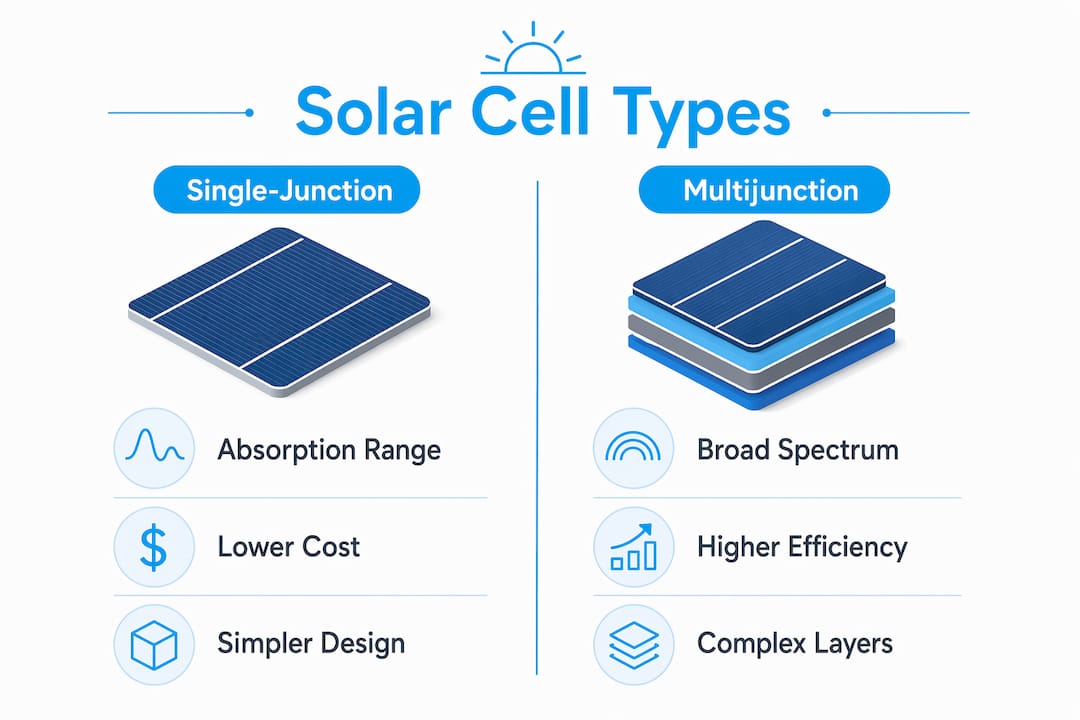
| Cell type | How it works | Efficiency advantage |
|---|---|---|
| Single-junction silicon | Absorbs one range of the solar spectrum | Lower cost, widely available |
| Multijunction cell | Uses multiple layered materials to capture different portions of the solar spectrum | Higher efficiency, used in aerospace and concentrated solar |
Multijunction solar cells capture a broader slice of the solar spectrum than any single material can. Each layer is tuned to absorb a different wavelength of light, so less energy is wasted as heat.
Temperature also affects cell performance in a way that surprises most students. Higher temperatures reduce voltage far more than they increase current, so total power output drops as a cell heats up. A panel baking on a rooftop in summer may actually produce less power than the same panel on a cold, clear winter day.
Pro Tip: If you are comparing solar panels, look at the temperature coefficient listed on the spec sheet. A lower negative coefficient means the panel loses less power as it heats up. This number matters more than peak efficiency ratings for most real-world installations.
How do solar cells combine into panels and full systems?
A single silicon cell produces approximately 0.5 to 0.6 volts when exposed to light. That is not enough to power anything useful on its own. The solar energy conversion process scales up by connecting many cells together.
Cells wired in series and parallel within a panel increase both voltage and current to levels practical for homes and businesses. Wiring cells in series adds their voltages together. Wiring strings of cells in parallel adds their currents together. A standard residential panel typically contains 60 to 72 cells and produces between 250 and 400 watts under ideal conditions.
The panel itself is more than just cells. Manufacturers encapsulate the cells in a transparent polymer layer, mount them in an aluminum frame, and cover them with tempered glass. This structure protects the cells from rain, hail, wind, and UV degradation for 25 years or more.
The system does not stop at the panel. Here is how electricity moves from sunlight to your wall outlet:
- Panels generate DC electricity and send it to an inverter.
- The inverter converts DC to AC, which is the form of electricity used by household appliances and the electrical grid.
- AC electricity flows to your home's main electrical panel.
- Excess electricity either charges a battery storage system or feeds back into the grid through a net metering arrangement.
Battery storage systems like the Tesla Powerwall allow homeowners to store surplus solar electricity for use at night or during grid outages. Without storage, a grid-tied system simply exports excess power and draws from the grid when panels are not producing.
What real-world factors affect photovoltaic system performance?
Lab ratings and real-world output are two different things. Standard test conditions used to rate solar panel efficiency do not represent actual operating conditions. Variables like shading, soiling, temperature, and the angle of sunlight incidence all reduce output below the nameplate rating.
The most common performance killers in real installations include:
- Shading. Even partial shade on one cell can reduce output across an entire string of cells. A single leaf or bird dropping can have an outsized effect on a traditionally wired panel.
- Soiling. Dust, pollen, bird droppings, and pollution accumulate on panel surfaces and block incoming light. Regular panel cleaning directly preserves the efficiency that soiling would otherwise erode.
- Angle of incidence. Panels produce peak power when sunlight hits them perpendicularly. As the sun moves across the sky, the angle changes and output varies throughout the day.
- Temperature. As noted above, heat reduces voltage and lowers total power output. Panels mounted with an air gap behind them run cooler and perform better than panels flush against a roof surface.
- System losses. Wiring resistance, inverter inefficiency, and mismatch between cells all subtract from the total power delivered to the grid.
Understanding these variables matters because they are manageable. Proper installation angle, regular cleaning, and quality inverters all close the gap between rated and actual performance. The financial benefits of clean panels are well documented: soiled panels can lose a measurable percentage of their annual output, which translates directly into lost savings on electricity bills.
Key Takeaways
Photovoltaic cells convert sunlight into electricity through the photovoltaic effect, and real-world output depends as much on design, installation, and maintenance as it does on the underlying physics.
| Point | Details |
|---|---|
| Core mechanism | Photons knock electrons loose in silicon, and the p-n junction turns that movement into directed electric current. |
| Material dominance | Crystalline silicon holds a 95% market share because of its proven efficiency and manufacturing maturity. |
| Scaling up | Cells wired in series and parallel form panels; inverters then convert DC output to AC for home and grid use. |
| Heat hurts output | Higher temperatures reduce voltage more than they increase current, lowering total power in hot conditions. |
| Maintenance matters | Soiling, shading, and angle losses are real and manageable; regular cleaning preserves rated efficiency. |
Why the physics of solar cells should change how you think about maintenance
Most students and new solar owners focus entirely on the technology inside the panel. That makes sense. The photovoltaic effect is genuinely fascinating, and the engineering behind a multijunction cell is impressive. But after working closely with solar systems, I have come to believe that the physics lesson most people miss is the one about losses.
The p-n junction inside a silicon cell is a near-perfect mechanism. It does its job reliably for decades. The weak link is almost never the cell itself. It is the surface above the cell. A layer of dust or pollen sitting on the glass does not care how well-engineered the semiconductor beneath it is. It simply blocks photons from reaching the cell in the first place, and blocked photons produce zero electricity.
The counterintuitive insight here is that a panel with a 20% efficiency rating and a dirty surface may perform worse than a panel with an 18% efficiency rating that is kept clean. Efficiency ratings describe the cell. Performance describes the system. Those are two different things, and confusing them costs solar owners real money every year.
The good news is that the solution is straightforward. Clean panels, proper installation angle, and shade-free siting recover most of the gap between rated and actual output. The physics inside the cell is already doing its job. The question is whether you are letting it.
— Marquis
Solaralchemist keeps your panels performing like new
Solar panels are a long-term investment, and the photovoltaic cells inside them do their job best when the surface above them is clean and clear.

Solaralchemist serves homeowners and businesses across Madison, Wisconsin and the surrounding area with professional-grade solar panel cleaning using deionized water systems that leave no residue and cause no surface damage. Dirty panels lose output quietly, often without any visible sign until you check your production data. If you are not sure whether your system needs attention, the signs your panels need cleaning guide from Solaralchemist walks you through exactly what to look for. Protecting the efficiency of your array starts with keeping the glass clear.
FAQ
What is the photovoltaic effect?
The photovoltaic effect is the process by which photons from sunlight knock electrons loose inside a semiconductor material, generating an electric current. Edmond Becquerel first observed this phenomenon in 1839.
How much voltage does a single solar cell produce?
A single crystalline silicon cell produces approximately 0.5 to 0.6 volts when exposed to light. Cells are wired together in series inside a panel to reach voltages useful for homes and businesses.
Why does heat reduce solar panel output?
Higher temperatures reduce voltage more than they increase current in a photovoltaic cell, so total power output drops as the cell heats up. This is why panels on cool, clear days often outperform panels on hot summer afternoons.
What does an inverter do in a solar system?
An inverter converts the direct current produced by solar panels into alternating current compatible with household appliances and the electrical grid. Without an inverter, solar electricity cannot power standard home devices.
How does dirt affect solar panel performance?
Soiling from dust, pollen, and bird droppings blocks photons from reaching the photovoltaic cells beneath the glass, directly reducing electricity output. Regular cleaning removes this barrier and restores the panel's rated performance.