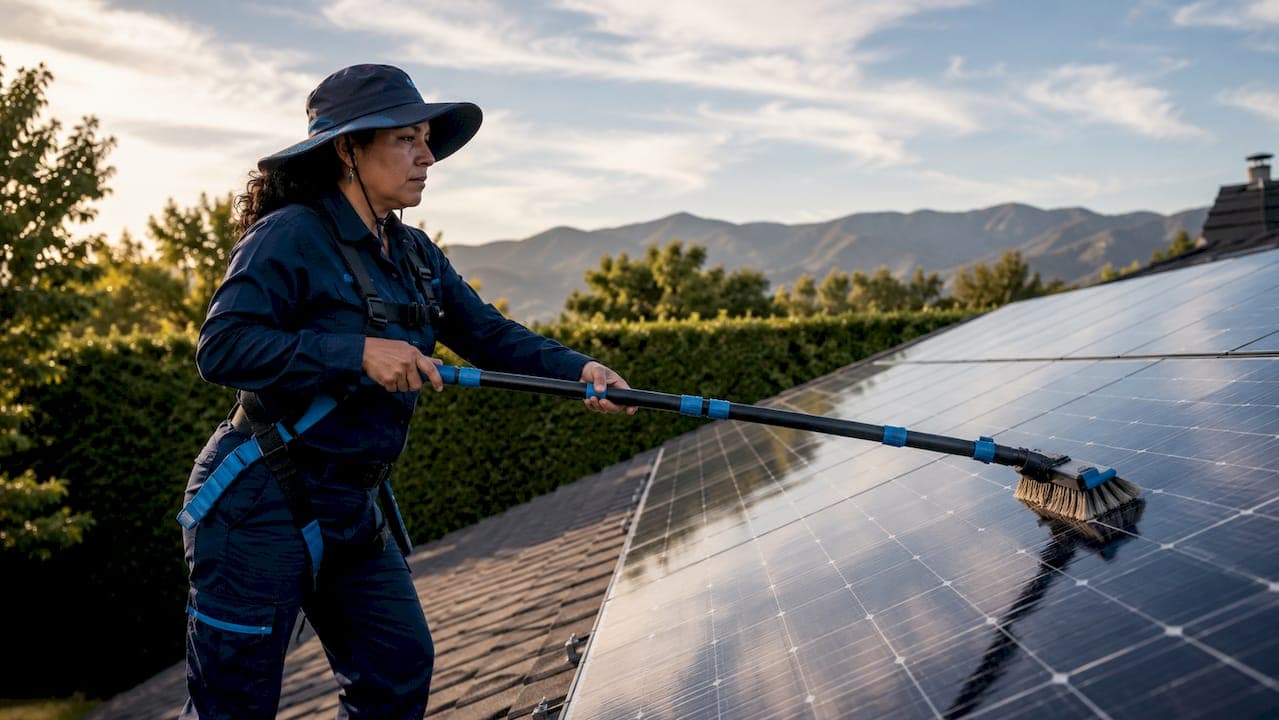
Dirty solar panels are the single most preventable cause of lost energy output for homeowners and business owners. Regular solar cleaning, the industry term is soiling mitigation, removes the dirt, pollen, bird droppings, and pollutant film that block sunlight and cut your system's production. Uncleaned panels lose between 5% and 25% of energy output annually, and in desert or high-pollution regions that figure can reach 40% within a single month. Understanding why regular solar cleaning matters is the first step toward protecting the investment you made in renewable energy.
Why regular solar cleaning matters for energy output
Dirt does not just sit on your panels. It actively blocks the photons that your cells need to generate electricity. The more surface area covered, the less power your inverter sees. Soiling losses vary widely by region, with coastal salt spray, agricultural dust, and urban pollution each creating a different type of film that rain alone cannot remove.
The effects of dirty solar panels go beyond a simple percentage drop in daily production. Uneven soiling creates shading across individual cells, which forces those cells to act as resistors rather than generators. That resistance generates heat. Persistent soiling causes hot spots and Potential Induced Degradation (PID), accelerating cell degradation by 1–5% annually. PID is a silent failure mode. You will not see it on the panel surface, but you will feel it in your utility bill and in a shortened system lifespan.
Uneven loading from soiling also strains your inverter. When some strings produce significantly less than others, the inverter works harder to reconcile the imbalance. Over time, that added strain shortens inverter life and increases the likelihood of costly repairs.
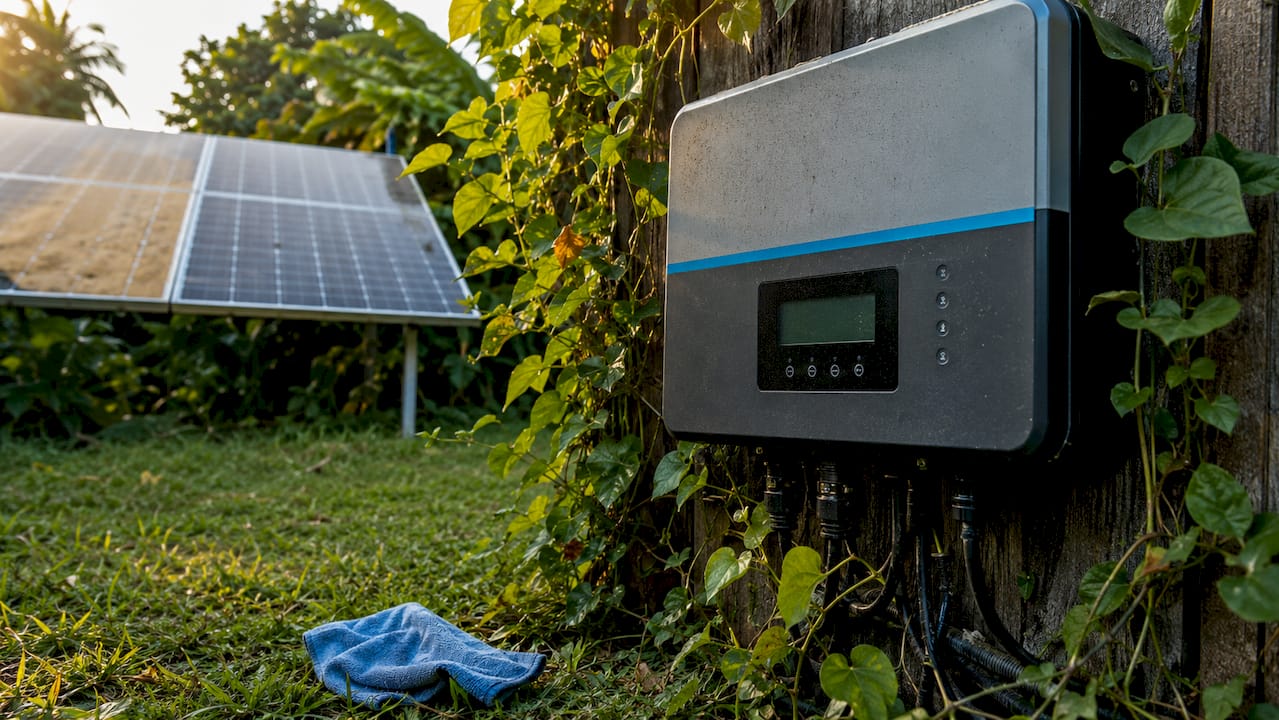
The contaminants that cause the most damage
Not all dirt is equal. These are the contaminants that cause the greatest impact on solar efficiency:
- Bird droppings create dense, opaque spots that cause severe localized shading and are highly acidic, etching the glass surface over time.
- Pollen forms a sticky film in spring that rain smears rather than removes, coating large surface areas.
- Salt deposits from coastal air crystallize on the panel surface and attract additional particulate matter.
- Industrial dust and exhaust film bond chemically to the glass and require mechanical cleaning to release.
- Leaf debris and tree sap create persistent shading and can trap moisture, promoting corrosion at panel edges.
How often should you clean solar panels?
Cleaning frequency depends directly on your local environment. Residential systems in temperate climates should be cleaned 1–2 times per year, with spring being the most productive time to clean after pollen season ends. Systems in desert, coastal, or industrial zones need cleaning every 2–4 months to prevent compounding soiling losses.
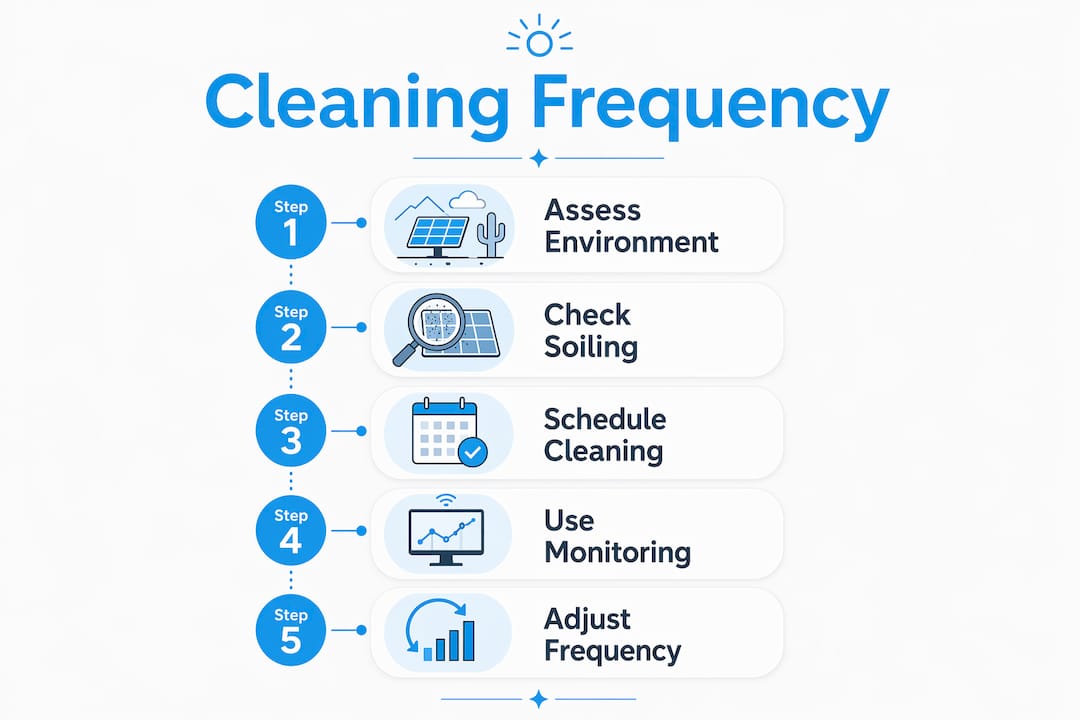
The table below shows recommended solar panel cleaning frequency by environment:
| Environment | Recommended cleaning frequency | Primary soiling type |
|---|---|---|
| Temperate (e.g., Madison, WI) | 1–2 times per year | Pollen, general dust |
| Desert / arid regions | Every 2–3 months | Fine dust, sand |
| Coastal areas | Every 2–4 months | Salt spray, humidity film |
| Industrial / urban zones | Every 2–3 months | Exhaust particulate, soot |
| Agricultural areas | Every 2–4 months | Crop dust, fertilizer film |
Your annual solar maintenance checklist should align with these intervals and account for seasonal events like spring pollen peaks or summer dust storms.
Pro Tip: Use a monitoring app such as SolarEdge, Enphase Enlighten, or your inverter's built-in dashboard to track daily production baselines. A drop of 10% or more below your baseline on a clear day is a reliable signal that cleaning is overdue, regardless of the calendar.
Production monitoring removes the guesswork from scheduling. Monitoring apps help detect soiling losses quickly and allow you to schedule cleaning at the exact point where the cost of a cleaning visit is justified by the energy you will recover. For small residential systems in mild climates, this data-driven approach often confirms that one annual cleaning is sufficient.
Does rain actually keep solar panels clean?
Rain does not clean solar panels effectively. Rain rinses loose dust but fails to remove sticky grime and bird droppings, and it can spread existing dirt unevenly across the panel surface, creating new shading patterns. In some cases, a light rain on a dusty panel produces mud streaks that are harder to remove than the original dust layer.
The distinction between dry dust and pollutant film matters here. Dry dust in a low-humidity environment may partially wash off in a heavy rain. Pollutant film, salt deposits, and organic material like pollen and bird droppings require mechanical action to remove. Rain provides none.
Here is what rain actually does and does not do for your panels:
- Does: Rinse loose, dry particulate from low-soiling environments after heavy rainfall.
- Does not: Remove bird droppings, salt crust, pollen film, or industrial residue.
- Does not: Clean panel edges or mounting hardware where debris accumulates.
- Can worsen: Uneven soiling by redistributing dirt into streaks that create irregular shading.
Pro Tip: After a significant rain event, check your monitoring dashboard the following clear day. If production has not returned to your pre-soiling baseline, the rain did not finish the job. Schedule a cleaning.
Performance monitoring after rain events is the most reliable way to determine whether natural cleaning was sufficient. Waiting for the next scheduled cleaning date without checking your data means leaving recoverable energy on the table.
What are the safest methods for cleaning solar panels?
Safe solar panel cleaning uses soft materials, the right water chemistry, and the right timing. Using standard tap water leaves mineral deposits that attract new dust and create a fresh soiling substrate. Deionized or distilled water is the correct choice because it evaporates without leaving residue. Solaralchemist uses professional-grade deionized water systems specifically for this reason.
Thermal shock is a serious risk when cleaning panels that have been in direct sun. Pouring cold water on a hot panel surface causes micro-cracking in the glass and cells, the same way a hot glass shatters under cold water. Always clean in the early morning before panels heat up, or on overcast days.
The core rules for safe cleaning are straightforward:
- Use: Soft microfiber cloths or soft-bristle brushes designed for solar panels.
- Use: Deionized or distilled water, never tap water.
- Use: Mild, pH-neutral soap if mechanical action is needed for stubborn deposits.
- Avoid: Pressure washers, which force water under panel frames and damage seals.
- Avoid: Abrasive pads, steel wool, or any tool that scratches the anti-reflective coating.
- Avoid: Harsh chemical cleaners, solvents, or bleach-based products.
Improper cleaning tools void solar panel warranties at many manufacturers. Read your warranty documentation before cleaning, or work with a professional service that already knows the approved methods. A guide on cleaning without scratching covers the technique in detail if you plan to clean yourself.
Pro Tip: Never clean panels from a ladder while reaching across the array. Work from the ground with an extension pole, or hire a professional for roof-mounted systems. Safety matters more than saving a service fee.
How does regular cleaning affect your financial returns?
Regular cleaning directly improves your return on investment. Cleaning restores 5%–25% of lost output, which translates into lower utility bills and a faster payback period on your original system cost. For a 10 kW system losing 15% output to soiling, recovering that production adds meaningful kilowatt-hours back to your monthly generation.
Professional cleaning costs range from $150 to $500 per visit, depending on system size and site conditions. For most residential systems, a single cleaning that recovers 15% output pays for itself within weeks of restored production. The solar cleaning ROI calculation depends on your system size, local electricity rate, and current soiling level.
The financial case for regular maintenance includes warranty protection as well. Regular maintenance preserves manufacturer warranty coverage, protecting you against future failure claims. Most panel warranties specify that the owner must maintain the system in good working order. Documented cleaning records demonstrate compliance and protect your claim if a panel fails prematurely.
| Financial factor | Impact of regular cleaning |
|---|---|
| Energy output recovery | Restores 5%–25% of lost annual production |
| Utility bill savings | Directly proportional to recovered output |
| Inverter lifespan | Reduced strain from even loading extends service life |
| Warranty compliance | Documented cleaning supports valid warranty claims |
| System lifespan | Prevents PID and hot spot degradation of 1%–5% per year |
Ignoring cleaning does not just cost you energy today. It compounds. A system degrading at 3% per year from preventable soiling damage loses a significant share of its rated output before the warranty period ends, with no recourse if the manufacturer can point to neglected maintenance.
Key takeaways
Regular solar panel cleaning is the most cost-effective maintenance action you can take to protect energy output, extend system lifespan, and preserve warranty coverage.
| Point | Details |
|---|---|
| Soiling causes serious losses | Dirty panels lose 5%–25% of annual output, with extreme environments reaching 40% in a month. |
| Cleaning frequency depends on location | Temperate climates need 1–2 cleanings per year; coastal, desert, and industrial zones need every 2–4 months. |
| Rain is not a substitute | Rain removes loose dust but cannot clear bird droppings, pollen film, or salt deposits. |
| Method and timing matter | Use deionized water, soft brushes, and clean in the early morning to prevent thermal shock and warranty voids. |
| Cleaning protects your investment | Restored output, lower inverter strain, and documented maintenance all improve long-term ROI and warranty standing. |
What I've learned from years of watching neglected panels underperform
Most homeowners assume their panels are fine because they look clean from the ground. That assumption is almost always wrong. The contaminants that cause the most damage, pollen film, salt crust, and bird dropping acid, are nearly invisible from street level but show up immediately in production data.
The mistake I see most often is treating cleaning as a cosmetic task rather than a performance task. People clean their panels when they look dirty. The right trigger is a production drop, not a visual one. A panel coated in a thin layer of pollen film looks clean but can be losing 10%–15% of its output every day. Monitoring tools like Enphase Enlighten and SolarEdge change this entirely. They give you a number, not a guess.
Thermal shock is the other mistake that costs people real money. I have seen micro-cracked panels from homeowners who cleaned on a hot afternoon with a garden hose. The damage is permanent and invisible until output degrades over the following months. Cleaning in the early morning is not a preference. It is the only safe time.
The broader point is this: your solar system is a long-term financial asset. Treating it with the same discipline you would apply to any other major investment, scheduled maintenance, documented records, professional service when needed, is what separates a system that delivers its projected returns from one that quietly underperforms for years.
— Marquis
Get professional solar cleaning from Solaralchemist
Solaralchemist serves homeowners and business owners across Madison, Wisconsin and the surrounding communities with professional-grade solar panel cleaning using deionized water systems and specialized equipment. If your production data shows a drop or your last cleaning was more than a year ago, your system is almost certainly leaving energy on the table.

Check the signs you need a cleaning to see where your system stands today. Solaralchemist's team handles everything from scheduling to safe, warranty-compliant cleaning so you get maximum output without the risk of DIY damage. Reach out to schedule a visit and start recovering the production your system is built to deliver.
FAQ
How much output do dirty solar panels lose?
Dirty panels lose between 5% and 25% of annual energy output, with extreme environments like deserts or industrial zones reaching up to 40% loss within a single month.
How often should residential solar panels be cleaned?
Residential systems in temperate climates need cleaning 1–2 times per year. Coastal, desert, and industrial locations require cleaning every 2–4 months due to higher soiling rates.
Can I use a pressure washer to clean my solar panels?
No. Pressure washers can void solar panel warranties and force water under panel frames, damaging seals. Use a soft brush and deionized water instead.
Does rain clean solar panels well enough?
Rain removes loose dry dust but cannot remove bird droppings, pollen film, or salt deposits. Check your production monitoring after rain to confirm whether output has returned to baseline.
What is the best time of day to clean solar panels?
Clean panels in the early morning or on overcast days. Cleaning hot panels with cold water causes micro-cracking from thermal shock, which permanently damages cells and reduces long-term output.