
Solar integration with building energy systems means embedding photovoltaic (PV), solar thermal, battery storage, and control technologies directly into a building's energy infrastructure — not simply bolting panels onto a roof. Done right, it creates a coordinated architecture where generation, storage, distribution, and load management work together in real time. The most advanced framework for this is the PEDF model: Photovoltaics, Energy storage, DC distribution, and Flexibility, which minimizes AC/DC conversion losses and treats the building as an active energy node rather than a passive consumer. Building Energy Management Systems (BEMS) aligned with ASHRAE Guideline 36 tie these components together through automated control and real-time monitoring. The result: measurable reductions in energy costs, carbon output, and grid dependence.
Key technologies in a fully integrated solar building system include:
- Building Integrated Photovoltaics (BIPV): PV cells embedded in roofing, façades, and glazing
- Hybrid PV/Thermal (PV/T) collectors: Single systems producing both electricity and usable heat
- Battery storage: Lithium-ion and flow batteries that store surplus solar generation
- Thermal Energy Storage (TES): Hot or chilled water tanks that shift heating and cooling loads
- Smart inverters: Grid-interactive devices that regulate voltage, frequency, and power flow
- BEMS platforms: Centralized control software coordinating all energy assets
How solar integrates with building energy systems: core applications
Solar energy serves buildings in several distinct but complementary roles, and understanding each one is the foundation for any serious integration project.
BIPV replaces conventional building materials with power-generating equivalents. Roof tiles, curtain wall panels, and electrochromic windows all qualify. The architectural advantage is real: BIPV eliminates the structural penalty of rack-mounted arrays while turning the building envelope into a generation asset. Commercial façades facing south or southwest in the U.S. can contribute meaningfully to daytime load offset, particularly in high-rise applications where roof area is limited relative to floor area.
Hybrid PV/T systems extract both electricity and heat from the same collector surface. A standard PV panel converts roughly 15%–20% of incident solar radiation to electricity; the rest becomes waste heat. PV/T collectors capture that heat for domestic hot water, space heating, or absorption cooling. Multi-objective optimization using ANN and GA methods aligns these dual outputs with building electrical and thermal demand profiles across different climate zones, making PV/T particularly effective in mixed-use and healthcare facilities.

Energy storage is what transforms solar from a daytime-only resource into a dispatchable asset. Battery systems absorb midday surplus and release it during evening peak demand. Thermal Energy Storage tanks do the same for heating and cooling loads, pre-conditioning spaces during solar production hours to reduce mechanical system runtime later. For industrial facilities, pairing battery storage with solar battery integration strategies can eliminate demand charges that often represent 30%–40% of a commercial utility bill.
Design considerations that determine how well solar performs in your building
Getting solar integration right starts at the design table, not during commissioning.
Panel placement and envelope integration drive the baseline generation potential. South-facing orientations at latitude-matched tilt angles maximize annual yield in the continental U.S. Façade-integrated systems accept lower annual output in exchange for architectural function. Shading analysis using tools like PVsyst or HelioScope should be completed before structural decisions are finalized, because partial shading on even one string can suppress output across an entire array.
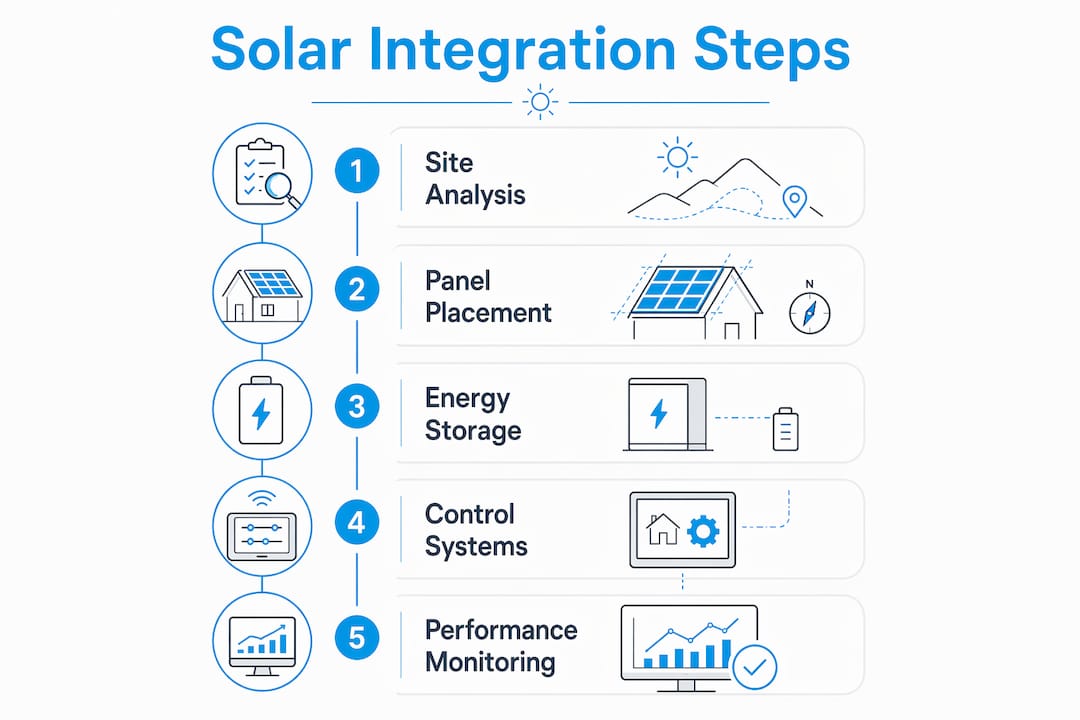
DC distribution architecture is the design choice that separates basic solar installations from genuinely efficient integrated systems. Every AC/DC conversion stage loses energy to heat. DC distribution networks recapture approximately 14% of energy otherwise lost in those conversion stages, a figure that compounds significantly in buildings with large PV arrays and on-site battery storage. Urban microgrids and industrial parks are already deploying DC bus architectures for exactly this reason.
| Design Parameter | Impact on System Outcome |
|---|---|
| Panel orientation and tilt | Determines annual energy yield; south-facing at latitude tilt maximizes U.S. output |
| DC vs. AC distribution | DC recaptures ~14% energy lost to conversion; reduces inverter count |
| Battery sizing | Affects self-consumption rate and demand charge reduction |
| Thermal storage volume | Shifts HVAC loads to solar production hours, reducing peak draw |
| BEMS control logic | Coordinates generation, storage, and loads for real-time optimization |
| Shading analysis | Prevents string-level losses that undermine whole-array performance |
Multi-objective optimization using Artificial Neural Networks (ANN) and Genetic Algorithms (GA) allows engineers to size PV arrays, battery banks, and thermal storage simultaneously against economic metrics like Levelized Cost of Energy (LCOE) and Net Present Value (NPV), alongside carbon reduction targets. Dynamic simulation tools like TRNSYS model combined PV, solar thermal, storage, and auxiliary systems against real building load profiles, accounting for climate variability across U.S. regions from Phoenix to Minneapolis.
Key design factors to evaluate before finalizing your system:
- Roof and façade structural load capacity for panel weight
- Local solar irradiance data (NREL's PVWatts database is the U.S. standard)
- Utility interconnection requirements and available transformer capacity
- Thermal load profile: domestic hot water, space heating, process heat
- Peak demand windows and time-of-use rate structure
Integrating solar with building controls and energy management
Hardware alone does not deliver integration. The control layer is where solar generation becomes a managed asset rather than an uncontrolled variable.
Building Energy Management Systems (BEMS) coordinate solar inverters, battery charge controllers, HVAC systems, lighting, and plug loads through a unified software platform. Johnson Controls Metasys is one of the most widely deployed enterprise BEMS platforms in U.S. commercial buildings, offering real-time monitoring and ASHRAE Guideline 36 compliance out of the box. Buildings running Metasys with Guideline 36 sequences achieve energy savings of up to 30% compared to conventional control strategies.

Fault Detection and Diagnostics (FDD) is a capability that separates mature BEMS platforms from basic building automation systems. Alarm fatigue is a documented operational problem: facilities with hundreds of monitored points generate alert volumes that overwhelm engineering staff. Platforms with built-in automated FDD and pre-configured analytics dashboards reduce manual triage, saving facility engineers approximately 18-20 hours per incident, and keeping solar and storage systems operating within design parameters without constant human intervention.
Pro Tip: When selecting a BEMS platform for a solar-integrated building, prioritize out-of-the-box preconfigured dashboards and automated FDD over custom-engineered solutions. The engineering time saved on initial setup and ongoing alarm management typically pays back the platform premium within the first year of operation.
Grid-interactive smart inverters extend the control layer beyond the building boundary. Modern grid-forming inverters do more than convert DC to AC: they actively regulate grid voltage and frequency and can restart the grid following an outage, a capability known as black-start. The U.S. Department of Energy identifies grid-forming inverter technology as a core enabler of high-penetration solar on the distribution grid. For building owners, this translates to resilience value: a solar-plus-storage system with grid-forming inverters can island and continue operating during utility outages.
Demand-side management closes the loop. Flexible loads including EV chargers, water heaters, and pre-cooling cycles can be shifted to match peak solar output, monetizing the building's energy flexibility as a grid service and reducing net energy costs simultaneously.
Regulatory and compliance considerations for U.S. solar integration projects
Local U.S. regulations create a decentralized solar integration landscape where municipal policies directly shape system design choices and financial outcomes. What works financially in California may not pencil out in a state without strong net metering rules.
Key regulatory factors every project team should evaluate:
- Net metering policies: Determine the compensation rate for excess solar exported to the grid; varies by state and utility
- Renewable Energy Credits (RECs): Tradeable certificates that can generate additional revenue streams for building owners
- Interconnection standards: IEEE 1547-2018 governs how distributed energy resources connect to the U.S. distribution grid
- Building codes: IBC and local amendments affect structural requirements for rooftop and façade-mounted systems
- Utility demand charge structures: Time-of-use rates and demand charges directly influence battery sizing decisions
- Incentive programs: Federal Investment Tax Credit (ITC) and state-level incentives alter project NPV substantially
Solar panel safety compliance requirements at the local level can affect permitting timelines by weeks or months, so engaging the authority having jurisdiction early in the design process protects your project schedule. Building owners in states with strong renewable portfolio standards generally see faster permitting and better interconnection terms than those in markets with limited policy support.
Key challenges and opportunities in solar-integrated building energy systems
The complexity of coordinating multiple energy vectors — electricity, heat, and storage — across different time scales is the central challenge of solar integration. Interoperability between inverters, BEMS platforms, and utility systems remains inconsistent, and upfront capital costs for fully integrated PEDF architectures are higher than conventional grid-tied PV installations.
The opportunities are proportionally significant:
- DC distribution adoption is accelerating in data centers and industrial facilities, creating a proven pathway for broader building deployment
- AI-enhanced energy management is moving from pilot programs to standard BEMS features, enabling predictive load shifting and automated demand response
- Grid-forming inverters are transitioning solar-plus-storage systems from passive generators to active grid stabilizers
- Carbon reduction from integrated solar buildings contributes directly to LEED, ENERGY STAR, and corporate ESG reporting targets
- Energy resilience through islanding capability addresses an increasingly acute concern for critical facilities
Flexible load management, specifically the ability to shift EV charging, water heating, and HVAC pre-conditioning to solar production hours, is often the highest-return optimization available to building operators without additional capital investment. Improving your ENERGY STAR score through solar-thermal integration and demand management is a documented path to both operational savings and asset value appreciation.
Maintaining solar energy systems for peak integration performance
A solar system that is not maintained is a solar system that is quietly losing output. Soiling from dust, pollen, bird droppings, and seasonal debris can reduce panel production by measurable margins, and those losses compound daily. Regular professional cleaning, scheduled around local weather patterns and seasonal soiling cycles, is the single most cost-effective maintenance action available to building operators.
Best practices for maintaining a solar-integrated building system:
- Cleaning frequency: Quarterly cleaning is the baseline for most U.S. climates; monthly service is warranted in high-dust or high-pollen environments
- Monitoring integration: Connect inverter-level production data to your BEMS so soiling losses appear as performance deviations, not invisible yield reductions
- Thermal collector maintenance: Drain and flush solar thermal circuits annually; inspect heat exchanger surfaces for scaling
- Battery system checks: Verify state-of-charge calibration and cell balance quarterly; review thermal management system performance seasonally
- Inverter firmware: Keep inverter firmware current to maintain grid interconnection compliance and access performance improvements
- Documentation: Maintain a maintenance log tied to production data so you can quantify the energy yield impact of each service event
Solar cleaning in facility management requires coordination with your BEMS schedule. Cleaning during low-irradiance periods, early morning or overcast days, avoids thermal shock to panels and keeps the maintenance window outside peak generation hours. Solaralchemist uses professional-grade deionized water systems that leave no mineral residue on panel surfaces, protecting both output and manufacturer warranties.
The monitoring layer of your BEMS should flag any string producing below expected output for more than two consecutive days. That threshold catches soiling losses, shading from new obstructions, and early-stage equipment faults before they become costly failures. Proactive maintenance scheduling, driven by real production data rather than calendar intervals alone, is what separates high-performing integrated systems from underperforming ones.
How solar thermal collectors integrate with building heat systems
Solar thermal collectors serve the thermal side of a building's energy budget in ways that PV panels cannot. Flat-plate and evacuated-tube collectors capture solar radiation and transfer it as heat to a fluid circuit, which then feeds domestic hot water systems, radiant floor heating, absorption chillers, or industrial process heat applications.
In a fully integrated building energy system, solar thermal output connects to a Thermal Energy Storage tank that buffers the mismatch between solar availability and thermal demand. A hospital, for example, might use evacuated-tube collectors to pre-heat domestic hot water to 120°F, reducing the load on gas-fired water heaters by a substantial margin during daylight hours. The TES tank extends that benefit into evening hours when solar collection stops.
Combined solar thermal and PV systems, modeled using tools like TRNSYS, allow engineers to optimize the split between electrical and thermal generation based on the building's actual load profile. Buildings with high hot water demand relative to electrical load, such as hotels, laundries, and food service facilities, often find that solar thermal delivers a shorter payback period than additional PV capacity for the same roof area.
Monitoring, control, and optimization techniques for solar-integrated buildings
Effective monitoring is not passive data collection. It is the feedback loop that makes every other integration decision defensible.
At the inverter level, string-level monitoring catches production anomalies that module-level monitoring misses in cost-sensitive installations. At the system level, BEMS platforms aggregate inverter data, weather station inputs, utility meter readings, and storage state-of-charge into a unified dashboard. ASHRAE Guideline 36 sequences provide the control logic framework for coordinating HVAC, lighting, and plug loads against real-time solar generation data.
Optimization techniques in active use across U.S. commercial buildings include:
- Model Predictive Control (MPC): Uses weather forecasts and load predictions to pre-position battery state-of-charge and thermal storage ahead of demand peaks
- Demand response automation: BEMS platforms with OpenADR 2.0 compatibility receive utility signals and automatically shed or shift loads
- Performance ratio tracking: Compares actual vs. expected output daily, flagging soiling, shading, or equipment degradation
- Commercial solar maintenance scheduling: Ties cleaning and inspection intervals to monitored performance data rather than fixed calendar dates
The gap between a monitored system and an unmonitored one widens every year. Buildings with active BEMS-integrated solar monitoring consistently outperform those relying on annual audits alone.
Economic analysis and cost-benefit considerations for solar building integration
The financial case for solar integration in U.S. buildings rests on several compounding value streams, not a single payback calculation.
Direct energy cost savings come from reduced grid electricity purchases during solar production hours and from demand charge reduction when battery storage is sized to shave peak demand. Incentive value from the federal ITC, accelerated depreciation (MACRS), and state-level rebates reduces net capital cost. REC revenue provides an ongoing income stream in active REC markets. Grid service revenue from demand response programs and, increasingly, from grid-forming inverter capabilities adds a fourth value layer that conventional payback analyses often omit.
LCOE and NPV are the two metrics that matter most for investment decisions. LCOE expresses the lifetime cost of solar generation per kilowatt-hour, allowing direct comparison against utility rates. NPV captures the total financial value of the project over its life, discounting future cash flows to present value. Both metrics shift favorably when battery storage, thermal integration, and demand response are included in the analysis rather than evaluated as separate line items.
The solar maintenance tips that protect long-term yield are also the ones that protect long-term financial returns. A system producing at 85% of nameplate capacity due to soiling and deferred maintenance is not delivering the NPV the financial model projected. Keeping panels clean, inverters current, and storage systems calibrated is not optional maintenance. It is yield protection.
Key Takeaways
Solar integration with building energy systems delivers maximum value when generation, storage, distribution, and control are designed as a unified architecture rather than assembled as separate components.
| Point | Details |
|---|---|
| PEDF architecture reduces losses | DC distribution recaptures approximately 14% of energy lost to AC/DC conversion stages. |
| BEMS alignment with ASHRAE Guideline 36 | Johnson Controls Metasys and similar platforms achieve energy savings of up to 30% in commercial buildings. |
| Grid-forming inverters add resilience | Smart inverters regulate grid voltage and frequency and enable black-start capability during outages. |
| Local regulations shape project viability | Net metering rules, RECs, and municipal codes vary by state and directly alter solar ROI. |
| Maintenance protects financial returns | Regular cleaning and BEMS-integrated monitoring prevent soiling losses from eroding projected NPV. |